
Rock wool has become one of the most specified insulation materials in the world. Stricter building energy codes and fire safety regulations keep pushing demand upward across construction, industrial insulation, and shipbuilding. For manufacturers planning to enter this market, the production line itself is the single largest investment: a continuous industrial process that melts basalt and other minerals at high temperature, converts the melt into fine fiber, and cures, cuts, and packages the finished product. Choosing the wrong supplier does more than delay a project. It can leave a plant that never reaches rated capacity, consumes far more energy than quoted, or produces fiber quality that fails to win certification in target markets.
A reliable turnkey rock wool production line supplier is one that designs and delivers the complete process from raw material batching through final packaging, proves its capability through running reference lines of similar capacity, guarantees measurable performance in the contract, and supports the plant with commissioning, training, and spare parts for its entire service life. To find one, evaluate every candidate against defined technical, commercial, and service criteria, verify each claim through factory audits and reference visits, and sign only a contract that ties payment milestones to tested results. An experienced rock wool production line manufacturer will welcome this level of scrutiny, because a supplier that resists verification is already showing you what the partnership will look like after the down payment clears.
The framework below walks through what a turnkey scope actually includes, where these suppliers are found, the criteria that separate dependable partners from risky ones, and the verification steps to complete before any contract is signed.
What Is a Turnkey Rock Wool Production Line?
A turnkey rock wool production line is a single-vendor package covering the entire manufacturing process, from raw material preparation through melting, fiberizing, curing, and final packaging, delivered installed, commissioned, and tested to an agreed output specification, so the buyer receives a plant that is ready to run rather than a collection of machines that must be integrated by the buyer’s own engineering team.
Turnkey delivery contrasts with sourcing individual machines from separate vendors and coordinating mechanical, electrical, and process integration in-house. Under a turnkey contract, one supplier carries responsibility for process design, equipment manufacturing, civil-work interfaces, installation, commissioning, and performance acceptance. This concentrates accountability and shortens the coordination path when problems appear, which matters in a process industry where every stage depends on the one before it.
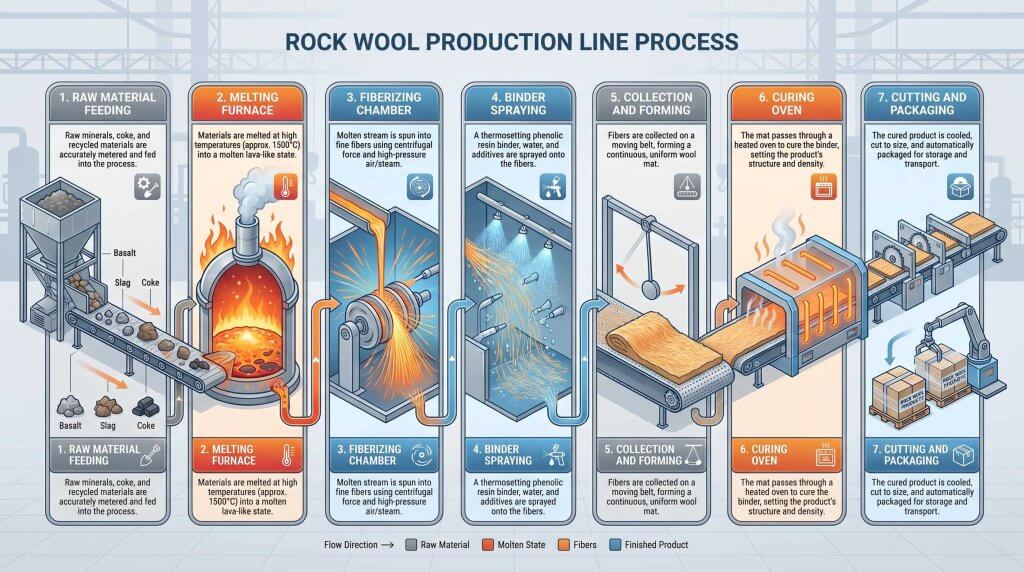
Understanding the process chain is therefore essential, because final product quality is decided by how well the stages work together. A complete line is typically organized as follows:
- Raw material batching and feeding: basalt, dolomite, slag, and other minerals are crushed, stored in silos, weighed, and automatically fed in controlled proportions, with coke added as fuel for cupola-fired lines.
- Melting: the batch is melted at roughly 1,450°C to 1,600°C in a cupola furnace or an electric furnace. The melting furnace is the energy heart of the line, and its thermal efficiency drives both operating cost and melt quality.
- Fiberizing: molten melt flows to high-speed centrifugal spinners that draw it into fibers only a few microns in diameter, while binder and water-repellent additives are sprayed onto the forming fibers.
- Collection and forming: fibers are deposited under negative pressure into a primary mat, then folded and layered by a pendulum system to build the required density and thickness.
- Curing: the binder-impregnated mat passes through a curing oven where the resin polymerizes and the product gains its final density and mechanical strength.
- Cooling, cutting, and packaging: cured product is cooled, sawn to precise dimensions, and prepared for storage and dispatch, increasingly through automated packaging systems.
- Emission control: bag filters, wet electrostatic precipitators, and after-burners keep exhaust within local environmental limits throughout the process.
Because these stages are interdependent, a weak link in any single one drags down the entire line. Fiber diameter depends on melt temperature, mat uniformity depends on fiberizing stability, and scrap rates depend on curing control. This interdependence is the core argument for turnkey procurement: when one supplier owns the whole chain, no stage can be quietly blamed on another vendor.
Who Manufactures Rock Wool Production Lines?
Rock wool production lines are manufactured by three broad groups of suppliers: large international engineering companies that deliver high-capacity lines for capital-intensive projects, specialized full-line manufacturers concentrated in Asia and Europe that offer complete turnkey packages at mid-range cost, and local fabricators that assemble partial lines from mixed components. No single group is best for every project; the right choice depends on the capacity target, the budget, and the level of service the buyer expects across the plant’s life.
| Supplier Type | Explanation |
| International engineering heavyweights | Deep engineering resources and proven ultra-large capacity lines, at premium prices and long project cycles. Best suited to flagship plants with extreme output requirements and the budgets to match. |
| Specialized turnkey manufacturers | Companies focused on mineral wool equipment that supply the full process chain, customize capacity from small-scale to mid-large plants, and compete on total cost of ownership rather than headline price. |
| Local fabricators and assemblers | Lower upfront cost through partial scope and mixed-brand components, but thin process know-how, limited references, and weak long-term after-sales. Suitable mainly for buyers with strong in-house engineering teams. |
When surveying the market, treat these categories as a starting point rather than a verdict. Every group contains both dependable and weak suppliers, and the difference between them is rarely visible in a brochure. What distinguishes a credible supplier is a list of running reference lines you can visit or contact, at capacities close to your own target, together with documented process calculations rather than copied specifications. Regional origin also affects practicalities that are easy to underestimate: language support, time-zone coverage for troubleshooting, shipping logistics for large furnace components, and the availability of engineers on-site during commissioning. A supplier whose service model fits your operating reality will resolve problems faster than one whose paper advantages look stronger.
8 Key Criteria for Evaluating a Turnkey Supplier
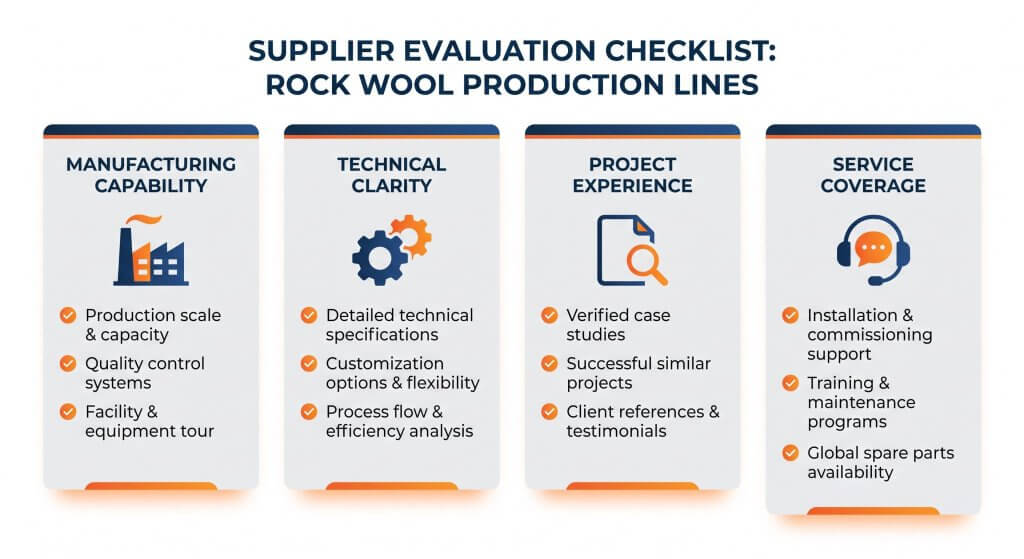
The eight criteria that most reliably separate a dependable turnkey supplier from a risky one are technical capability and customization, proven track record, energy efficiency and total cost of ownership, automation and process control, fiber quality and safety compliance, after-sales service and spare parts, documentation and training, and financial stability with contractual transparency. Candidates must be weighed against all eight, because weaknesses in any one area tend to surface only after the line is running, when they are most expensive to fix.
| Criterion | Explanation |
| Technical capability and customization | Ability to design the line around your capacity, product mix, and local energy conditions, supported by process calculations and factory testing. |
| Proven track record | Running reference lines of comparable capacity, with customers willing to share actual output, energy, and downtime data. |
| Energy efficiency and total cost of ownership | Furnace thermal efficiency, waste heat recovery, and realistic long-term energy budgets rather than the lowest purchase price. |
| Automation and process control | PLC-based control, automatic dosing, and fault monitoring that stabilize quality and reduce dependence on operator skill. |
| Fiber quality and safety compliance | Equipment that consistently produces fiber diameter, shot content, and density within specification, meeting target-market product standards. |
| After-sales service and spare parts | Commissioning support, operator training, guaranteed spare parts supply, and defined response times for the line’s service life. |
| Documentation and training | Complete mechanical, electrical, and process documentation plus structured training so your team can run the plant independently. |
| Financial stability and contractual transparency | A supplier solvent enough to honor warranties, willing to accept itemized pricing and performance guarantees in the contract. |
Technical Capability and Customization
The first test is whether the supplier can configure a line around your requirements instead of reselling a fixed design. Annual capacity ranges, product density and thickness windows, and the choice between a coke cupola and an electric furnace should all be discussed against your local fuel and electricity prices, not against what the supplier happens to have in its standard catalog. Ask for the heat balance and output calculations behind the proposal, and check whether the equipment list covers the complete scope, including emission control, utility interfaces, and spare parts for the first operating period. A capable supplier will also offer pre-assembly and testing of core equipment in its own workshop before shipment, because finding machining or assembly defects on your foundation is vastly more expensive than finding them in the factory.
Energy Efficiency and Total Cost of Ownership
Rock wool production is inherently energy-intensive, and the melting stage dominates the operating budget for the life of the plant. A quotation that looks cheap on purchase price can become the expensive option once ten or fifteen years of furnace fuel or electricity are counted. Evaluate the thermal efficiency of the melting system, the presence of waste heat recovery, and the energy consumption of collection and curing equipment, then compare candidates on projected total cost of ownership rather than initial investment. Be equally wary of quotations that fall dramatically below the market range: a supplier can only hit an abnormally low price by omitting necessary equipment, substituting lower-grade materials, or planning to recover the difference through change orders. A detailed breakdown of what drives rock wool production line cost helps expose which line items are being under-specified, and gives you a rational basis for comparing proposals that initially look similar.
Fiber Quality and Safety Compliance
Product quality is decided in the fiberizing and curing stages, so ask every supplier how its equipment controls fiber diameter, shot content, and density uniformity. Consistent fiber diameter and low shot content translate directly into thermal performance and into the scrap rate your plant will live with. Compliance also matters commercially, because target markets impose product standards that your output must meet, and the line design determines whether it can. On the safety side, modern rock wool contains no asbestos, and its fibers are engineered to be biosoluble so that inhaled fibers dissolve and are cleared from the lung rather than persisting, a property reflected in the regulatory profile of mineral wool. The International Agency for Research on Cancer classifies rock (stone) wool in Group 3, not classifiable as to carcinogenicity to humans, in its evaluation of man-made vitreous fibres. Confirm that the supplier can support certification of your product in the markets you intend to serve, including the relevant testing during performance acceptance.
After-Sales Service and Spare Parts
The months between mechanical completion and stable rated production are where weak suppliers are exposed. A dependable partner provides engineers on-site through commissioning and trial production, trains your operators and maintenance staff, and stays engaged while the line is tuned toward its guaranteed figures. Beyond startup, the questions are simple: which spare parts are held in stock or guaranteed with defined delivery times, what is the committed response time for faults, and is remote diagnostic support available so that minor issues do not each require an engineer’s flight. Suppliers that answer these questions vaguely before the contract rarely answer them better after it.
Red Flags and Common Sourcing Mistakes
The clearest warning signs when sourcing a turnkey rock wool production line are unverifiable references, quotations that avoid itemized pricing, refusal to accept performance testing, and vague or missing commitments on spare parts and service response. Most disappointed buyers can trace the failure back to a red flag that was visible, and overlooked, before the contract was signed.
- Choosing on purchase price alone, while ignoring energy consumption and maintenance costs that will run for decades.
- Accepting references that cannot be visited or contacted, or that involve capacities far from your own target.
- Signing quotations without itemized equipment lists, which hides scope gaps until installation.
- Omitting emission control systems from the budget, deferring compliance costs until regulators intervene.
- Skipping pre-shipment factory testing of core equipment such as the melting and fiberizing sections.
- Agreeing to contracts without performance guarantees, warranty terms, or penalty provisions for missed output.
- Underestimating infrastructure requirements, including power supply, water, and foundations, until they stall commissioning.
Each of these mistakes shares one pattern: the cost of avoiding it was small and visible before signing, while the cost of correcting it appears only after the plant is built. Sourcing discipline therefore pays for itself many times over.
How to Verify a Supplier Before Signing the Contract
Before signing, verify a turnkey supplier by auditing its manufacturing facility, checking at least one running reference line of comparable capacity, requiring pre-shipment testing of core equipment, and negotiating performance guarantees with payment tied to tested results. Each step removes a layer of risk that no proposal document can address on its own.
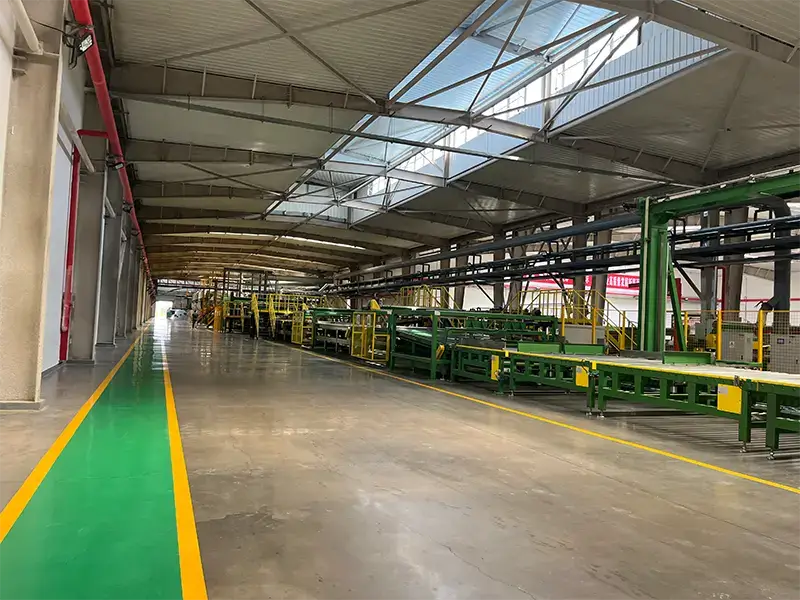
- Audit the factory. Walk the workshop where your equipment will be built, inspect machining quality and in-progress assemblies, and check whether the supplier actually manufactures the critical sections or merely brokers them.
- Verify running references. Visit a reference line in person, or arrange a live video walkthrough, and ask the operator about actual capacity, energy consumption, downtime, and how the supplier responded when problems arose.
- Require pre-shipment testing. Core equipment such as the melting furnace, spinners, and curing oven should be assembled and tested in the supplier’s workshop against contract parameters before anything is shipped.
- Negotiate performance guarantees. Put rated capacity, unit energy consumption, and fiber quality ranges into the contract, with acceptance testing after commissioning and payment milestones tied to the results.
- Confirm lifetime support in writing. Spare parts pricing and delivery commitments, warranty coverage, response times, and training obligations belong in the contract, not in reassuring conversation.
A turnkey contract should read like a performance promise rather than a parts list. Suppliers that design, build, and stand behind complete turnkey rock wool production line packages are the ones whose incentives stay aligned with yours long after installation, and they will not hesitate to put that alignment in writing.

Frequently Asked Questions
The questions buyers raise most often once shortlisting begins concern the limitations of the product itself, the scale of the investment, and the timeline from contract to production.
What is the downside of rock wool?
The main downsides of rock wool are its higher density and cost compared with glass wool, temporary skin irritation during unprotected handling, and reduced insulation performance if the material is allowed to stay wet over time. In practice these are managed rather than fundamental problems: modern water-repellent treatments protect against moisture, protective clothing resolves handling irritation, and the higher price is offset by superior fire resistance and temperature tolerance in demanding applications.
How much does a turnkey rock wool production line cost?
A turnkey rock wool production line typically represents an investment from several million US dollars for a small-capacity line to well into the tens of millions for a large, highly automated plant, with the final figure driven by capacity, furnace type, automation level, and environmental configuration. Because the range is so wide, the only useful approach is to obtain itemized quotations from multiple suppliers and compare them line by line, checking what has been omitted as much as what has been included.
How long does it take to deliver and commission a turnkey line?
From contract signature to stable production, a turnkey rock wool line usually takes roughly six to fourteen months, depending on capacity, the state of civil works and utilities, and the depth of acceptance testing. Larger lines and sites that require new power or gas infrastructure sit at the upper end, while well-prepared sites with experienced suppliers can compress commissioning by organizing operator training during equipment manufacturing.




