
Specification sheets for rock wool board, rock wool blanket and rock wool pipe insulation look almost interchangeable: same basalt origin, same non-combustible class, same thermal conductivity band. Buyers comparing them for a project, and investors comparing them for a plant, often assume they come from three different industries. They do not.
The production difference lies almost entirely after fiberization. Board is built up in overlapping layers by a pendulum, pressed to a fixed thickness and cured under load, which produces a rigid panel. Blanket is cured with little compression so the fibers keep their loft, then wound into rolls. Pipe sections are wound spirally onto a perforated mandrel, cured by air fed through that mandrel, split and hinged. Melting and fiberizing are common to all three; density, tooling, line speed and packaging are not.
Following the melt from furnace to pallet shows where the routes separate, and why those separations are hard to reverse.
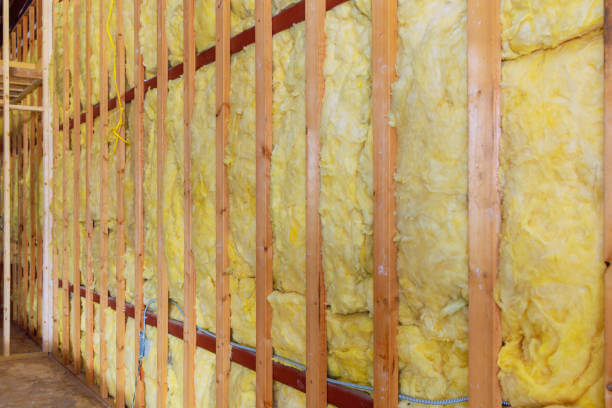
The Shared Upstream: One Melt, Three Forming Routes
Roughly two thirds of the process is identical for all three products. Basalt, dolomite and slag are weighed, melted at around 1,450 to 1,500 degrees Celsius, spun into fibers, coated with binder and collected as a primary mat. What changes afterwards is not the material but the geometry it is forced into.
The batch is charged with coke in a cupola furnace or melted with electrodes in an electric furnace. The melt flows onto wheels spinning at several thousand revolutions per minute and is drawn into fibers of roughly 4 to 7 microns, while binder and water repellent are atomized onto them. Everything downstream of the collection chamber turns that loose mat into a product with fixed density, fixed thickness and a shape that fits a surface, and on a rock wool production line there are exactly three ways to do it.
What the Three Product Forms Actually Are
| Form | Structure | Density (kg/m3) | Thickness | Surface it serves |
| Rock wool board | Rigid or semi-rigid panel, usually 1,200 x 600 mm | 60 to 200 | 25 to 150 mm | Flat walls, roofs, tank shells, equipment casings |
| Rock wool blanket | Flexible roll or mattress, plain or wire mesh faced | 30 to 100 | 25 to 100 mm | Curved vessels, large diameter pipe, ducts |
| Rock wool pipe section | Pre-formed half cylinders, 1 m lengths, split and hinged | 70 to 180 | 30 to 100 mm wall | Straight pipe runs of a known outer diameter |
Facings cut across all three forms: plain, foil, wire mesh or jacket. Standards also treat them as separate classes, which is the clearest evidence that form, not chemistry, defines the product.
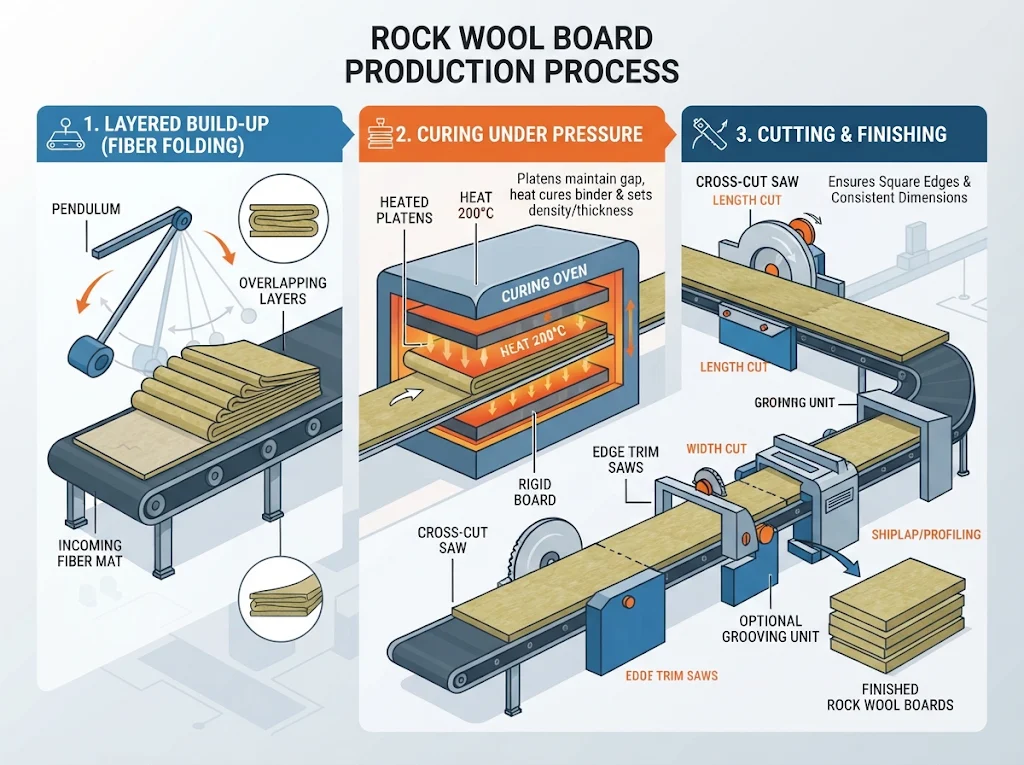
How Rock Wool Board Is Produced
Board is the high-pressure route. The mat is folded into overlapping layers by a pendulum, then pressed to a controlled gap inside the curing oven. Pressing under heat turns a soft web into a panel that holds its thickness, and sets compressive strength, flatness and dimensional stability.
The pendulum swings across the conveyor, laying the web in overlapping folds. Folds multiplied by web weight set area weight, and the oven gap converts area weight into density, so a board line is controlled through two variables: fiber per square meter, and how far the platens close.
Fiber Orientation and Layered Build-Up
In a pressed board the fibers lie predominantly parallel to the face, which is why the material resists compression through its thickness but is weaker across a sawn edge. Its product standard describes this orientation as part of the specification. Layer count governs quality: too few layers and the board delaminates at the edges, while uneven overlap creates soft bands that appear after installation.
Curing Under Pressure and Calibration
The curing oven is where board is really made. Platens hold a gap equal to the target thickness, hot air raises the mat to roughly 200 degrees Celsius, and the binder crosslinks while the mat is restrained. That gap is a tolerance statement: too wide and the board comes out under-dense and springs back, too narrow and the fibers crush. Binder content runs higher than on a blanket line, since the panel must carry load.
Cutting, Grooving, and Edge Finishing
A finished board passes through a cross-cut saw, edge trim saws, optional grooving or shiplap profiling, then facing lamination. The cutting section decides joint quality more than any other unit: square edges and consistent width are what let panels butt tightly on site, and loose tolerances here become thermal bridges on a wall.
How Rock Wool Blanket Is Produced
Blanket is the low-compression route. The mat is cured with a wide oven gap and essentially no pressing, so it keeps loft and flexibility, and the product is slit, wound into rolls and packed under compression instead of cut into panels.
The upstream is identical, but the objective inverts: instead of forcing the mat into a fixed volume, the line keeps the web open while the binder sets, so the blanket can wrap a curve without cracking. Density follows collection rate and line speed rather than platen pressure, and the oven gap is wider than the delivered thickness.
Low-Density Control and Loft Retention
Blanket densities typically run from 30 to 100 kg/m3, a third to a half of a structural board. That is a performance requirement: the trapped air is the insulation. Three habits protect loft: light pressure at the folding and pressing machine, airflow tuned to cure without packing the mat down, and controlled packing compression with a known recovery time.
Rolls, Facings, and Compression Packaging
After curing, blanket is slit to width, optionally stitched to galvanized wire mesh, wound into rolls and wrapped. Industrial blanket is normally supplied with a facing or jacket and secured with heat resistant bands, an industry convention that reflects handling rather than manufacturing.
How Rock Wool Pipe Sections Are Produced
Pipe sections take the winding route. A thin, still-uncured web is wound spirally around a perforated steel mandrel until the required wall thickness is reached, cured by hot air blown through the mandrel, then split lengthwise, hinged and grooved to fit one specific pipe outer diameter.
This is the only route where tooling, not formulation, defines the product. A pipe section is made to fit, and the fit comes from mandrel diameter and wrap count.
Mandrel Winding versus Block Cutting
| Aspect | Mandrel winding | Block cutting |
| Tooling | One mandrel per inner diameter | Saw or cutting strings, no mandrel |
| Wall thickness uniformity | High, set by wrap count | Moderate, set by cut geometry |
| Density profile | Controlled by wrap tension | Radial gradient, denser outward |
| Changeover | Mandrel swap, relatively quick | Cutting program and block setup |
| Best suited to | High volume, standard diameters | Short runs, special diameters |
| Trim waste | Low | Higher, since material is cut away |
A third variant moves the problem to site: a cured mat with transverse V-grooves, wrapped by hand, trading tooling precision for more joints and labour.
Splitting, Hinging, and Dimensional Tolerance
Splitting happens after curing, never before, because a split section cannot be wound. The cylinder is cut lengthwise, a T-shaped hinge slit is milled so the halves open like a clamshell, and tongue-and-groove faces lock the closed section without gaps. Inner diameter must match the pipe within a small clearance: too tight and it will not close, too loose and the air gap defeats the insulation. The governing standard caps service temperature at 760 degrees Celsius and densities at 70 to 160 kg/m3.
Side-by-Side: Where the Production Parameters Diverge
The three routes cannot run on shared settings. Density target, binder content, curing pressure, cutting method, tooling and packaging change together, and the cost of switching between them is usually the largest single variable in product mix planning.
| Parameter | Board | Blanket | Pipe section |
| Target density | 60 to 200 kg/m3 | 30 to 100 kg/m3 | 70 to 180 kg/m3 |
| Binder content | Moderate to high | Low | High |
| Forming unit | Pendulum plus press | Pendulum, light pressure | Mandrel winder |
| Curing method | Pressed gap, hot air | Open gap, hot air | Air through mandrel |
| Cutting | Cross-cut saw, groove | Slitter, winder | Splitter, hinge cutter |
| Trim waste | Low, recyclable | Very low | Higher on the block route |
Changeover, Capacity, and Waste
Board and blanket can share an upstream when the oven gap is adjustable and the cutting section can be bypassed, which is why many plants run both on one line. Pipe sections rarely share anything beyond the furnace, so the rule is to share melting and separate forming. Capacity is quoted in tons per hour while the market buys cubic meters: at 150 kg/m3 a line yields half the volume of the same tonnage at 75 kg/m3, so density is a revenue variable.
Why the Production Route Decides Product Performance
Most performance differences between the forms are by-products of the forming route, not the recipe. One melt and one binder system can yield a panel that carries foot traffic or a wrap that compresses by half, because pressing, layer count and curing geometry change how fibers lock together.
The question is often framed as board versus rock wool, which mixes a form with a material. Rock wool is the material; board, blanket and pipe section are three ways of delivering it.
Compressive Strength, Dimensional Stability, and Fire Response
Layered build-up plus pressure gives board its compressive strength, which is why boards are specified where insulation may be walked on or clamped against. All three forms are non-combustible, but behaviour at temperature differs: dense board shrinks less and holds shape longer, while low-density blanket relies on binder chemistry and low shot content to avoid sagging on a vertical run.
Fit, Joints, and Thermal Bridging
A pipe section delivers uniform wall thickness around the circumference; a board cut and wrapped around the same pipe does not. Flat material on a curve leaves gaps, extra joints and a thickness that varies with the installer, which is why pipe sections cost more per cubic meter yet often less installed. Moisture behaves the same way: mineral fibers do not feed mold, so growth signals dust, oil, organic facings or persistent water ingress.

What This Means for Line Specification and Sourcing
Specify the product mix before the line. A board line needs a pendulum, a pressing curing oven and a sawing and grooving section. A blanket line needs slitting, winding and compression packing. A pipe line needs mandrel winding and splitting units that neither of the other two can replace.
Matching Line Configuration to Product Mix
- If more than 80 percent of output is board, treat blanket as a changeover product, not a second business.
- If the market is industrial contracting with tanks and vessels, blanket capability matters more than pipe capability, since oversized pipe is wrapped anyway.
- If the market is district heating or process piping, the pipe line is the business, and the mandrel range should be fixed before furnace size.
- In every case, the key equipment in a rock wool production line should be specified as a matched set, since strong forming behind a weak oven only moves the defect downstream.
Cost Structure: Rock Wool, Glass Wool, and Price per Delivered Performance
Buyers often ask whether rock wool or glass wool is cheaper, and the answer depends on the unit of comparison. Glass wool melts at a lower temperature and is produced at lower density, so it is generally cheaper per square meter at equal thickness. Rock wool burns more energy per ton and sells denser but holds a higher service temperature, so comparing rock wool and glass wool production per kilogram flatters glass wool; comparing installed thermal resistance at operating temperature narrows the gap.
Frequently Asked Questions
The three questions below cover line configuration, thermal performance and the limits of standard pipe diameters.
Can one line make boards, blankets and pipe sections?
Partially. Board and blanket can share a line when the oven is adjustable and cutting can be bypassed, because both build the mat with a pendulum. Pipe sections need winding, through-mandrel curing and splitting, so they run separately. A plant selling all three needs two lines.
Does the forming route change thermal conductivity or only mechanical properties?
Both, but indirectly. Conductivity is driven mainly by density and fiber fineness, which the recipe and spinning parameters set. The forming route then decides how evenly density is distributed, how much shot stays in the mat, and how closely delivered thickness matches nominal.
How is wall thickness controlled above standard pipe diameters?
Wall thickness comes from mandrel diameter and wrap count, so a diameter outside the available mandrel range cannot be wound economically. The section is then cut from a cured block, or the pipe is wrapped in board or blanket under a metal jacket. Above roughly 600 mm outer diameter, wrapping usually wins.




