
Rock wool, the insulation material produced by melting basalt and other volcanic rock at high temperature and spinning the melt into fine fibers, has moved from a niche industrial product to a default specification in fire-rated and energy-efficient construction. That demand has drawn many processors, distributors and new investors toward manufacturing the material themselves, but not everyone is ready to commit to a full-scale industrial plant with six-figure utility bills and a workforce to match. Entering at a small scale spreads the risk, yet a production line is still a tightly coupled system: one underpowered melting section or one mismatched curing oven caps the quality of everything downstream, no matter how good the rest of the equipment is.
Choosing the right rock wool production line for small-scale production comes down to five decisions made in order: define your target capacity and product mix, match the line configuration to those products, select the furnace type that suits low tonnage output, budget for the complete investment rather than the equipment price alone, and verify that the manufacturer meets recognized standards and can support the line for its full service life. Producers who work through these five points avoid the two most expensive mistakes in the segment, buying equipment that cannot reach commercial product quality and paying for capacity the market cannot yet absorb.
The sections below walk through each decision, with the practical trade-offs small-scale producers face at every step.

What Is a Rock Wool Production Line and How Does It Work?
A rock wool production line is an integrated chain of machines that converts raw stone and binder into finished insulation products, moving continuously from batching through melting, fiber forming, wool collecting, curing and cutting. For small-scale production the process chain is identical to that of a large plant; only the line width, melting capacity and degree of automation are reduced.
Rock wool belongs to the wider family of mineral wool, which also covers glass wool made from silica sand. In rock wool manufacture, raw materials such as basalt, diabase, dolomite and recycled slag are weighed and blended, then melted at roughly 1,400 to 1,500°C. The melt flows onto high-speed spinning wheels in a fiberizing station, where it is thrown into fibers, sprayed with a thermosetting resin binder, and deposited on a collecting belt as a low-density primary mat. That mat is compressed and passed through a curing oven, where the binder hardens and locks the fiber structure at the target density, before the cured board is trimmed, cut to size and packaged. Compact Rock Wool Production Lines built for lower tonnage follow exactly this sequence, so a small-scale buyer is choosing a narrower and slower version of proven technology rather than an untested design.
From Raw Stone to Finished Product: The Core Process Stages
- Batching: raw materials and recycled waste are weighed to a recipe and fed into the melting furnace continuously.
- Melting: the furnace brings the charge to fiberizing temperature and delivers a stable, low-turbulence melt flow.
- Fiber forming: spinning wheels atomize the melt into fibers while binder is applied.
- Wool collecting: a pendulum and collecting chamber lay the fibers into a uniform primary mat.
- Curing: the compressed mat passes through an oven that polymerizes the binder and sets density and thickness.
- Finishing: the cured product is cooled, edge trimmed, cut, stacked and wrapped for shipment.
Understanding this sequence matters for buyers because every stage sets the ceiling for the next one. A furnace with unstable melt temperature cannot produce uniform fiber, and non-uniform fiber cannot be cured into a flat, consistent board, which is why equipment selection starts at the melting end and works downstream.
What Should Small-Scale Producers Define Before Comparing Equipment?
Before requesting a single quotation, a small-scale producer needs four numbers on paper: target annual capacity in tons, the product types the market will buy, the usable floor area and utility supply of the intended site, and a total investment budget that includes more than the machines. These four parameters filter out most of the market automatically and prevent the common failure of buying a line first and searching for customers afterward.
Define Your Target Capacity and Product Mix
Capacity is quoted in tons of finished product per year, and entry-level lines typically start from a few thousand tons per year and scale upward in clearly defined steps. The critical discipline is sizing capacity against confirmed demand with a modest growth margin, because line utilization drives unit cost more than any other variable: a line running two shifts against a market that supports one shifts profitability in reverse.
The product mix matters just as much, because rock wool is sold in several distinct forms and each requires different finishing equipment. The main types are rigid boards for wall and facade insulation, flexible felt and rolled blankets for industrial piping and roofing, pipe sections for thermal insulation of circular ducts, and loose granulate wool for blowing into cavities. A line configured only for board production cannot simply switch to felt without additional modules, so the mix must be decided before configuration, not after.
Match the Line Configuration to Your Product Mix
| Product Type | Configuration Implications |
| Rigid boards | Requires a curing oven with thickness control, a longitudinal and cross cutting section, and a stacking and packaging system. |
| Felt and rolled blanket | Requires flexible facing and rolling equipment; density control focuses on compression before curing rather than rigid thickness stops. |
| Pipe sections | Requires an additional pipe section molding line, which adds floor space and is often purchased as a later expansion phase. |
| Loose granulate | Requires a shredding and baling module instead of curing and cutting, the simplest configuration of all. |
Space, Utilities, and Labor Considerations
A small-scale line is a long machine, not a small one. Even a compact configuration can run from batching to packaging in a straight line of considerable length, and the building must also house raw material storage, finished goods, and the dust and fume treatment systems that permitting will require. Utilities decide the furnace question in practice: an electric furnace demands a substantial and stable power supply that many sites simply do not have, while a coke-fired cupola shifts the demand toward fuel logistics, combustion air and emissions treatment. Labor planning should assume one well-trained shift team operating the line with a few maintenance staff, with automation level being the main variable between suppliers.
What Core Equipment Does a Small-Scale Line Need?
The core equipment set of a small-scale rock wool production line consists of the batching system, the melting furnace, the fiberizing station, the pendulum and wool collecting chamber, the curing oven, the cutting and packaging section, and the dust and fume treatment system. The quality and matching of these machines, far more than their count, determines both the capacity ceiling and whether product quality reaches commercial standards.
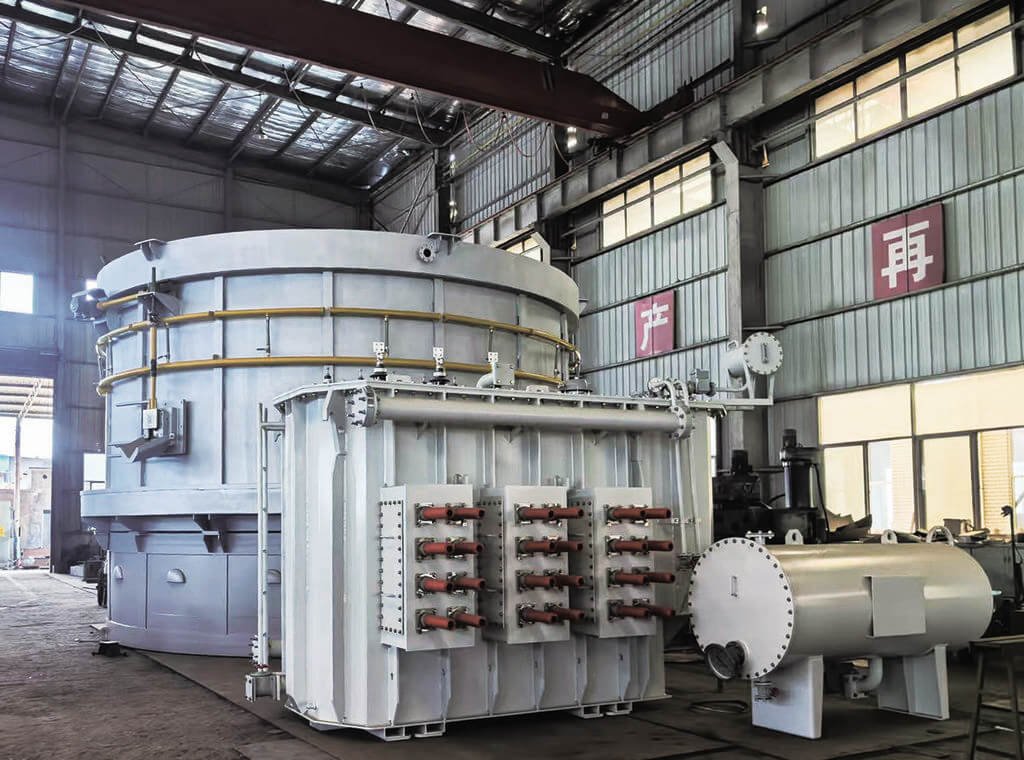
The Melting Furnace is the heart of the line and typically the largest single investment. Melt temperature stability controls fiber diameter and shot content, the non-fibrous particles that degrade insulation performance, so furnace quality shows up directly in product test reports. The fiberizing station and wool collector determine mat uniformity, which governs density consistency across the board face. The curing oven sets final thickness and density, and the cutting section decides dimensional tolerance, the specification facade contractors check first on delivery.
| Equipment Section | Function and Selection Focus |
| Batching system | Weighs and blends raw materials to recipe accuracy; focus on weighing precision and refractory-friendly feeding. |
| Melting furnace | Delivers stable melt at fiberizing temperature; focus on temperature control and refractory life. |
| Fiberizing station | Spins melt into fibers and applies binder; focus on wheel design and wear parts availability. |
| Pendulum and collector | Builds the primary mat; focus on pendulum speed range and chamber suction uniformity. |
| Curing oven | Sets density and thickness; focus on temperature zones and press control. |
| Cutting section | Trims and cuts to size; focus on blade quality and tolerance capability. |
| Dust and fume treatment | Captures emissions at each stage; focus on filter type matched to local discharge limits. |
A practical evaluation habit is to ask each supplier which section limits capacity and which limits quality, because a line is only as strong as its weakest stage, and the honest answers differ between configurations.
Cupola Furnace or Electric Furnace: Which Suits Small-Scale Output?
For most small-scale rock wool lines, an electric furnace is the more practical melting choice, because its capacity range matches low tonnage output, its emissions profile simplifies permitting, and its temperature control produces a more uniform melt, while a coke-fired cupola becomes competitive where coke is cheap and emissions treatment capacity already exists. The furnace is also the single decision with the longest lock-in, since it fixes the utility demand and the environmental compliance path of the entire plant.
A Cupola Furnace melts the charge with coke combustion, which keeps operating cost low where coke supply is reliable and gives the furnace high single-line output, but it requires combustion air handling, slag management and more extensive flue gas treatment. An electric furnace converts electrical energy to heat with precise control and no combustion products at the point of use, which is why permitting authorities in many regions view it more favorably for smaller sites inside industrial zones.
Capacity, Emissions, and Energy Trade-offs
| Factor | What It Means for a Small-Scale Producer |
| Capacity match | Electric furnace designs scale down to small melt rates efficiently; a cupola is happiest at higher throughput and can leave a small line over-furnished. |
| Energy source | The choice is effectively between a guaranteed power supply contract and a coke supply and handling operation. |
| Emissions compliance | Combustion-free melting removes a large share of flue gas volume and its treatment burden; cupola routes need filters and scrubbers sized to regulations. |
| Temperature control | Electric melting gives finer melt temperature stability, which translates directly into lower shot content and better fiber quality. |
Because energy use and emissions are the two largest operating sensitivities in mineral wool manufacturing, industry associations such as EURIMA, the European insulation manufacturers association, publish overviews of how the sector manages production energy and environmental performance that are useful background when weighing furnace proposals against local discharge rules.

How Much Does a Small-Scale Rock Wool Production Line Cost?
The cost of a small-scale rock wool production line is driven by rated capacity, automation level, furnace type and scope of supply, and the equipment purchase typically represents only part of the total project investment once installation, utilities, commissioning and working capital are counted. A quotation that looks cheap next to its competitors is usually narrower in scope, lighter in steel, or shorter in support rather than genuinely better value.
A complete budget should be built from the following blocks and compared across suppliers on the same basis. Equipment supply covers the machines themselves and varies most with capacity and automation. Installation and commissioning cover civil works coordination, mechanical erection, electrical connection and cold and hot commissioning runs. Utility works cover power connection or fuel storage, compressed air, process water and the dust and fume treatment installation. Spare parts and refractory are consumables from day one, since furnace refractory and fiberizer wheels are recurring costs that first-time buyers often miss. Working capital covers raw material stock and the production cycle until revenue stabilizes, which for a new entrant can be a longer period than the equipment lead time.
Two price signals deserve special caution. A quotation far below the market level usually means necessary sections have been omitted or undersized, and quality problems of that kind surface after commissioning when they are most expensive to correct. Conversely, a supplier that cannot give a transparent cost breakdown for each section is asking the buyer to compare numbers that do not describe the same line. A detailed treatment of what moves prices in this equipment category, including capacity and configuration effects, is available in this analysis of Rock Wool Production Line Cost, which is worth reading before shortlisting quotations.
How Do You Evaluate a Rock Wool Production Line Manufacturer?
A reliable rock wool production line manufacturer can be verified through four checks: documented compliance with recognized standards, reference projects running at comparable capacity, genuine process engineering capability, and a concrete after-sales support commitment covering training and spare parts. Rock wool production lines are supplied by specialized equipment manufacturers concentrated in a small number of countries, so most small-scale buyers evaluate suppliers across borders, which makes verifiable references more important, not less.
The evaluation should confirm each of the following points with evidence rather than assurances.
- Standards compliance: the equipment is designed and manufactured to the relevant national or international standards for mechanical, electrical and pressure-containing components, and the manufacturer can state which standards apply.
- Reference lines: the supplier can show running installations at a capacity and product mix close to the buyer’s plan, ideally with contactable customers.
- Engineering depth: the supplier sizes the furnace, curing and collection sections as a matched system and explains the capacity and quality limits of each section.
- Emissions capability: the offered dust and fume treatment is sized to the buyer’s actual discharge limits, not to a generic standard.
- Support commitment: commissioning supervision, operator training, a spare parts list with prices, and a defined response time for faults are written into the contract.
Reference visits are the strongest single signal available to a small-scale buyer. Standing in front of a running line producing board of the intended density and thickness answers more questions than any datasheet, and a manufacturer that cannot arrange such a visit at a comparable installation is telling the buyer something about its installed base.
Frequently Asked Questions
These answers address follow-up questions that small-scale buyers raise most often after the main selection decisions are made.
Is 100mm Rock Wool Enough?
For many external wall applications 100mm is a common and workable thickness, but “enough” depends on the climate zone, the target thermal transmittance for the building, and the fire rating requirement of the assembly rather than on the material alone. Colder climates and higher performance targets routinely call for 150mm or more, and the correct thickness should always be confirmed against the applicable building code rather than a rule of thumb.
Can a Small-Scale Line Be Expanded Later?
Yes, if expansion is planned at purchase time. The practical levers are building length reserved for additional sections, a batching and melting section sized with headroom, and a curing oven and collector designed for higher line speed. Retrofitting capacity into a line purchased with no margin is far more expensive than buying the margin initially, so buyers with credible growth forecasts should specify the expansion question in tender documents.
How Many Workers Does a Small-Scale Line Need?
A small line with a normal level of automation typically runs with one shift team of several operators covering batching, the hot zone, curing and finishing, plus maintenance staff shared across shifts. Higher automation reduces the headcount in cutting and packaging first, since those sections are the most labor-intensive, so the automation level quoted by the supplier should be judged section by section rather than as a single figure.




