
Glass wool is one of the oldest and most widely specified insulation materials in modern construction and industry. Because it is inexpensive, lightweight, non-combustible and effective at both thermal and acoustic control, it sits in places most people never see: inside wall cavities, wrapped around ventilation ducts, hidden above suspended ceilings and lagged around hot process pipes. For engineers, contractors and procurement teams, the practical question is not whether glass wool works, but where it should be used and what performance it delivers in each setting.
Glass wool is used for thermal insulation, acoustic control and fire protection across a wide range of sectors. Its most common applications are building envelope insulation such as walls, roofs, floors and ceilings, HVAC duct and pipe insulation, sound absorption in studios and offices, high-temperature insulation of boilers, ovens and industrial equipment, and temperature control in cold storage, refrigeration and transport. In every case, the material works by trapping still air and absorbing sound energy inside its fibrous structure.
The sections below explain how glass wool achieves these results, which applications suit it best, what it costs, and where its limits lie.
What Is Glass Wool and How Does It Work?
Glass wool is a type of mineral wool manufactured by melting glass and spinning the molten material into fine, flexible fibers that are bonded with a resin binder into rolls, batts, slabs and loose-fill. It insulates because its open, porous fiber network holds millions of tiny air pockets that stop air from circulating, and because the same elastic structure absorbs sound waves instead of reflecting them.
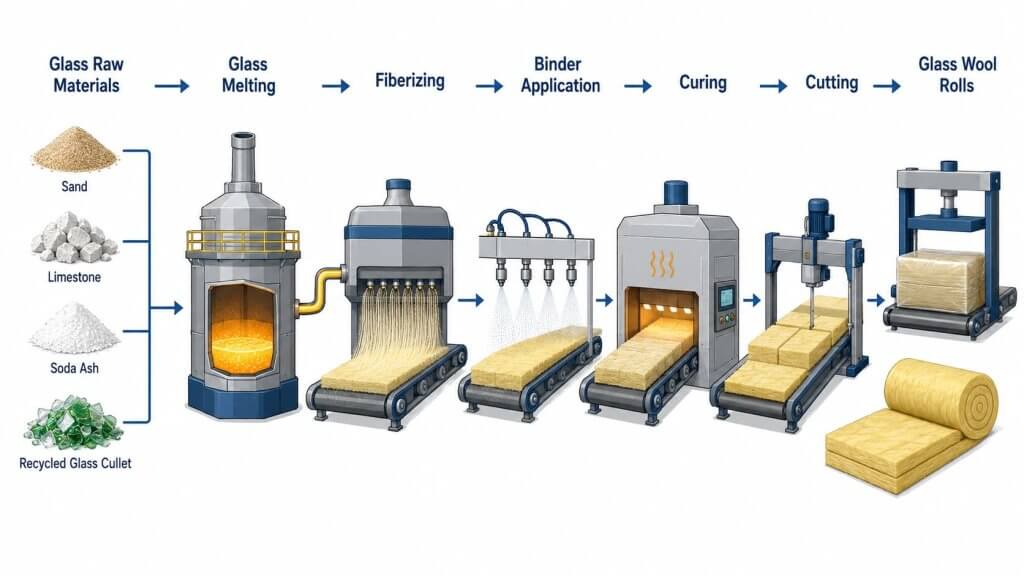
The raw material is usually a blend of recycled glass cullet, silica sand, limestone and soda ash, melted at high temperature and then drawn into fibers only a few micrometres in diameter. A thermosetting binder holds the fibers together in a resilient mat. This places glass wool in the mineral wool family alongside rock wool and slag wool, a group defined by its inorganic, fibrous composition. Thickness and density can be varied during production, so one base recipe yields products from soft rolls for lofts to stiff boards for façades.
How It Traps Heat and Sound
Heat transfer through a material happens by conduction, convection and radiation. Glass wool counters all three: the fibers themselves conduct poorly, the trapped air pockets are too narrow for convection currents to form, and the dense fiber network scatters radiant energy. The result is a thermal conductivity typically between 0.030 and 0.045 W/m·K at ambient temperature, where lower values indicate better performance.
Acoustically, glass wool behaves like a porous absorber. Sound waves enter the open structure, lose energy through friction as they move the fibers, and are converted into a small amount of heat. Thicker, denser products absorb more, which is why glass wool boards with a noise reduction coefficient in the 0.8 to 1.0 range are common in noise-critical spaces.
Production follows a consistent sequence regardless of final format: batching and melting, fiberization, binder application, curing, cutting and packaging. A modern glass wool production line links these stages into a continuous automated process, and the recipe determines everything from density to fire rating. Readers who want to know what glass wool is made of in more depth can follow the link.
What Is Glass Wool Used For? Main Application Areas
Glass wool is used wherever a lightweight, non-combustible, inexpensive barrier against heat, cold or noise is needed. The five largest application groups are building envelope insulation, HVAC duct and pipe insulation, acoustic treatment, industrial and high-temperature insulation, and cold chain and transport insulation.
Building and Construction Insulation
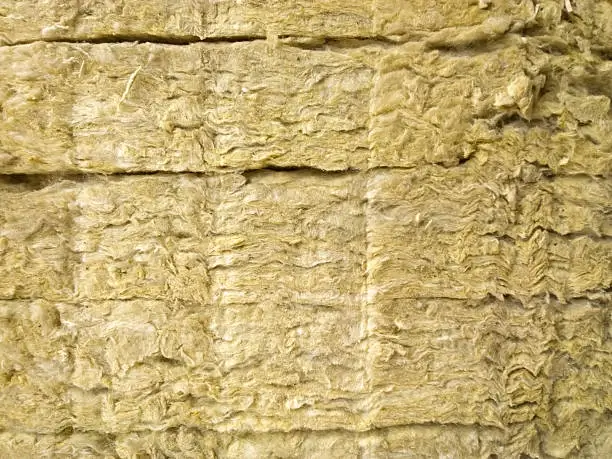
Construction consumes the largest share of global glass wool output. In low-density roll and batt form it fills stud walls, timber frames, cavity walls and drywall systems; laid flat it insulates lofts, ceilings and suspended timber floors; and rigid slabs are used behind cladding and on façades. The objective is usually twofold: reduce heating and cooling loads, and satisfy building code requirements for thermal performance.
HVAC Duct and Pipe Insulation
Ventilation and air conditioning systems rely on glass wool to keep conditioned air at temperature between the plant room and the occupied space. Duct wrap blankets are wound around rectangular and circular ductwork, duct liners are fitted inside the duct to cut both heat loss and fan noise, and pre-formed pipe sections with a longitudinal slit are slipped over pipework. Controlling condensation on cold surfaces is a further benefit in humid climates.
Acoustic and Soundproofing Applications
Schools, cinemas, recording studios, offices, hotels and plant rooms all use glass wool for sound control. The material appears as ceiling tiles, partition infill, wall panels and acoustic lining around compressors and mechanical equipment. Because it is non-combustible, it is also accepted in escape routes and assembly buildings where acoustic materials of organic origin would not be permitted.
Industrial and High-Temperature Insulation
Industrial glass wool is engineered for continuous operating temperatures that commonly reach 250 to 400 degrees Celsius. It is applied to boilers, storage tanks, ovens, ductwork, exhaust systems and machine enclosures, protecting workers from hot surfaces, conserving process energy and reducing condensation on chilled lines.
Cold Storage, Refrigeration and Transportation
The same insulating principle works in reverse. Glass wool is used in cold rooms, refrigerated warehouses and chilled pipework to reduce heat gain, and in buses, trains, ships and shipping containers for both temperature control and cabin acoustic comfort. Low weight matters here, because it reduces structural and fuel penalties.
| Application area | Typical form | Primary purpose |
| Building envelope | Roll, batt, slab | Thermal insulation, code compliance |
| HVAC ducts and pipes | Duct wrap, duct liner, pipe section | Energy loss and condensation control |
| Acoustic treatment | Board, ceiling tile, panel | Noise reduction and reverberation control |
| Industrial equipment | High-density slab, blanket | Heat conservation, personnel protection |
| Cold chain and transport | Blanket, board | Heat gain control, acoustic comfort |
What Are the Main Benefits of Glass Wool Insulation?
The main benefits of glass wool are its low thermal conductivity, non-combustible fire behaviour, strong sound absorption, light weight, low cost and high recycled content. These advantages combine to make it the default choice for large, cost-sensitive insulation projects.
Thermal performance is the headline benefit. Because a well-installed envelope reduces the energy needed for heating and ventilation, insulation ranks among the most cost-effective efficiency measures available for a building. Fire performance is the second: inorganic glass fibers do not ignite, do not spread flame and produce little toxic smoke, which allows products to reach the highest non-combustible classifications under international fire test standards.
Sustainability matters increasingly to specifiers. Modern glass wool is made with a high proportion of recycled glass, is formaldehyde-free in many product lines, and stays effective for the life of the building. Its low density also cuts freight weight and packaging volume, lowering transport emissions per square metre installed.
| Property | Typical range | Practical effect |
| Thermal conductivity | 0.030 to 0.045 W/m·K | Effective heat and cold barrier |
| Fire classification | Non-combustible, Class A1 | No flame spread, little toxic smoke |
| Noise reduction coefficient | 0.8 to 1.0 | Absorbs speech and machinery noise |
| Density | 10 to 96 kg/m³ | Lightweight, low structural load |
| Recycled content | Up to about 80 percent | Lower embodied impact |
Is Glass Wool Expensive?
No. Glass wool is one of the least expensive insulation materials available, generally costing less than rock wool, rigid foam boards and spray foam for the same insulated area. Bulk glass wool typically falls in a range of roughly three to twelve currency units per square metre, with foil-faced or higher-density grades costing more.
Several factors move the price. Density and thickness are the two biggest, since they directly determine how much raw material a product contains. Facing type, such as aluminium foil, kraft paper or glass tissue, adds a finishing step. Order volume matters greatly in business-to-business purchasing, because wholesale contracts for large projects can bring the unit price well below retail. For a breakdown by grade and thickness, see the current average price of glass wool. What makes the material economical in practice is not only its purchase price but its installed cost: it is light, easy to cut and quick to fit, which reduces labour and waste.

What Are the Disadvantages of Glass Wool Insulation?
The main disadvantages of glass wool are temporary skin, eye and respiratory irritation during handling, loss of thermal performance when the material becomes wet, and lower rigidity than high-density boards. It also requires careful installation to avoid compression and gaps that reduce its rated performance.
The irritation issue is mechanical rather than chemical: microscopic fibers abrade the skin surface on contact, producing itching and redness that subsides once the fibers are washed off. Correct handling, including gloves, long sleeves and respiratory protection during installation or removal, removes most of the risk.
Moisture is the more serious technical limitation. Water conducts heat far better than air, so saturated material loses much of its insulating value, and prolonged dampness can encourage mould growth on adjacent materials. Vapour barriers, correct detailing and dry storage during construction are therefore essential.
Finally, because low-density glass wool is soft and compressible, it is unsuitable for applications that demand load-bearing capacity or precise rigidity; denser mineral wool, rigid foam or specialist boards are better choices there. Several of these trade-offs apply to the wider disadvantages of mineral wool family as a whole.
Is Glass Wool Safe to Touch and Handle?
Yes, incidental contact with modern glass wool is safe, but it can cause temporary mechanical skin irritation, so protective clothing and gloves are recommended during prolonged handling. Glass wool used for insulation is not classified as a human carcinogen and does not contain asbestos.
This position reflects decades of research. The international agency that evaluates cancer hazards reclassified common insulation glass wool from a possible to a non-classifiable category for humans in 2001 and 2002, based on epidemiological studies of manufacturing workers that found no consistent increase in respiratory cancer. The change followed the industry-wide shift to biosoluble fibers, which dissolve in the lung and are cleared by the body rather than persisting.
Two practical points follow. First, irritation is a friction reaction, not an allergy or poisoning: wash exposed skin with cool water rather than scratching. Second, risk is highest when fibers are airborne, so dusty operations such as cutting, blowing or removing old material call for respiratory protection, eye protection and good ventilation. Products already enclosed in facings, or sealed inside a wall assembly, present no meaningful exposure in normal use.
FAQ
Does glass wool contain asbestos?
No. Asbestos is a naturally occurring mineral with a different, highly biopersistent fiber structure. Glass wool is manufactured from glass and does not contain asbestos. Products are also routinely tested and certified as asbestos-free to satisfy import and project requirements.
How long does glass wool insulation last?
When kept dry and correctly installed, glass wool holds its thermal and acoustic performance for decades, typically matching the service life of the building element it insulates. Performance only degrades if the material is compressed, disturbed or repeatedly exposed to moisture, which is why correct detailing and vapour control matter more than the material itself.
Can glass wool be recycled at end of life?
Yes, glass wool is recyclable, and new production commonly incorporates a high proportion of recycled glass. Offcuts and site waste can often be returned to manufacturers or processed through construction waste routes, although local recycling infrastructure varies and should be confirmed for each project.




