
Glass wool insulation is specified in a large share of modern buildings, and its performance depends as much on how it is made as on what it is made of. A single production line turns inexpensive minerals and recovered glass into millions of fine fibers bonded into stable rolls and boards, and knowing that sequence helps buyers judge capacity, quality consistency, and project cost before they accept a quotation.
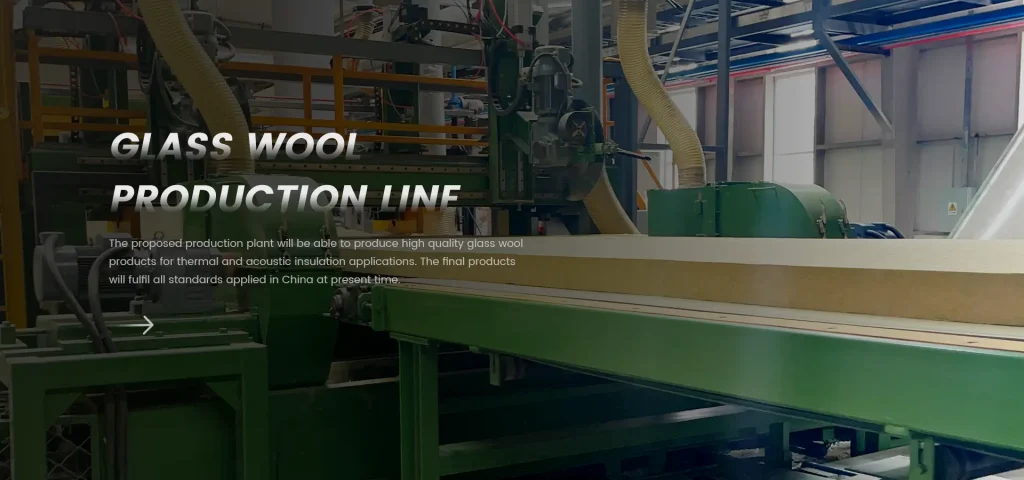
A glass wool production line works as one continuous flow: silica sand, soda ash, limestone, borax, and recycled glass are blended, melted into homogeneous glass at 1,400 to 1,600°C, drawn into fibers a few micrometers thick by a high-speed spinner, sprayed with a thermosetting binder, collected into a mat, cured at roughly 200 to 250°C, then cooled, cut, faced, and compressed for shipment.
The sections below follow that sequence stage by stage and explain which parameters decide whether the finished product meets its declared performance.
How a Glass Wool Production Line Works: Step-by-Step Overview
A glass wool production line converts mineral batch and recycled cullet into bonded insulation through nine linked stages: batching, melting, fiberizing, binder application, collection and forming, curing, cooling, cutting and facing, and packaging. A deviation in any one stage surfaces later as a density, thickness, or thermal conductivity fault in the finished product.
A complete glass wool production line is usually described by its working width, line speed, and annual tonnage, but the sequence changes little with scale. Only the furnace size, spinner count, forming width, and cold-end automation change.
| Stage | Function |
| Batching and feeding | Weigh and mix sand, soda ash, limestone, borax, and cullet to a fixed recipe |
| Melting | Dissolve the batch into homogeneous molten glass at 1,400 to 1,600°C |
| Fiberizing | Draw the melt into fibers roughly 3 to 10 micrometers in diameter |
| Binder application | Spray resin, water-repellent agent, and dust-suppressing oil onto the fibers |
| Collection and forming | Build a primary mat and layer it into a fleece at the target density |
| Curing | Force hot air through the compressed mat at 180 to 270°C to set the binder |
| Cooling | Return the cured mat to ambient temperature before trimming |
| Cutting and facing | Trim, slit, cross-cut, and laminate to final product dimensions |
| Packaging | Compress and wrap rolls, boards, and pipe sections for transport |
Because the material never leaves the conveyor, the stages are coupled: a furnace that drifts a couple of degrees changes melt viscosity, which changes fiber diameter, which changes the density of the mat reaching the curing oven.
Raw Material Batching and Glass Composition
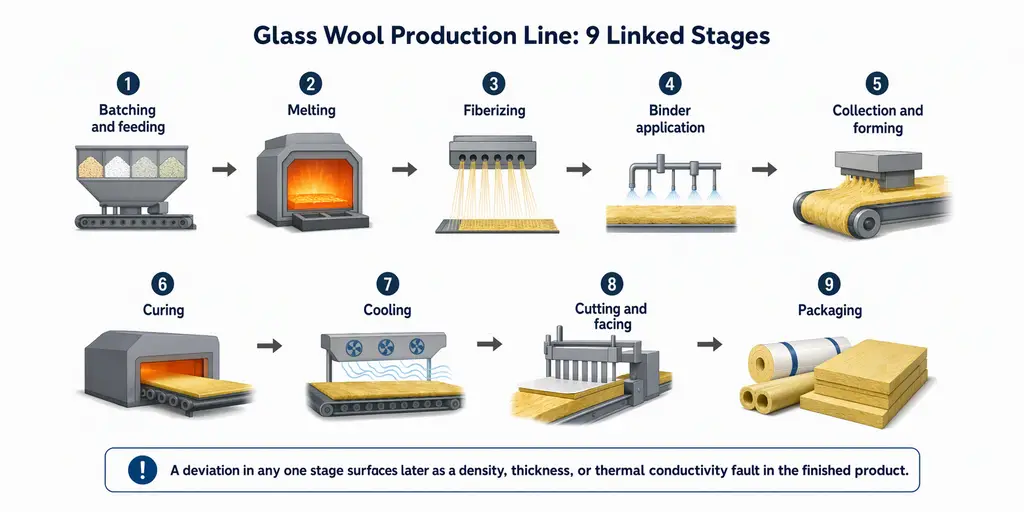
Batching weighs, mixes, and feeds the raw materials, mainly silica sand, soda ash, limestone, borax, and recycled glass cullet, in the proportions set by the glass recipe. That recipe fixes the oxide composition of the melt, which governs melting temperature, fiber formation, and the final thermal performance of the insulation.
Glass wool is spun from glass with a defined chemical composition rather than from a single mineral, which is why the batch is always a blend. Silica sand forms the network, soda ash and borax adjust melting temperature and viscosity, and limestone contributes calcium oxide that improves the durability of the fibers.
Recycled glass, known as cullet, is the main energy lever, because it is already glass and melts more easily than virgin raw materials. Its composition varies between bottle, window, and flat glass, and ceramics or metals must be removed before it reaches the furnace. Weighing accuracy of a fraction of a percent keeps the melt uniform, since small errors appear later as bubbles or a fiber diameter that drifts off target.
Melting the Batch into Molten Glass
Melting takes place in a furnace held at roughly 1,400 to 1,600°C, where the mixed batch stays long enough, usually 20 to 30 minutes, to become a homogeneous liquid with stable viscosity, no unmelted particles, and no entrained gas bubbles. It is the most energy-intensive stage on the entire line.
The Melting Furnace supplies the heat for the batch reactions and delivers a melt whose viscosity is constant enough for repeatable fiberizing. Viscosity, not temperature alone, is the controlling variable, so melt quality is judged on temperature uniformity, residence time, furnace pressure, and a stable draw rate. Fuel-fired furnaces burning gas or coke offer high melting rates but generate emissions that must be treated, while electric melting gives finer temperature control and tolerance for a wider range of cullet grades at the cost of a large electrical load.
Fiberizing: From Molten Glass to Fine Fibers
Fiberizing feeds a thin stream of melt onto a spinner rotating at several thousand revolutions per minute. Centrifugal force throws the glass through thousands of small orifices in the spinner wall, and a high-velocity hot air stream stretches the primary filaments into fibers typically 3 to 10 micrometers in diameter.
Centrifugal Spinning
The melt lands on a spinning disc, flows outward, and leaves through the orifice ring as primary filaments, which ring-shaped nozzles attenuate with hot high-velocity gas. Because the transformation takes a fraction of a second, output depends on spinner speed, orifice geometry, glass viscosity, and air pressure together. This is the mainstream route, yielding long flexible fibers at high throughput.
Flame Attenuation
Here the melt is drawn through a bushing into coarse primary filaments, then stretched by a high-temperature gas flame. It suits specialty grades needing very fine, short fibers, but consumes more energy and leaves more unfiberized debris.
| Method | Key characteristics |
| Centrifugal spinning | Long flexible fibers, low shot content, high output, standard for insulation |
| Flame attenuation | Very fine short fibers, higher energy per ton, used for specialty grades |
Fiber Diameter and Shot Content
The same material is called glass wool in Europe and fiberglass in North America, and the process of fiberglass insulation production is exactly this stage followed by binder application and curing. Finer fibers trap more air and lower thermal conductivity but reduce resilience, so each product class has its own target diameter range. Shot content, the share of unfiberized glass, adds weight without insulation value and increases dust during cutting, which makes it a clear indicator of a well-tuned section.
Binder Application, Fiber Collection and Forming
As soon as the fibers are formed, a thermosetting binder is sprayed evenly onto the airborne fiber veil. The coated fibers are then drawn by negative pressure onto a moving conveyor to build a primary mat, which a pendulum system folds into a fleece of uniform thickness and density.
Binder Systems
Binder content is only a small percentage of the finished weight, and both extremes cause problems: too little leaves the product weak and slow to recover thickness, while too much raises thermal conductivity without improving insulation value. Traditional phenolic resins are increasingly replaced by formaldehyde-free and bio-based systems that cut plant and indoor emissions, applied together with a silicone water repellent and a dust-suppressing oil.
Forming Chamber and Pendulum Layering
The veil is pulled into a forming chamber under negative pressure and deposited on a perforated conveyor or rotating drum collector, then laid down in overlapping folds by a pendulum swinging across the full width. This layering sets density independently of fiber throughput and gives glass wool its directional strength, with higher stiffness through the thickness, which is what rigid boards require. Inline basis-weight gauges scan the full width and correct the mass profile before curing, because an uneven mat cannot be fixed afterwards.
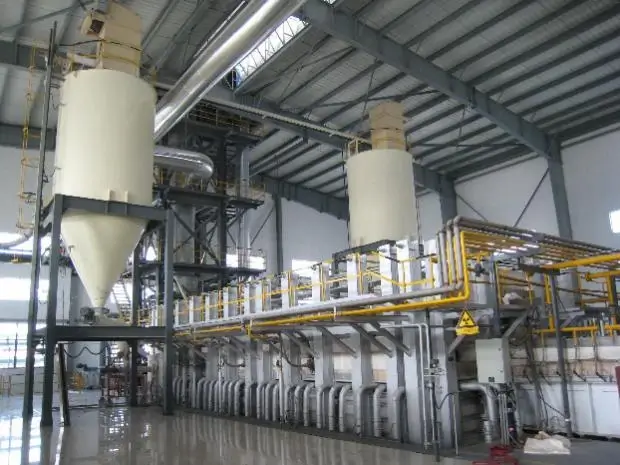
Curing the Fiber Mat
Curing presses the uncured fleece between two perforated conveyors that hold it at the target thickness while heated air at roughly 180 to 270°C is forced through it. Over 10 to 30 minutes the binder cross-links at the contact points between fibers, converting a fragile fleece into a rigid board or a resilient blanket.
The oven follows a ramp, hold, and taper profile: early zones drive off the water carried by the aqueous binder, middle zones hold the resin in its polymerization window, and final zones taper down so the surface does not over-cure. Airflow can switch between top-down and bottom-up so that no density gradient builds between the faces of the product.
Because the resin is thermosetting, the reaction is permanent and the product will not re-soften in service, which is why the oven is unforgiving about upstream errors: under-cure leaves weak bonds and edge delamination, a correct cure delivers full cross-linking with dimensional stability, and over-cure makes the product brittle while wasting energy.
Cutting, Facing and Packaging
After cooling, the cured mat passes through the Products Cutting System, which slits the edges, trims the width, and cross-cuts the mat to the ordered length. Facings are then applied, and the finished product is compressed and wrapped for transport.
Longitudinal slitters set the net width and cross-cut saws divide the mat to length within a tight tolerance, while dust extraction collects the fines. Product families diverge here: thin flexible material is folded into rolls, rigid material becomes boards and slabs, and pipe sections are formed into curved shells. Facings are bonded on the same line, aluminium foil for vapour control, kraft paper for general building use, and glass cloth or black felt where protection or acoustics matter.
Edge trim and off-cuts are crushed and returned to the melting furnace as cullet, so rejected material re-enters the batch instead of leaving the plant as waste. Packaging is part of the process rather than an afterthought, since products are compressed to a fraction of their nominal thickness and rely on the cured binder network to recover it when the pack is opened.
Quality Control on a Glass Wool Production Line
Quality control combines inline measurement with laboratory testing of samples taken at fixed intervals. Thickness, density and mass per unit area, fiber diameter and shot content, thermal conductivity, water repellency, and reaction to fire are each compared against the declared specification and the applicable product standard.
| Check | What it verifies |
| Mass per unit area and density profile | Confirms the material is distributed evenly across the width, which controls performance and cost |
| Thickness and dimensional accuracy | Confirms the conveyor gap, compression set, and cutting tolerance stay inside specification |
| Fiber diameter and shot content | Determines softness, tensile strength, and thermal conductivity |
| Thermal conductivity | Measured on laboratory samples, it is the headline value declared to buyers |
| Water repellency and moisture behaviour | Shows the additive is working and performance will recover after wetting |
| Reaction to fire | Confirms the non-combustible classification claimed in the product documentation |
The harmonised European standard for factory-made mineral wool products, EN 13162, sets out the characteristics to be declared, the test methods, the conformity assessment procedure, and the labelling requirements. A line that holds its process parameters tightly is normally the line that passes conformity assessment with the fewest surprises.
Limitations and Safe Handling of Glass Wool
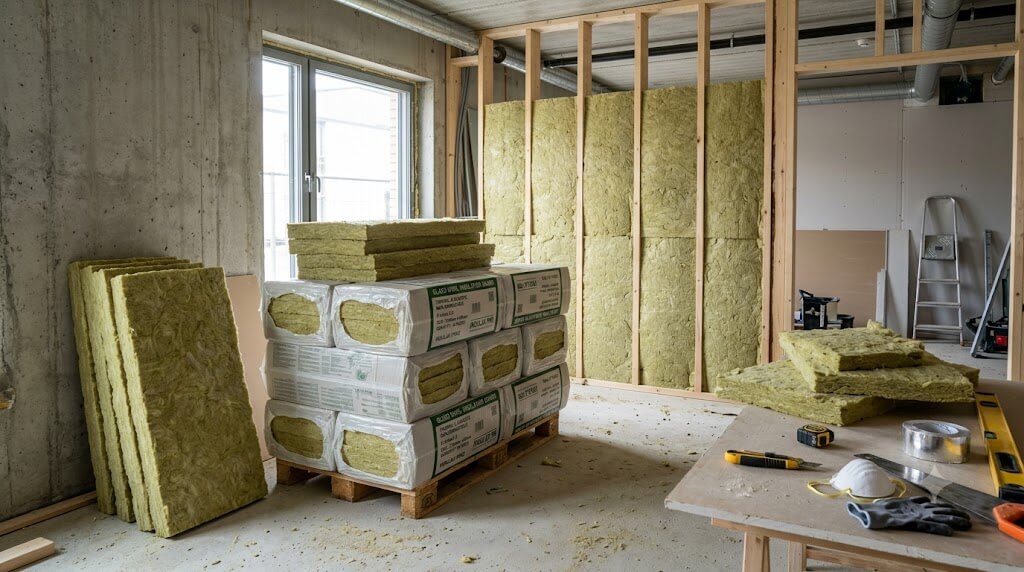
The main limitations of glass wool are mechanical irritation of the skin, eyes, and respiratory tract during handling, and a temporary loss of thermal performance if the material becomes saturated with water. Neither issue affects the installed product when it is handled with basic protective equipment and detailed correctly.
The irritation has a physical cause rather than a chemical one. Fibers that break during cutting or handling can lodge in the upper layers of the skin and produce the temporary itching known as fiberglass itch, and airborne dust can irritate the nose and throat. Public health reviews of synthetic vitreous fibers describe these effects as short-lived, note that glass wool fibers dissolve in lung fluid far more readily than asbestos fibers, and record no consistent excess of lung disease among glass wool workers.
Moisture is the more commercially significant limitation. Water displaces the air trapped between fibers, so thermal performance drops sharply while the material is wet. The water-repellent additive slows absorption but does not make the product waterproof, so designers pair glass wool with a vapour control layer and a weather-resistant skin, and saturated material should be dried or replaced rather than covered over.
Frequently Asked Questions
The three questions below cover the topics plant operators and buyers raise most often once they understand the process itself.
Why Can’t You Touch Fiberglass With Bare Hands?
You can, but it is not comfortable. The fibers are coarse enough to penetrate the outer layer of the skin, and the resulting mechanical itch can last for hours. The NIOSH Pocket Guide for fibrous glass dust lists skin and eye contact as exposure routes and recommends preventing skin contact and washing exposed skin daily. Long sleeves, gloves, and safety glasses keep handling comfortable, and the irritation fades on its own after washing with cool water and mild soap because the sensation is physical rather than chemical.
What Capacity Can a Glass Wool Production Line Reach?
Capacity is set by the furnace melting rate and the throughput of the curing oven rather than by the fiberizing section alone. Lines serving a regional market are typically built around a few tens of thousands of tons per year, while mid-size and larger lines specified for export markets run considerably higher. Working width and line speed are the two variables buyers compare most often, since a wider line running at the same speed multiplies output without a proportional increase in labor.
How Much Recycled Glass Can a Glass Wool Production Line Use?
Recipes in commercial operation incorporate a large share of recycled cullet, and where a clean supply is available the recycled content can approach the practical maximum allowed by the batch chemistry. The constraint is logistical rather than technological: cullet must be collected, sorted, and freed of ceramics and metals before it reaches the batch house, and its composition must be monitored because different sources of waste glass do not share the same oxide balance.




