
Rock wool keeps winning ground as fire codes and building energy regulations tighten, and every new board starts the same way: basalt and slag melted at roughly 1,500°C, spun into fibers a few micrometers in diameter, and sprayed with a thermosetting resin. Between that fragile, binder-coated fleece and a finished product stands a single machine. Among all the equipment that makes up rock wool production lines, the curing oven has the largest single influence on product quality, plant availability, and energy cost, so choosing one deserves the same rigor as choosing the melting furnace.
To choose a curing oven for a rock wool production line, match the machine to your production numbers first: a continuous chain-plate oven sized to your line width, speed, and capacity, with independently controlled temperature zones covering the 200 to 250°C curing window, uniform airflow, and thickness calibration across your product range. Then separate offers on energy efficiency, safety compliance, maintenance design, and the supplier’s rock wool references.
The sections below work through those decision points in the order they usually arise.
What a Curing Oven Has to Accomplish in Your Line
A curing oven must polymerize the resin binder evenly through the compressed fiber mat while calibrating the product to its final thickness at full line speed, converting a soft fleece into a board or blanket with consistent strength, density, and dimensions.
In equipment quotations the machine often appears under the name Thermal Polymerization Furnace, because thermal polymerization is precisely what it does: heat cross-links the resin at the contact points between fibers, permanently fixing them in their compressed position. Phenol-formaldehyde binders remain the dominant chemistry in mineral wool insulation, and their reaction window is narrow, which is why oven design revolves around temperature control and airflow rather than raw heat output.
To see what the oven inherits from upstream, place curing in the full process sequence:
- Melting of batched raw materials in a cupola or electric furnace.
- Fiberizing of the melt on high-speed spinning machines.
- Spraying of binder and process additives onto the airborne fiber stream.
- Collection and pendulum laying of the fibers into a continuous layered mat.
- Pre-pressing, then curing, where the oven sets final thickness, density, and strength.
- Cooling, cutting, and packaging of the cured product.
Every upstream variable arrives at the oven door: mat weight, moisture content, binder loading, and line speed. Selection is therefore about matching the oven to the extremes of your product mix, not the average day. Under-cured product stays weak and recovers poorly after compression packaging, over-cured surfaces darken and turn brittle, and neither defect can be corrected downstream.
Batch or Continuous: Choosing the Right Oven Type
Industrial curing ovens come in two types, batch ovens and continuous conveyor ovens, and a rock wool line almost always needs the continuous kind, because rock wool is produced as an endless mat that must be cured while it moves.
| Item | Explanation |
| Batch curing oven | Cures a discrete load inside a closed chamber, one recipe at a time; suited to specialty products, small lots, and pilot-scale work where flexibility matters more than throughput |
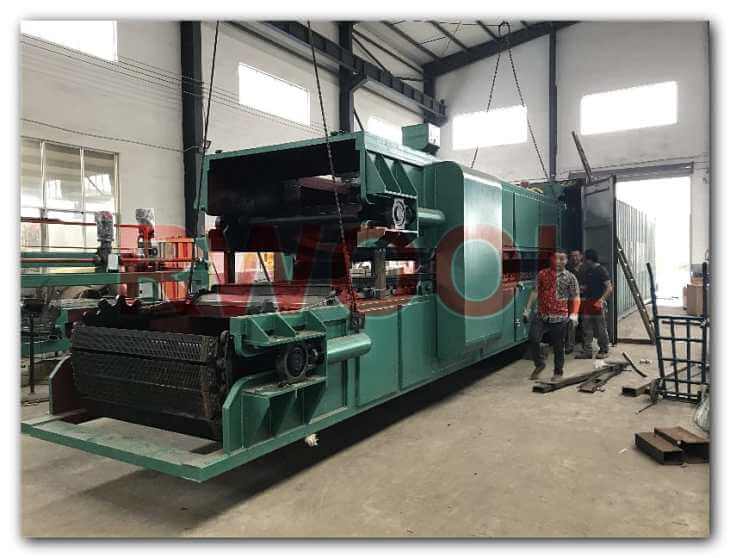
| Continuous curing oven | Conveys the mat between upper and lower chain-plate conveyors through successive heated zones that cure and thickness-calibrate it in one pass; the standard configuration for industrial rock wool lines |
| Throughput behavior | A continuous oven keeps pace with line speed around the clock, while a batch oven adds loading, ramping, and unloading time to every cycle |
| Investment behavior | Batch systems cost less up front and suit entry-level or multi-product plants, but at industrial capacity the continuous oven wins on uninterrupted output |
For a plant that intends to scale, specify the continuous oven from the outset. The machine is engineered around the line’s width and speed envelope, and retrofitting a longer, wider, or faster oven later is a construction project, not an equipment swap.
Match the Oven to Your Line: Specifications That Decide Performance
Every curing oven specification should trace back to a production number, your line width, speed, annual capacity, and the thickness and density range of your product mix, because any mismatch becomes either a bottleneck or a quality problem within weeks of commissioning.
Temperature Capability and Zone Control
The binder cures in a window of roughly 200 to 250°C, and the closer the oven holds that window across the whole mat, the more consistent the product. Modern ovens divide the tunnel into multiple independently controlled zones arranged in a ramp-hold-taper profile: early zones raise the mat temperature, middle zones hold it, and final zones taper down to prevent overheated surfaces. When comparing offers, look at the number of zones, the precision of each control loop, and the density of temperature measurement inside the tunnel, not the single maximum temperature figure in a brochure.
Size, Width, and Speed Matching
| Item | Explanation |
| Oven length | Typically 20 to 35 m; together with conveyor speed it sets the residence time available for curing thick or dense products |
| Internal width | Must cover your working mat width, commonly 1,200 to 2,400 mm, with automatic edge sealing to stop bypass airflow |
| Conveyor speed range | Should span your planned line speeds with margin, so the oven can slow down for heavy products without starving upstream stages |
| Thickness calibration | The adjustable upper conveyor must cover your full product range, for example 30 to 200 mm, and hold tolerances near ±1 mm |
| Density range | Denser mats resist airflow, so fan capacity and heater power must be rated for the heaviest product you intend to sell, not the average one |
Airflow and Heating System Design
Uniform airflow through the mat is the single most important technical condition for even curing, and it is where designs differ most. Ask how the supplier guarantees distribution across the full width, whether airflow can be switched between top-down and bottom-up to balance both faces of the board, and how edge sealing adjusts when product width changes. Gas burner systems are the most common heating choice for their operating cost profile, while electric heating suits sites with strict emissions rules or cheap electricity. The exhaust system must also be sized for the moisture and volatile organic compounds released by the binder, since that stream feeds the downstream filtration equipment.
Energy Efficiency and Long-Term Operating Cost
Energy consumption, not the purchase price, dominates the total cost of owning a curing oven, so thermal design and heat recovery deserve the same scrutiny as output specifications.
The oven is one of the largest energy consumers on the line, which makes it a major driver of overall Rock Wool Production Line Cost over a ten-year horizon. The features that separate an economical oven from an expensive one are concrete and checkable:
- A thermally optimized, well-insulated housing with low outer-surface temperatures.
- A high recirculation ratio that reuses hot process air instead of venting it.
- Heat recovery on the exhaust air stream.
- Modulating, high-efficiency burners or matched electric heaters.
- Zone-level control that heats only the zones the current product needs.
- An energy simulation supplied before fabrication, not after commissioning.
Suppliers who model predicted energy consumption for your specific product mix give you a number to hold them to, and that number usually matters more than a few points of difference in capital price.
Safety Standards and Maintenance-Friendly Design
A curing oven runs hot, around the clock, with combustible binder volatiles in its exhaust stream, so safety compliance and maintenance access are selection criteria of the same rank as throughput and energy efficiency.
Compliance and Fire Protection
Ovens that release flammable substances are a regulated equipment class: NFPA 86 is the North American reference standard and DIN EN 1539 its European counterpart, and both govern construction, ventilation, interlocks, and fire protection for dryers and ovens. Beyond certificates, ask what the design actually contains: early fire detection and extinguishing inside the tunnel, chain and flight monitoring with overload protection, and purge and interlock logic that prevents ignition during start-up. Insurers in many markets make these features a condition of coverage, not an option.
Maintenance-Friendly Features
Mineral wool lines often run continuously for weeks, and every hour of oven downtime stops the whole line, so maintenance design directly buys availability:
- Large inspection doors for access to the tunnel interior.
- Swing-out or withdrawable fan assemblies that can be serviced without hot work inside the oven.
- Externally mounted burners for safe inspection during operation.
- Online cleaning systems for flights and chains, where fiber dust and binder deposits accumulate.
- Automatic central lubrication of chains, with monitoring for chain length and wear.
How to Evaluate a Curing Oven Supplier
Judge a curing oven supplier on verifiable mineral wool references, engineering depth, and lifecycle support rather than on brochure specifications and price alone.
A capable supplier should clear every item on this list:
- Reference plants with capacity, width, and product mix comparable to yours, which you can contact.
- Process engineering that simulates temperature profiles, airflow, energy consumption, and exhaust values before anything is manufactured.
- Custom design around your product range rather than a fixed catalogue envelope.
- Design-to-standard capability, whether the project follows NFPA 86 or DIN EN 1539, with certified control cabinets where the destination market requires them.
- Commissioning, operator training, and spare parts availability in your region, not only from headquarters.
- Documentation and remote diagnostics that outlive the original project team.
The pattern to look for is a supplier who studies your process before quoting, because the most expensive mistakes in this purchase are specification mistakes made before the contract is signed.
Frequently Asked Questions
Buyers shortlisting a curing oven most often ask about the temperature limits of the material itself, multi-product flexibility, and inspection routines.
What temperature can rockwool withstand?
Bonded stone wool products are typically rated for service temperatures of roughly 700 to 850°C, while the stone fibers remain stable beyond 1,000°C and melt at about 1,500°C, according to published mineral wool heat-resistance data. The organic binder is the limiting component: it breaks down at around 250°C, which is why curing ovens operate in a controlled window just below that threshold.
Can one curing oven process both rock wool and glass wool?
Both are mineral wool cured by the same principle, hot-air polymerization of a thermosetting binder, so a dual-product oven is feasible. The catch is that rock wool runs denser and thicker products with higher fan loads, while glass wool favors lighter and faster production, so an oven intended for both needs generous fan capacity, wide-ranging conveyor adjustment, and flexible zoning from the start. Most single-fiber plants configure the oven for one product and take the efficiency gain.
How often should a rock wool curing oven be inspected?
A workable routine splits checks by interval. Daily: conveyor and burner condition plus alarm status during the shift. Weekly: cleaning of accessible deposits and lubrication levels. Monthly: calibration of zone temperature sensors and chain tension checks. Annually: a full audit of fire protection, interlocks, and the exhaust system aligned with the inspection, testing, and maintenance requirements of the applicable oven standard. Ovens with online monitoring carry part of this burden automatically, but none of it disappears entirely.




