
Rock wool insulation starts as volcanic rock melted at roughly 1,500°C and spun into fibers a few micrometers in diameter. Those loose fibers only become a usable product after a binder has been cured, and the machine responsible is the curing oven. Positioned between the forming section and the cooling section, it determines the thickness accuracy, density profile, and mechanical strength of every board and blanket the plant ships, which is why many plant engineers describe it as the heart of the production line.
A curing oven works by conveying the binder-coated fiber mat between an upper and a lower perforated conveyor that compress it to the target thickness, while fans force heated air at roughly 200 to 250°C through the mat. The heat polymerizes the thermosetting resin at the contact points between fibers, permanently bonding them and locking in the product’s final thickness, density, and shape.
The sections below trace where curing sits in the overall process, what happens inside the oven step by step, which components do the work, and which operating parameters decide final product quality.
What Is a Curing Oven in a Rock Wool Production Line?
A curing oven is an enclosed, heated chamber on a rock wool line in which hot air polymerizes the thermosetting binder inside the mineral fiber mat. The reaction converts a soft, fragile fleece into a dimensionally stable board or blanket with the specified density, strength, and thickness, which is why the oven is often described as the heart of the entire plant.
Mineral wool owes its structure to a small percentage of resin, typically a phenolic or other thermosetting binder, sprayed onto the fibers while they are still airborne during fiberizing. At room temperature this binder stays chemically inactive, so the freshly formed mat holds together only by mechanical entanglement and would collapse under load. The thermal treatment inside the oven is what activates it: once cross-linked, the resin permanently fixes every fiber in its compressed position.
Without this stage there would be no bonded rock wool products at all, no boards, no blankets, no pipe sections. Every quality attribute that customers specify, from compressive strength to thickness recovery after compression packaging, is created during the few minutes the mat spends inside the oven.

Where the Curing Oven Fits in the Rock Wool Production Process
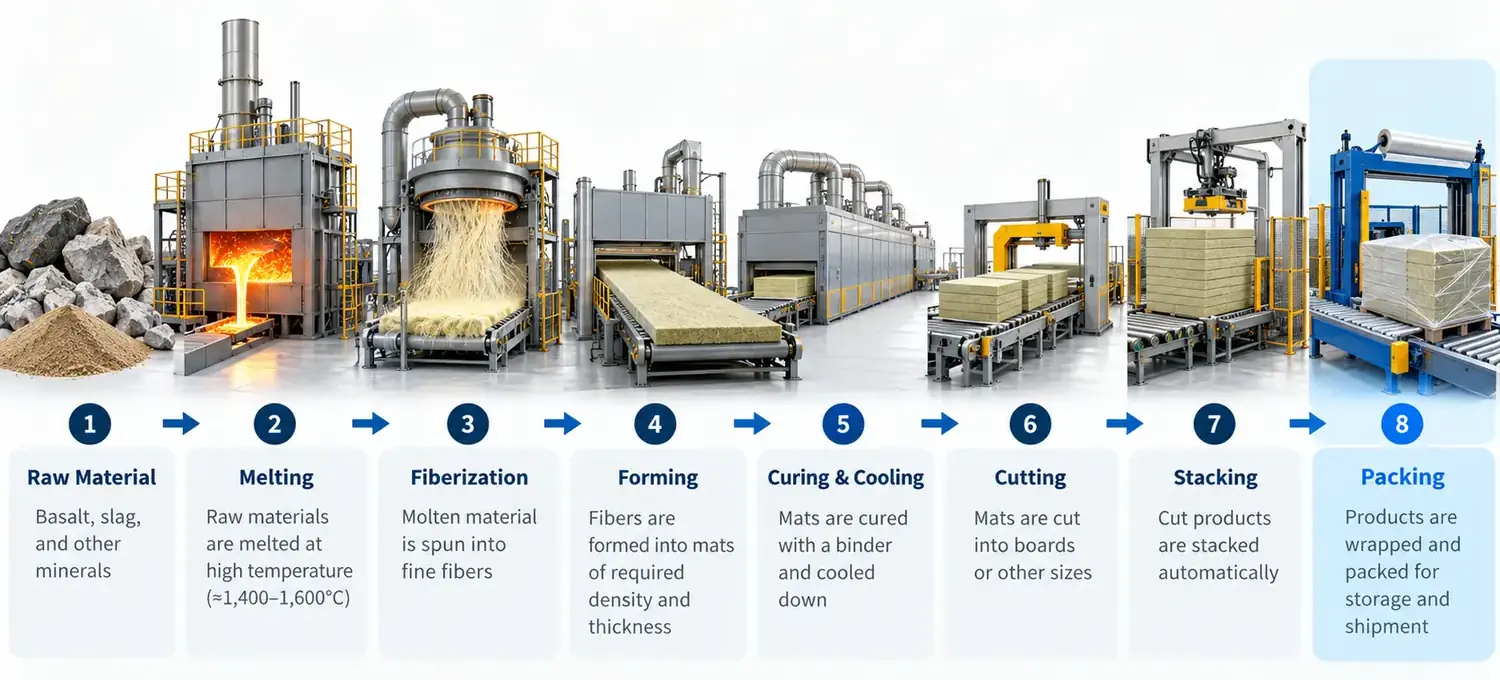
The curing oven receives the layered, uncured mat after melting, fiberizing, binder application, and forming, and it hands over a fully cured product to the cooling and cutting sections. It is the last stage that changes the material’s internal structure, and therefore the last point at which quality can be locked in.
A rock wool line runs as one continuous sequence, and a detailed Stone Wool Manufacturing Process guide covers each stage in depth:
- Batching: basalt, slag, and dolomite are crushed, weighed, and mixed to the target chemistry.
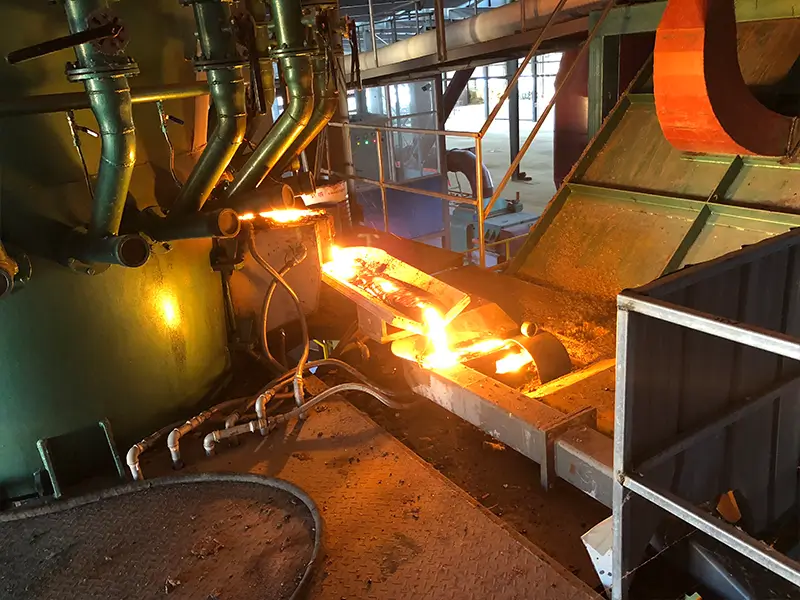
- Melting: the mixture melts at roughly 1,400 to 1,500°C in a cupola or electric furnace.
- Fiberizing: spinning wheels draw the melt into fine fibers.
- Binder application: resin, water-repellent agent, and dust-control oil are sprayed onto the airborne fiber stream.
- Collection and forming: fibers settle into a primary mat, and a pendulum system layers them into a uniform fleece.
- Curing: the compressed mat passes through the curing oven, where heat sets the binder.
- Cooling: ambient air stabilizes the board temperature.
- Cutting and packaging: saws trim, slit, and divide the product before stacking and wrapping.
The curing stage depends on everything upstream. Uneven fiber distribution or inconsistent binder spraying cannot be corrected once the resin has polymerized, so curing is both the final quality gate and the place where upstream problems first become visible in the finished product.
How the Curing Oven Works, Step by Step
Inside the oven, the mat travels sandwiched between two perforated flight conveyors that hold it at the target thickness while heated air is pushed through it zone by zone. Water evaporates, the resin cross-links, and the mat exits as a rigid, dimensionally stable product.
Compression Between the Upper and Lower Conveyors
The mat enters between two parallel conveyors built from perforated steel plates, called flights, carried on heavy-duty chains. The upper conveyor is mounted on motorized lifting mechanisms, so the gap between the two conveyors defines the final board thickness. As the mat advances, it is gently compressed to this set gap, and because the resin cures in this compressed state, the fibers stay fixed at the target thickness after the product leaves the oven.
Adjusting the conveyor spacing during operation lets one line switch between product types, from thin flexible blankets of roughly 20 mm to rigid boards up to 250 mm thick, with working widths after trimming commonly reaching 2,400 mm and net widths up to 2,500 mm on large lines.
Hot Air Circulation Through the Mat
Burners heat a stream of process air, and high-capacity circulation fans push it through the perforations in the flights and directly through the fiber mat. The airflow performs two jobs at once: it evaporates the water carried by the aqueous binder, and it raises the resin to its polymerization window of roughly 200 to 250°C.
As the thermosetting resin cures, it cross-links at the contact points between adjacent fibers, building the rigid three-dimensional network that gives rock wool its mechanical strength. Because the resin is thermosetting, the cure is permanent, and the board will not re-soften when the finished insulation is later exposed to heat in service.
Multi-Zone Temperature Control and Airflow Management
Modern ovens are divided into several independently controlled heating zones along their length, typically following a ramp-hold-taper profile: early zones raise the mat temperature, middle zones hold the cure temperature, and final zones taper down to prevent surface defects such as over-cured skins or discoloration.
Airflow direction is engineered with equal care. Many designs can switch between top-down and bottom-up flow to prevent density gradients between the two faces of the board, and automatic width sealing stops air from bypassing the mat at its edges, where it would escape without doing any curing work. Uniform airflow across the full mat width is the single most important condition for consistent product quality.
Key Components of a Rock Wool Curing Oven
A rock wool curing oven is built around seven core components: the two flight conveyors, the chain drive system, the heating unit, the circulation fans, the air distribution plenums, the insulated housing, and the automation system that coordinates them all.
| Component | Function |
| Upper and lower flight conveyors | Perforated steel flights that carry the mat and compress it to the target thickness |
| Chains and drive system | Move both conveyors in synchronization at the line speed, with variable frequency control |
| Heating unit | Gas burners or electric heaters that raise the process air to the curing temperature |
| Circulation fans | Force heated air through the mat for uniform binder polymerization |
| Air plenums and distribution | Spread the airflow evenly across the full product width |
| Insulated housing | Retains heat, keeps outer surfaces safe, and cuts energy loss |
| Control and monitoring system | Regulates zone temperatures, conveyor speed, and safety interlocks |
Because mineral wool lines often run continuously for weeks, production-grade designs add flight and chain-length monitoring, automatic lubrication, online cleaning of flights and chains, and early fire detection with extinguishing systems. Thermal efficiency is a major design focus, since the oven is one of the largest energy consumers on the line, and well-engineered housings keep heat loss low while exterior surfaces stay cool. These details are what distinguish a basic oven from an industrially proven Thermal Polymerization Furnace designed for around-the-clock output.
Operating Parameters That Determine Curing Quality
Four interacting parameters decide curing quality: oven temperature, residence time, product thickness, and target density. They must be balanced together, because each one changes how deeply and evenly the hot air can cure the binder.
| Parameter | Typical Range | Why It Matters |
| Curing temperature | 200 to 250°C | Below the window the resin under-cures; above it, energy is wasted and edges can turn brittle |
| Conveyor speed | Up to about 15 m per minute | Sets residence time; slower speeds give deeper heat penetration for thick mats |
| Product thickness | About 20 to 250 mm | Thicker products slow heat transfer into the mat core |
| Product density | Roughly 25 to 230 kg per cubic meter | Denser mats resist airflow, so fans and zones must work harder to cure the center |
Residence time, usually several minutes, follows from conveyor speed and oven length. When any parameter drifts, the defects are visible immediately: under-cured cores that crumble under load, over-cured surfaces that darken and lose strength, or thickness deviations across the board width. This is why modern lines tie zone temperatures and conveyor speed into a single closed-loop control system that reacts to measured product temperature.
What Happens After the Curing Oven?
After curing, the continuous board passes through a cooling section where ambient air brings its temperature down, and then moves to cutting stations that trim, slit, and divide it into finished boards, strips, or rolls before packaging.
Cooling is not an optional convenience. Cutting a hot board causes dimensional drift after the saw, and warm product can deform under its own weight in the stacker. Once cooled, longitudinal and cross-cutting saws trim the edges and cut the board to length, and off-cuts fall into a recycling loop that returns them to the fiberizing stage. A well-integrated Cutting Section preserves the dimensional accuracy the oven has just locked in, which is why the two stages are engineered together as one continuous dimensional chain.

Frequently Asked Questions
The three questions below cover the safety and process topics that buyers and plant operators ask most often once they understand how the oven itself works.
Can You Touch Rock Wool With Bare Hands?
You can, but it is not comfortable. Rock wool contains coarse fibers that cause temporary mechanical itching on exposed skin, much like handling straw. The irritation is physical rather than chemical or allergic, and it clears after washing gently with cool water and soap. Gloves, long sleeves, and safety glasses are recommended for any manual handling.
Is Rock Wool Safe for the Lungs?
Modern rock wool is considered safe when standard dust controls are followed. The fibers are biosoluble, so they dissolve in lung fluid and are cleared by the body’s natural processes, and the International Agency for Research on Cancer classifies insulation rock wool in Group 3, not classifiable as to carcinogenicity (IARC Monograph Volume 81). An N95 respirator is still recommended when cutting product in enclosed spaces, since airborne dust of any kind should be minimized.
Can Rock Wool Be Produced Without a Curing Oven?
Only for a narrow product range. Loose-fill blowing wool and some growing substrates are made with little or no binder, so they skip thermal curing. Every bonded product, boards, blankets, pipe sections, and mesh-wrapped mattresses, requires thermal polymerization, which makes the curing oven indispensable on virtually every commercial rock wool line.




