
Mineral wool lines run fast and make a bulky, low-density product that occupies far more truck or container space than its weight suggests. Packaging is therefore not a cosmetic final step. It decides how much finished insulation fits into each shipment, how well the product survives handling, and how much labour the end of the line consumes.
A packing machine for mineral wool automatically receives finished boards, rolls or bundles from cutting and stacking, counts and aligns them, compresses them to a target height where required, applies protective film or a bag, seals the package, and transfers the finished pack to palletizing or storage.
The sections below place that machine in the production flow, then break its cycle down stage by stage.
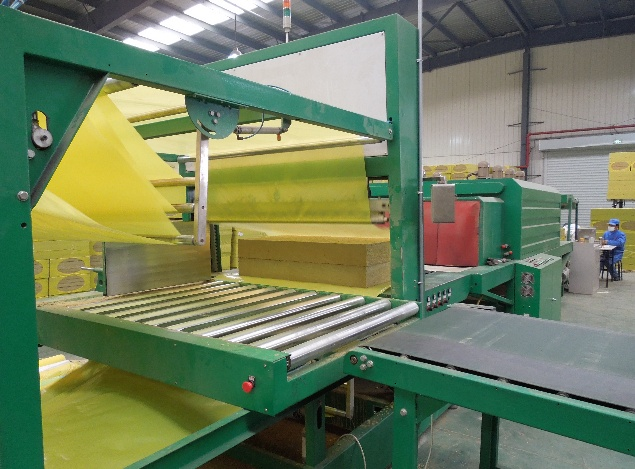
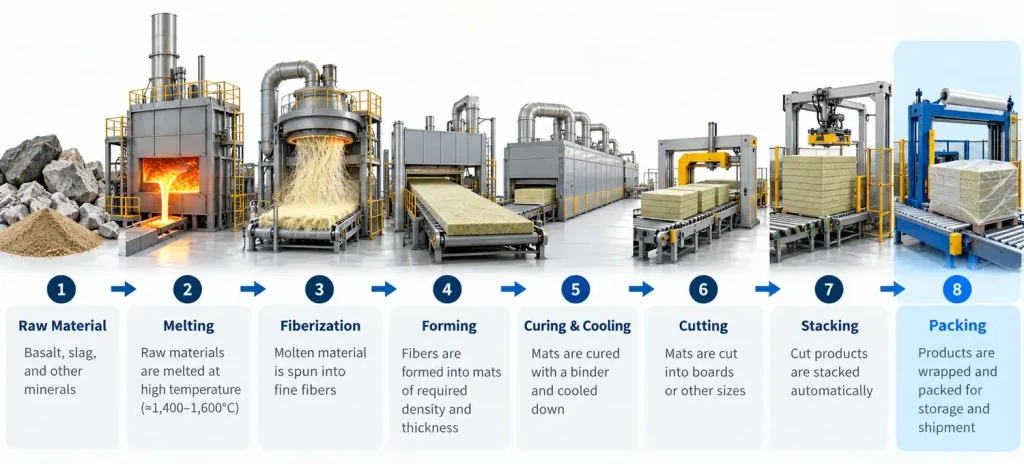
How the Packing Machine Fits Into Mineral Wool Production
The packing machine is the final production unit on a mineral wool line. It sits directly after cutting and stacking, and every stage upstream exists to deliver a dimensionally stable, fully cured product into it. Once sealed, that bundle becomes the unit the plant stores, sells and ships.
The Steps Before Packing
Product reaches the packer only after a fixed sequence, and the condition of the material entering it is decided stages earlier.
- Raw material preparation: basalt and dolomite are weighed and blended.
- Melting: around 1,400 to 1,500°C in a furnace.
- Fiberization: the melt is spun into fibres and coated with a binder.
- Forming: the fibres are collected into a blanket of controlled thickness.
- Curing and cooling: an oven at roughly 200°C sets the binder and gives the product its strength (European insulation manufacturers association).
- Cutting: saws trim the blanket to size.
- Stacking: pieces are counted and piled to a specified pack height.
- Packing: the stack is compressed, wrapped, sealed and discharged.
Because each stage constrains the next, a mineral wool production line behaves like a single chain, and packing is where upstream variation shows.
Why Packaging Determines Shipping Cost and Product Quality
Mineral wool is elastic, so a pack can be compressed well below its free thickness and still recover on site. That cuts pack volume: more packs per truck, per container and per warehouse position, and lower transport emissions per tonne. Sealing also keeps moisture and dust out of the fibres and gives every pack the same shape, so palletizing stays reliable.
How a Packing Machine for Mineral Wool Works Step by Step
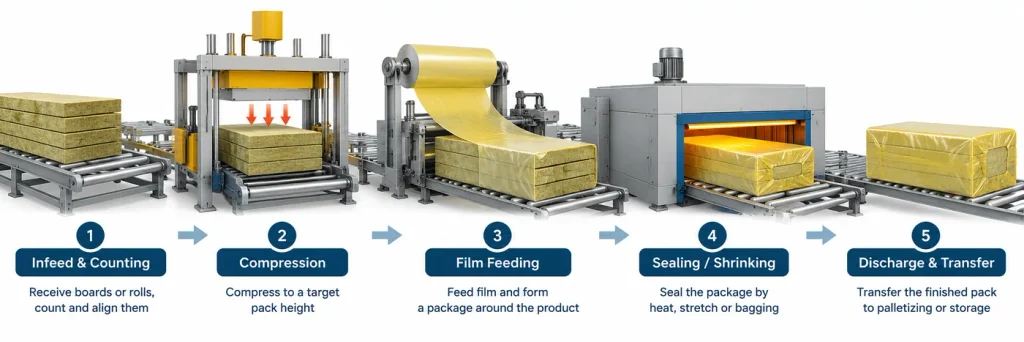
The cycle is a repeating loop. Product arrives from the stacker, is counted and squared, compressed to a target height, enclosed in film or a bag, sealed by one of three methods, and discharged as a finished pack. The slowest stage sets the output of the whole machine.
Stage 1: Infeed, Counting and Stacking
Infeed conveyors carry boards or rolls to a stacking station, where sensors confirm that the right number of pieces has arrived. Counting logic is tied to a product recipe, so a format change alters the pieces per pack automatically. Squaring guides keep the bundle aligned, because a stack skewed by a few millimetres seals poorly.
Stage 2: Controlled Compression
A compression plate, driven hydraulically, pneumatically or by servo motors, presses the stack to a target pack height. What matters is not force alone but pressure, compressed height and holding time together. Over-compressing a cured board crushes the fibre matrix and slows thickness recovery, while under-compressing wastes volume. Rolls are folded and flattened instead, so they stay stackable.
Stage 3: Film Feeding and Package Forming
Film feeding turns a flat roll of material into a package that surrounds the product. The film passes through tension rollers that keep it flat and wrinkle-free, and incorrect tension is a common cause of loose or torn packs. Depending on the machine, the film is laid above and below the bundle, or formed into a tube the product passes into. Systems such as an Automatic Heat Shrink Packaging Machine combine feeding and sealing.
Stage 4: Sealing, Shrinking or Stretching
This is where packers diverge: assuming every machine uses a heat tunnel is a common mistake.
Shrink systems pass the bundle through a heated tunnel, where the film contracts. The wrap is sealed first by a heated bar, then cooled so the film sets. This gives a tight, printable pack that suits rigid boards, but it uses more energy.
Stretch hood systems stretch a tubular film over the bundle and seal the ends. No heat tunnel is needed, because the elastic recovery of the film holds the pack, which also lowers film consumption and removes the fire risk.
Bagging systems fit a pre-formed or formed-in-place bag over the product, which suits loose wool and small formats needing a fully enclosed barrier.
Stage 5: Discharge, Palletizing and Transfer
Once sealed, the pack leaves on a discharge conveyor. A modern line then continues automatically: packs are turned, grouped and stacked onto pallets by robotic arms, then given a secondary wrap before storage. Automated Logistics System equipment handles this section, and it must run in step with the packer, or a stranded pack stops the machine behind it.
| Stage | Main Action | Key Control |
| Infeed | Receive and align | Position and count |
| Stacking | Build the bundle | Pieces per pack |
| Compression | Reduce volume | Pressure and height |
| Film application | Cover the bundle | Film tension |
| Sealing | Close the package | Temperature and seal time |
| Shrink, stretch or bag | Tighten or enclose | Heat, stretch ratio, bag fit |
| Discharge | Transfer the pack | Conveyor synchronization |
Packing Machine Types Used for Mineral Wool
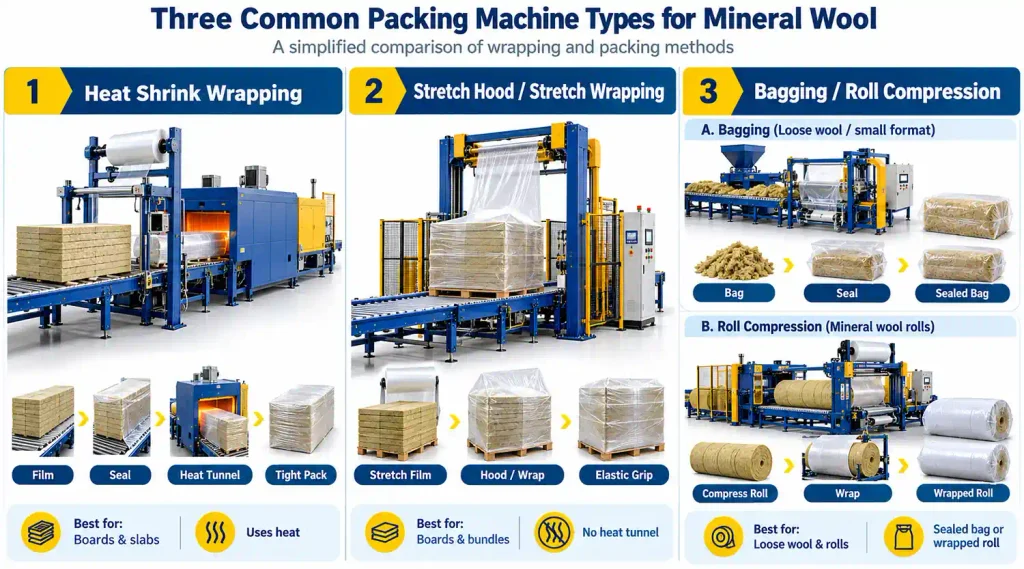
Most mineral wool packing machines fall into three families: heat shrink wrapping machines, stretch hood and stretch wrapping systems, and bagging or roll compression units. They differ in how the film is applied and tightened, which decides energy use, film consumption and the formats each can handle.
Heat Shrink Wrapping Machines
Heat shrink machines wrap the bundle in shrinkable film, seal it, and pass it through a heated tunnel where the film contracts. They are the traditional choice for rigid boards and slabs, giving a tight, uniform, printable pack. The drawbacks are energy use and a hot tunnel to maintain.
Stretch Hood and Stretch Wrapping Systems
Stretch hood systems form a tube of elastic film, stretch it, and pull it over the pack before sealing the ends, so the film’s own recovery tension holds the load without heat. Stretch wrapping winds film around the pack instead. Both use less film and energy than shrink lines and tolerate irregular shapes well, but they need film with the right elasticity.
Bagging and Roll Compression Units
Bagging units enclose the product in a pre-formed or formed-in-place bag. They suit loose wool, small formats and any product needing a sealed barrier rather than a tight wrap. Roll compression units serve a different format: rolls are compressed axially, held, then wrapped, so they keep a compact cylindrical shape.
How VFFS Machines Compare and Where They Fit
Vertical form fill seal machines work on a different logic: film is formed into a tube, filled from above, sealed and cut into individual bags. That principle suits powders, granules and other free-flowing goods. Large mineral wool boards and rolls are neither free-flowing nor drop-fillable, so VFFS equipment is rarely the primary packer on an insulation line.
| System | Working Principle | Best For | Main Limitation |
| Compression plus shrink | Compress, wrap, seal, shrink | Boards and slabs | Higher heat energy use |
| Stretch hood | Stretch tubular film over the pack | Boards and bundles | Requires correct film elasticity |
| Roll wrapping | Compress or roll, wrap, seal | Mineral wool rolls | Product-specific configuration |
| VFFS | Form bag, fill, seal, cut | Loose or free-flowing material | Not suitable for large boards or rolls |
Key Parameters That Determine Packing Quality and Cost
Four parameters drive most packing outcomes: the film grade and thickness, the compression ratio and its effect on thickness rebound, the pack dimensions relative to the machine envelope, and the cycle rate the machine has to sustain.
Film Material and Thickness
Thickness determines puncture resistance and load-bearing strength: a thin film saves material but tears on cut edges, while an over-thick film costs more and seals poorly if the sealing parameters are not matched to it. The properties that matter are tensile strength, elasticity, sealability and ultraviolet resistance for outdoor storage.
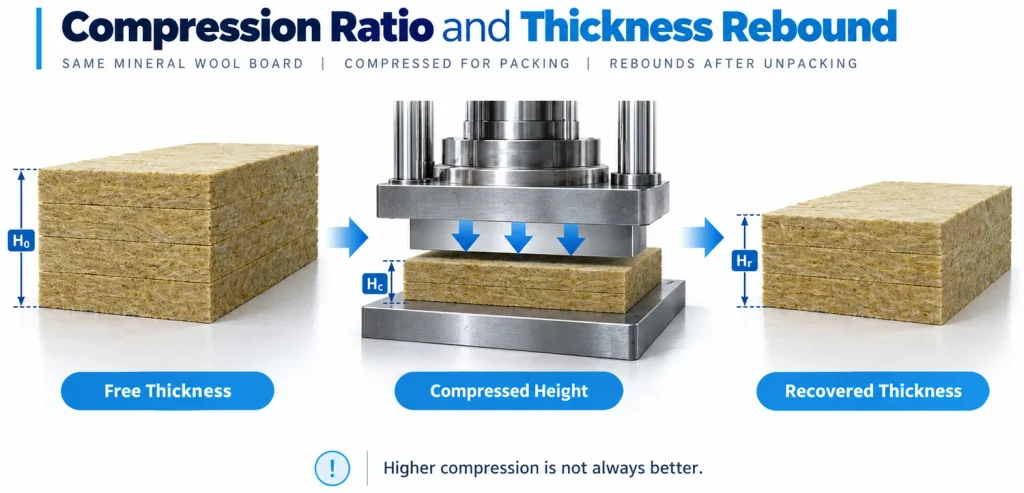
Compression Ratio and Thickness Rebound
A higher compression ratio is not automatically better. Three numbers have to be read together: the product’s free thickness, the compressed height the machine reaches, and the thickness the product recovers to after unpacking. Cured mineral wool recovers most of its thickness, but recovery slows under excessive pressure held too long. Buyers should ask for expected recovered thickness at the specified compression, and for the performance characteristics declared under EN 13162.
Matching Packaging to Product Format and End Use
One machine rarely suits every format. Boards and slabs need rigid, stackable packs; rolls need axial compression and cylindrical wrapping; bundles need grouping before wrapping; loose wool needs a sealed bag. End use matters as much: warehouse storage can take a lighter wrap, whereas export packs standing outdoors usually need heavier film, a full seal and often a secondary hood. These products are all described as mineral wool, whether made from rock or glass, but the specification should follow actual storage and transport conditions.
Common Packing Problems and How to Solve Them
Almost every packing fault traces back to one of six causes: film tension, sealing parameters, compression settings, product alignment, film condition or conveyor synchronization. Because these variables interact, a fault that looks like a film problem is often a compression or alignment problem upstream, and the same Rock Wool Production Line Problems appear across plants whatever the line capacity.
| Problem | Likely Cause | Corrective Action |
| Loose film | Incorrect film tension | Recalibrate tension settings |
| Poor seal | Wrong temperature or seal time | Optimize sealing parameters |
| Excessive rebound | Over-compression or long holding time | Adjust the compression cycle |
| Torn film | Sharp edges or film grade too thin | Check edge alignment and film specification |
| Uneven packs | Poor stacking or misaligned guides | Recalibrate guides and sensors |
| Line jams | Conveyor synchronization fault | Check sensors and cycle timing |
Stopping the machine mid-cycle to inspect the pack at each station shows whether the bundle was misaligned before it reached the film station.
Why the Packing Stage Deserves Attention
A packing machine for mineral wool is the point where a production line stops making material and starts making a saleable unit. Its settings decide pack volume, film and energy consumption, and how much labour the end of the line requires.
Packing performance is rarely improved by replacing the machine alone. Compression, film selection, sealing parameters and conveyor synchronization have to be tuned together, and the specification should follow the formats the plant actually ships.
FAQ
The questions below cover what usually surfaces after the machine type and cycle review: whether compression harms the product, whether temperature matters at the infeed, and what maintenance the machine demands.
Can compression during packing damage mineral wool?
Not if the cycle stays within the material’s elastic range. Cured mineral wool is designed to be compressed and to recover most of its thickness after unpacking. Damage occurs when pressure, compressed height or holding time exceeds what the binder structure tolerates, so recovery should be verified on samples.
Does mineral wool need to cool before packaging?
Yes. Product should be fully cured and cooled before it reaches the packer. If a pack is wrapped while still warm, the film can soften or seal inconsistently, and moisture trapped inside can affect the product in storage. Cooling normally happens between the oven and the cutting section.
How often does a mineral wool packing machine need maintenance?
Maintenance is driven by dust and heat more than by running hours. Sealing bars, cutting components, sensors, film rollers and conveyors should be checked on a defined schedule, and dust removal around the sealing and tunnel areas should be routine rather than corrective work.




