
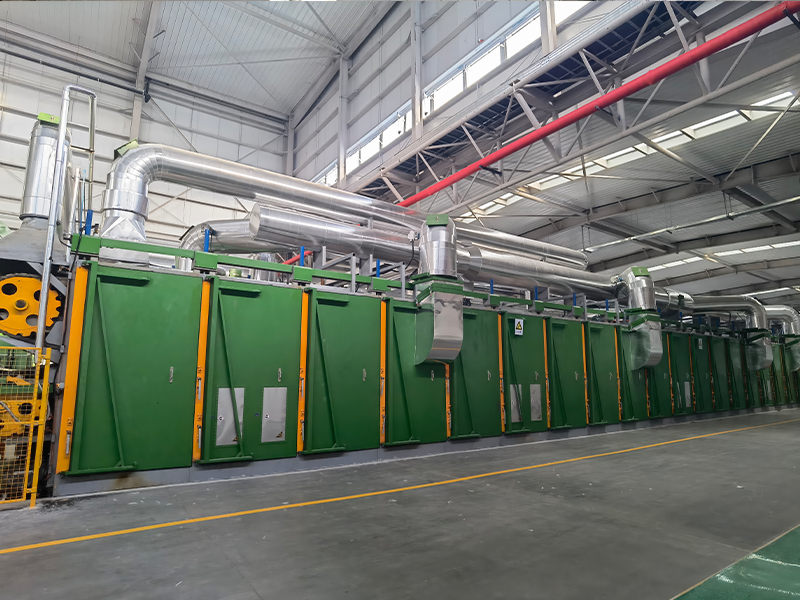
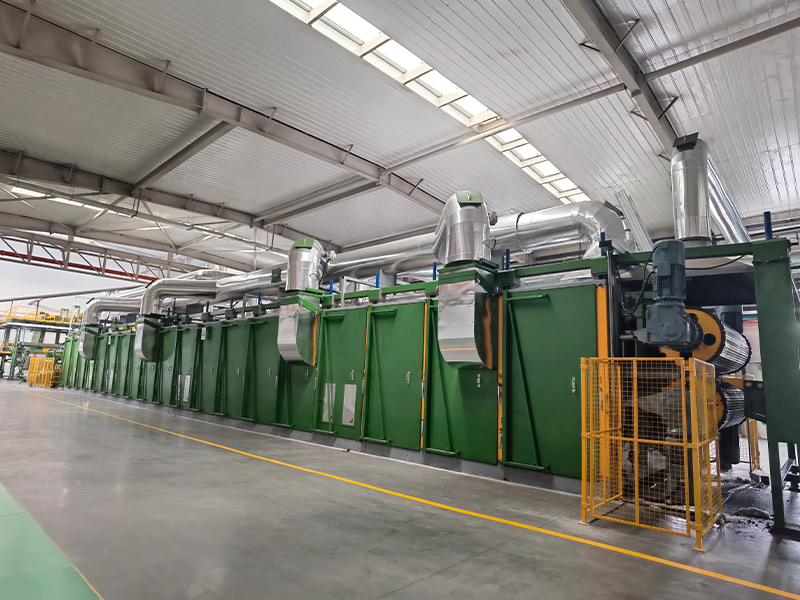
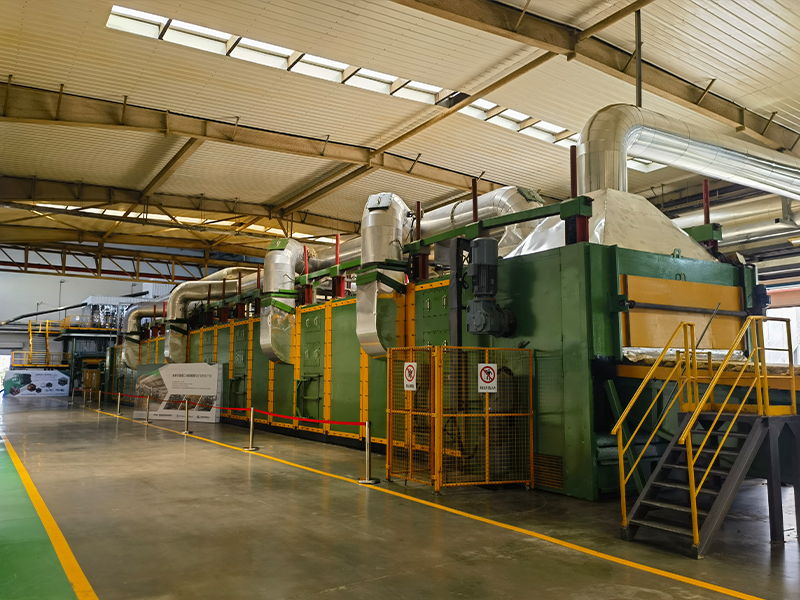
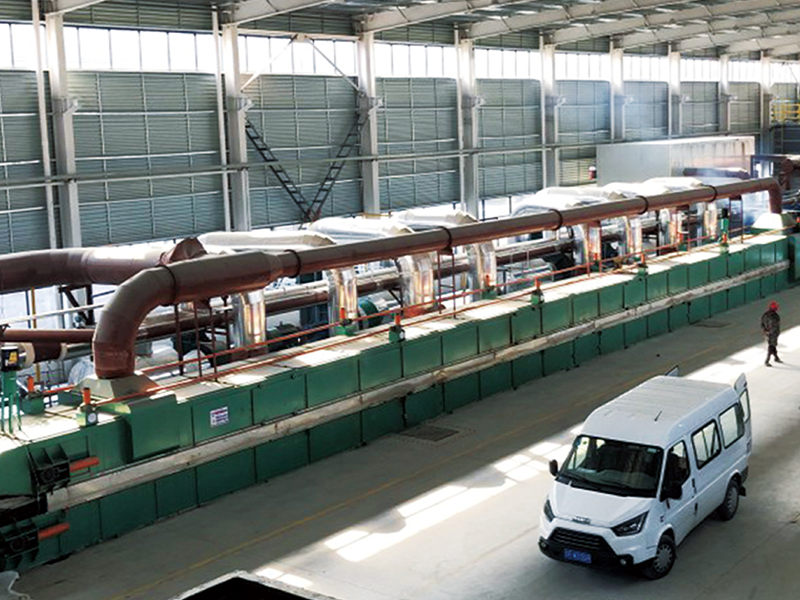
Introduction to the Rock Wool Curing Oven
The rock wool curing oven, an industrial curing oven, is an advanced solution designed for high-efficiency curing and polymerization processes in modern manufacturing. Leveraging cutting-edge hot air circulation technology, precise PLC-based automation, and optimized multi-stage curing, this system ensures superior product quality, energy efficiency, and operational stability. By integrating a dual-motor distributed drive and a high-efficiency thermal recycling system, the furnace provides a significant reduction in energy consumption while maintaining consistent curing results and high production capacity.
The Role of a Rock Wool Curing Oven in Manufacturing
A rock wool curing oven is an essential processing unit in a mineral wool production line, bridging fiber formation and downstream finishing. During this stage, the uncured fiber mat develops the structural integrity needed for subsequent handling and processing. Proper curing helps ensure that the material maintains its intended form as it moves through the manufacturing process, providing a foundation for consistent finished-product quality.
Key Specifications
| Category | Specification | Details |
|---|---|---|
| Production Capacity & Performance | Curing Stages | 4-stage thermal polymerization and curing process |
| Energy Efficiency | Waste heat recirculation utilization rate up to 75% | |
| Energy Consumption | Equivalent coke heat consumption 85–95 kg per ton | |
| Color Stability | Consistent and uniform color retention | |
| Surface Precision | High clarity for patterns, trademarks, and embossed letters | |
| Drive & Control Systems | Drive Configuration | Independent upper & lower distributed drives |
| Motor Setup | Dual-motor drive + planetary reducer + cross coupling | |
| Reducer Upgrade | Upgraded from P-series to K-series drive reducers for improved reliability | |
| Control System | Variable frequency PLC synchronization control with 100% adjustable sync rate | |
| Integrated Mechanical Design | Combines drive reducer, fixed coupling, and furnace body into a unified structure | |
| Hot Air Circulation System | Airflow Mechanism | Unique hot air box design + air isolation system |
| Forced Penetration Curing | High-pressure airflow ensures deep and uniform heat transfer | |
| Automatic Thermal Recycling | Intelligent circulation system maximizes reuse of waste heat | |
| Fan Configurations | Supports three optimized curing fan options: 55kW×2, 75×2, 75+55×2 |
Features of the Rock Wool Curing Oven
1. High-Efficiency Curing with Optimized Energy Consumption
The advanced curing oven integrates a multi-stage thermal curing process with precision-controlled hot air penetration. By achieving a 75% heat recovery rate, the system minimizes energy usage while ensuring consistent product density and curing performance.
The optimized heating process also helps maintain stable curing conditions throughout continuous production. As a key stone wool curing oven, it supports efficient binder polymerization while balancing thermal performance and energy consumption.
2. Intelligent Automation & Precise Synchronization
Equipped with a PLC-based frequency conversion control system, the stone wool curing oven achieves precise synchronization between the upper and lower chain plate drives. The dual-motor configuration ensures smooth operations, reduced mechanical stress, and enhanced production flexibility.
Automated drive coordination also helps maintain a stable conveying speed and consistent processing conditions. This enables the stone wool curing oven to adapt to different production requirements while improving operational reliability.
3. Advanced Hot Air Circulation & Heat Recovery
The unique hot air box design, combined with an advanced air isolation system, forces hot air to fully penetrate the curing zone. By recycling waste heat through an automatic circulation system, the furnace reduces operational costs and supports eco-friendly manufacturing.
Uniform airflow distribution helps improve heat transfer across the fiber mat, supporting consistent binder curing and finished-product quality. These features make the stone wool curing oven suitable for continuous industrial production where thermal efficiency and process stability are essential.
4. Optimized Mechanical Drive & Durability
Transitioning from synchronous belt drive to upper and lower independent distributed drives has improved efficiency and reduced maintenance. The integration of the reducer, coupling, and furnace body delivers superior structural stability, extending equipment lifespan.
The robust mechanical configuration also supports reliable conveyor movement under demanding operating conditions. Combined with routine maintenance and proper operating control, the system helps minimize unexpected downtime and maintain long-term production efficiency.
Applications of the Rock Wool Curing Oven
1. High-Density & High-Precision Product Manufacturing
The advanced curing oven is ideal for applications requiring precise thermal polymerization and consistent curing, including insulation boards, decorative panels, composite materials, and high-density engineered products.
As a core unit in a mineral wool production line, the mineral wool curing oven helps establish the structural integrity and dimensional stability required for downstream processing. Its curing process supports the manufacture of rigid and semi-rigid stone wool products, including building insulation boards, industrial batts, pipe insulation sections, and specialized high-density materials.
2. Energy-Saving & Environmentally Friendly Production
With its 75% waste heat recovery rate and reduced energy demands, the furnace supports green manufacturing while maintaining high throughput and consistent product quality.
For manufacturers operating continuous production lines, a well-integrated mineral wool curing oven helps balance thermal processing requirements with overall energy consumption. By supporting efficient binder curing and reducing avoidable heat losses, the equipment contributes to more resource-efficient mineral wool manufacturing. Appropriate exhaust treatment can also help manage emissions generated during the thermal polymerization process.
3. Upgrades & Modernization for Existing Plants
For manufacturers seeking to replace outdated industrial oven, the mineral wool curing oven provides a next-generation upgrade that combines automation, energy efficiency, and high-performance curing, ensuring compliance with modern environmental standards.
When upgrading an existing rock wool production line, manufacturers can evaluate a modern mineral wool curing oven to improve process consistency and integrate more advanced control systems. Depending on the existing line configuration, equipment modernization may also support the production of different product thicknesses and densities, including specialized stone wool products that require reliable binder bonding and dimensional stability.
FAQ
How does the Thermal Polymerization Furnace reduce energy consumption?
The furnace adopts an automatic hot air circulation system with an optimized waste heat recovery design, achieving up to 75% utilization of circulating hot air. This significantly reduces power consumption for fans and lowers overall thermal energy requirements, cutting operating costs by approximately 50% compared with traditional curing systems.
How many curing stages does the furnace support?
The Thermal Polymerization Furnace is designed with a 4-stage curing process:
Pre-heating stage — Controlled hot air gradually increases material temperature.
Primary curing stage — Forced hot air penetrates deeply into the material for initial polymerization.
Secondary curing stage — Stabilizes density and ensures uniform curing.
Final curing stage — Optimizes surface finish and color consistency.
This multi-stage process guarantees superior curing results, even for products with greater thickness and density.
What are the main advantages compared to conventional curing ovens?
- Higher Energy Efficiency → Up to 75% heat recovery rate
- Advanced Automation → PLC-controlled synchronous drive for precision
- Better Product Quality → Consistent color, stable density, and clear surface patterns
- Flexible Drive System → Independent upper & lower distributed drives
- Environmental Compliance → Lower emissions and optimized power usage

