
Specifying fibrous insulation usually comes down to two products that look nearly identical inside a wall cavity. Both arrive as batts, both carry R-value labels, and both are described as non-combustible. Yet prices differ sharply, and field performance diverges as soon as fire, moisture, or low-frequency noise enters the specification.
Rock wool insulation and fiberglass are different materials, not two versions of one product. Rock wool is spun from molten basalt and slag, which makes it two to four times denser, non-combustible above 1000°C, water repellent, and stronger at absorbing low-frequency sound. Fiberglass is spun from glass, which makes it lighter, cheaper, easier to fit into irregular cavities, and thermally comparable per inch in high-density grades. Rock wool wins on fire, moisture, and acoustics. Fiberglass wins on cost, weight, and installation speed.
The properties below show where that trade-off lands in a real specification.
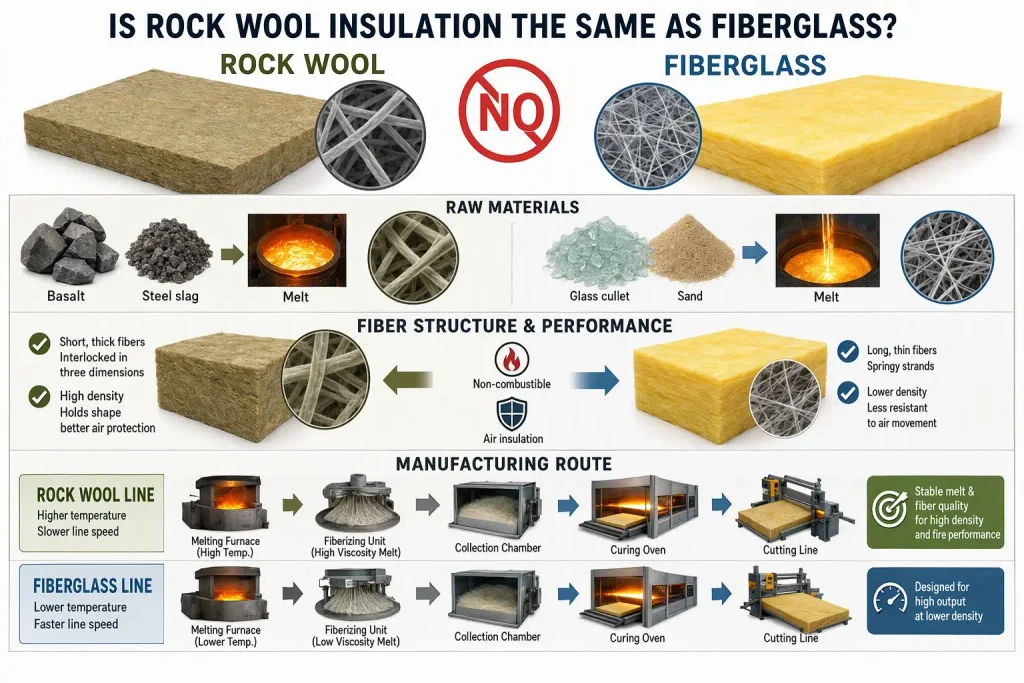
Is Rock Wool Insulation the Same as Fiberglass?
No. Both are man-made mineral fiber insulation, but rock wool is one member of the mineral wool family, alongside stone wool, while fiberglass is glass wool. They share a fibrous structure and a non-combustible fiber, but differ in raw material, density, and temperature limit.
Mineral wool is the umbrella term, and much of the confusion in tenders comes from treating the names as synonyms. The overlap between mineral wool and rock wool causes more specification disputes than any other term in this category, because a clause that says mineral wool without naming the sub-type can be satisfied by either product. Density and melting point belong in the text for that reason.
| Attribute | Rock wool | Fiberglass |
| Raw material | Basalt, slag | Recycled glass, sand |
| Melt temperature | 1400 to 1500°C | 1100 to 1250°C |
| Typical density | 40 to 200 kg/m³ | 10 to 50 kg/m³ |
| Fiber character | Short, interlocking | Long, fine, flexible |
| Common forms | Batts, boards, pipe sections | Batts, rolls, loose fill |
Raw Materials and Fiber Structure
Rock wool starts with basalt blended with steel slag. The viscous melt fiberizes into short, thick fibers that interlock in three dimensions, which is why a batt holds its shape without staples. Glass cullet and sand produce a thinner melt that draws into long, springy strands. Air insulates in both cases, but the denser mat protects that air more reliably.
Manufacturing Route and Why It Shapes Performance
Both materials pass through a melting furnace, a fiberizing unit, a collection chamber, a curing oven, and a cutting line. Rock wool lines run hotter furnaces and need centrifuges that handle a high-viscosity melt, while glass wool lines run cooler and faster. That difference is commercial, not cosmetic: a mineral wool production line that holds melt temperature and fiber quality stable decides whether a plant can supply the dense boards fire-rated assemblies require. Running rock wool on equipment sized for glass wool usually raises shot content and density variation.
Thermal Performance: R-Value and Thermal Conductivity
Per inch of thickness, rock wool holds a slight edge, typically R-3.0 to R-4.3 against R-2.9 to R-4.3 for fiberglass. Because high-density fiberglass reaches the top of that range, thermal performance alone rarely justifies the price premium. A 2×4 wall yields R-15 with rock wool and R-13 to R-15 with fiberglass.
| Property | Rock wool | Fiberglass |
| Thermal conductivity | 0.033 to 0.040 W/m·K | 0.030 to 0.044 W/m·K |
| R-value per inch | 3.0 to 4.3 | 2.9 to 4.3 |
| 2×4 cavity result | R-15 | R-13 to R-15 |
| Compression behavior | Recovers | Permanent loss |
Density explains the behavioral gap rather than the rated one. A denser batt suppresses convection inside the cavity, so the label value is more likely to be delivered. Fiberglass depends on trapped air, and a batt squeezed behind a pipe loses resistance the label still claims. Rock wool does not settle in a vertical cavity, while fiberglass can slump and leave a cold path at the top. Workmanship still dominates: gaps around headers and boxes cost more than the choice of material.
Fire Resistance and High-Temperature Behavior
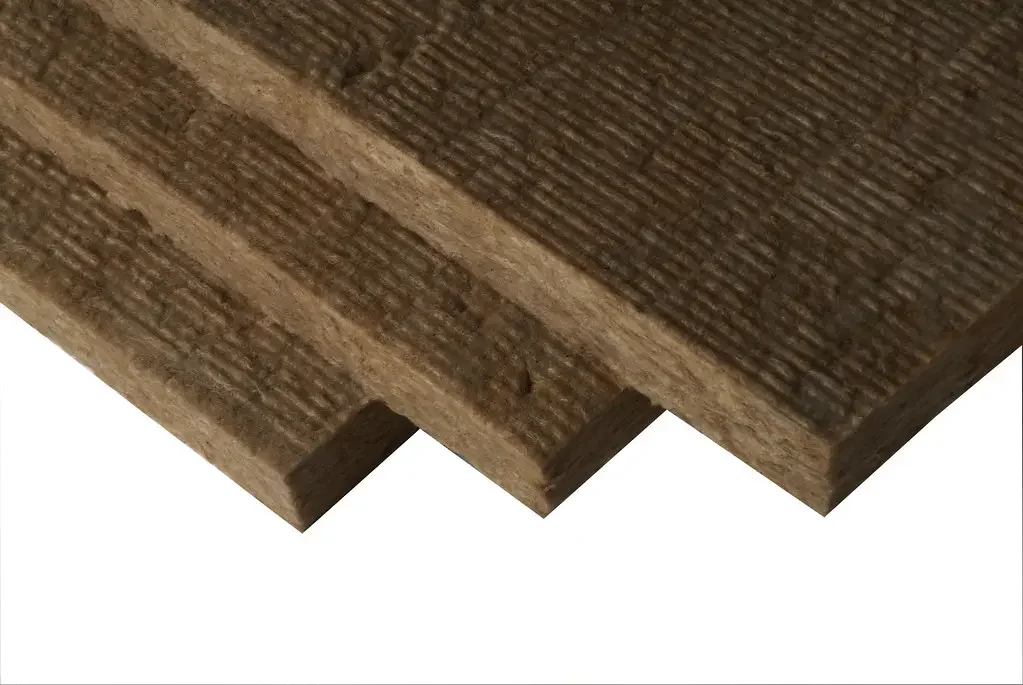
Rock wool stays intact well above 1000°C, while glass fibers soften near 700°C. In a compartment fire that margin decides whether the insulation keeps protecting the assembly or melts out of the cavity. Fire-rated separations and perimeter barriers are specified in rock wool almost without exception.
Both are inorganic and do not feed a fire. Mineral wool is non-combustible in fiber form and needs no halogenated flame retardants to qualify. The finished classification depends on binder content and facing, so read it from the product declaration rather than assuming it from the material name. Around flues, chimneys, and recessed light fixtures, rock wool holds its position and shape. In curtain wall perimeter joints it compresses into the gap and stays through the fire, which is the detail where a lower softening point becomes a real liability.
Moisture Behavior, Mold Risk and Durability
Rock wool repels water, drains rather than wicks, and returns to rated performance after drying. Fiberglass holds water in its air spaces, and a wet, compressed batt may never recover its original thickness. In damp conditions moisture behavior matters more than the R-value difference.
Water-repellent additives applied during fiberization make rock wool shed liquid water instead of drawing it in by capillary action. A saturated batt drains and dries, and because it contains no organic nutrient it does not support mold or vermin. Fiberglass loses thermal resistance the moment water displaces air, and the loss becomes permanent once the batt is compressed or contaminated by dust carried in with the water. Neither material replaces an air and vapor control layer.
Sound Absorption and Acoustic Performance
At equal thickness, rock wool absorbs more sound, particularly at low frequency, because higher density and airflow resistivity convert more acoustic energy into heat. Noise reduction coefficients run about 0.90 to 1.05 for rock wool against 0.70 to 0.95 for fiberglass.
The advantage is real but frequently oversold. Absorption inside a cavity and transmission loss between rooms are different metrics. Filling an empty partition lifts transmission loss by five to eight points whichever material is used, which is the cheapest acoustic gain available, and swapping materials on top of that adds very little. Rock wool separates itself on bass and mechanical hum, where greater mass and resistivity attenuate longer wavelengths. For reverberation, neither product helps, because insulation behind drywall does not change how a room sounds.
Cost Comparison: Which One Costs More?
Rock wool costs more, typically 25 to 100 percent more per square meter at the material level, with installed cost landing at roughly 1.5 to 1.8 times that of fiberglass.
Material Cost Versus Installed Cost
The labor penalty is smaller than the material penalty, and logistics widen the gap: a container carries far fewer square meters of dense board than of compressed batts, so freight per installed square meter rises even when the ex-works price looks comparable. Rigid product also generates more offcut around penetrations, and cut edges cannot be stuffed into gaps the way a flexible batt can. Where rock wool removes a separate fire-stopping detail or allows a thinner wall to reach the same acoustic target, the premium is absorbed elsewhere.
Disadvantages and Handling Challenges
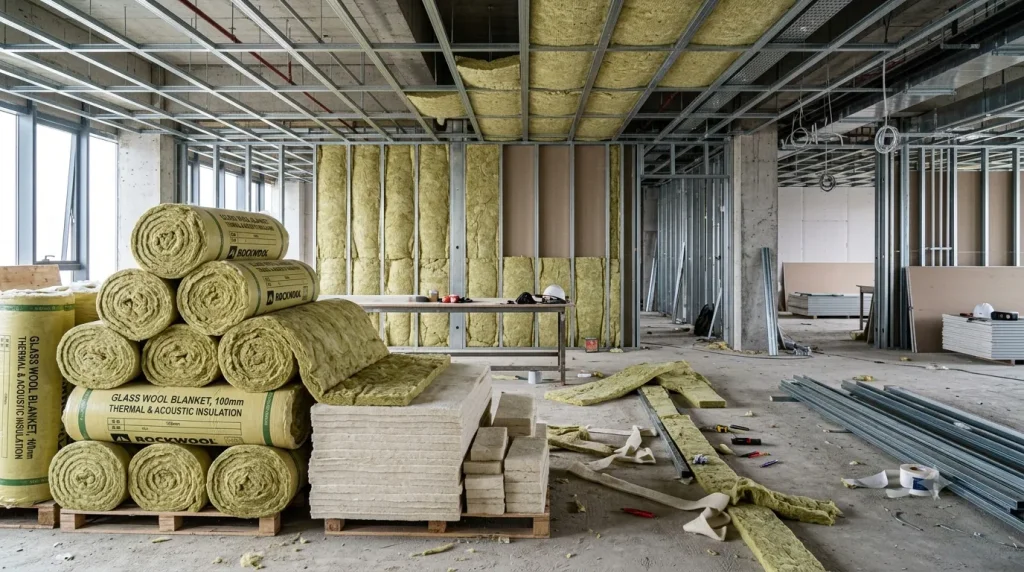
Both materials carry real drawbacks, and the drawbacks are of different types. Rock wool is heavier, costlier, and resists conforming to awkward geometry. Fiberglass irritates skin more, compresses easily, and loses performance when wet.
Drawbacks of Rock Wool Insulation
- Higher purchase price, and the premium is worst on small orders
- Noticeably heavier, which slows work overhead or in confined spaces
- Rigid structure will not follow out-of-square framing or curved surfaces
- Requires a serrated blade, and cutting generates dust and skin irritation
These handling complaints affect installed quality, which matters more than the datasheet. An installer against a time budget may leave small gaps rather than cut a precise board. A fuller review of the trade-offs appears in this analysis of the disadvantages of mineral wool.
Drawbacks of Fiberglass Insulation
- Finer fibers cause more itching and skin irritation
- Compresses permanently, and every compressed section loses R-value
- Retains water with no reliable recovery of thermal performance
- Lower softening point limits use in fire-rated assemblies
- Settles in vertical cavities and can leave a cold path at the top
Which One Should You Choose?
Neither material is universally better. Rock wool is the right choice where a fire rating, acoustic separation, or sustained moisture exposure governs the design. Fiberglass is the right choice where a code-minimum R-value at the lowest installed cost is the goal, or where framing is irregular and weight matters.
| Application | Material | Reason |
| Low-rise housing walls | Fiberglass | Lowest cost per delivered R |
| Party walls, mechanical rooms | Rock wool | Five to eight STC points higher |
| Fire-rated and high-rise work | Rock wool | Non-combustible above 1000°C |
| Perimeter fire barriers | Rock wool | Compresses into the joint |
| Industrial high temperature | Rock wool | Service temperature limit |
| Attics to high R-value | Fiberglass | Cheapest loose fill route |
Decide in three steps. Fix the fire and acoustic requirements first, because they eliminate one material outright in many cases. Set the acoustic target second and confirm whether cavity fill alone reaches it. Compare cost last, on installed square meters including freight, waste, and labor. Then lock density and reaction-to-fire class into the purchase order, since both materials ship in several densities under one family name.

FAQ
Does Rock Wool Insulation Contain Asbestos?
No. Rock wool is made from basalt, dolomite, and slag, while asbestos is a naturally occurring silicate mineral with a different crystal structure. Modern products have not contained asbestos for decades. Cutting dust is still a respiratory irritant, and handling guidance from the Insulation Institute covers the protective equipment expected on site.
What Happens if Rock Wool Insulation Gets Wet?
The batt takes on limited surface water, drains the rest, and dries without permanent loss of thermal resistance, provided it dries freely and is not compressed while saturated. This is why rock wool is often specified in below-grade details where construction moisture is expected. Fiberglass in the same situation holds water in its air spaces and can lose R-value for good.
Can Rock Wool and Fiberglass Be Used in the Same Assembly?
Yes, and the combination is sometimes deliberate: rock wool in the fire-rated or acoustically critical portion of a wall and fiberglass in the remaining field, or rock wool at the perimeter barrier and fiberglass above it. The two are chemically compatible and can be installed in contact, as long as each section still meets the density and classification its own detail calls for.




