
Noise complaints in buildings usually trace back to one weak point: an empty cavity behind a partition, floor or ceiling. Rockwool is the material most often specified to close that gap, yet density is chosen by habit rather than measurement, so projects end up underperforming or over-specified.
Yes, rockwool is genuinely good for soundproofing, and for most building applications the right density falls between 60 and 100 kg/m³ with a thickness that fills the full cavity depth. Density above roughly 100 kg/m³ rarely helps, and in thin partitions it can make things worse by turning the insulation into a rigid path for vibration.
The reasoning behind that range matters more than the number, so the sections below work through the physics and the assembly details.

How Rockwool Turns Sound Into Heat
Rockwool absorbs sound by forcing air to oscillate through a dense, randomly oriented fiber matrix, where viscous friction against millions of fine fibers converts acoustic energy into a negligible amount of heat.
Rockwool belongs to the mineral wool family, fibrous materials spun from molten rock and slag. It is roughly 95 percent air, so sound is not blocked at the surface but penetrates and loses energy as air particles drag across fibers. The governing property is flow resistivity, with acoustic grades typically between 8,000 and 40,000 Pa·s/m²: below that window sound passes almost untouched, above it the surface turns reflective.
Absorption and insulation are different jobs, and specification documents routinely confuse them: one reduces reflections inside a room, the other reduces transmission into the next room.
| Metric | What it measures | Test standard |
| NRC | Sound energy absorbed at a surface | ASTM C423 |
| αw | Absorption expressed as Class A to E | ISO 11654 |
| STC | Airborne sound blocked by an assembly | ASTM E90 and E413 |
| Rw | ISO equivalent of STC | ISO 717-1 |
Why Density Alone Does Not Explain Performance
Density is a proxy for flow resistivity, not a measure of acoustic quality. Two slabs at an identical 80 kg/m³ can differ measurably if fiber diameter or shot content differ, and a slab forced into a shallow cavity loses porosity at the face, where incoming sound first meets it. A closer look at how rock wool insulation works confirms that fiber fineness matters as much as mass.
What Density Is Rockwool Sound Insulation?
Acoustic grades run from about 40 to 140 kg/m³, and the practical band for sound absorption in walls, floors and ceilings is 60 to 100 kg/m³. Lighter material is thermal insulation, heavier material a fire-duty product.
| Density band | Behavior in a cavity | Typical acoustic use |
| 30 to 50 kg/m³ | Soft, strong high frequency absorption, weak low frequency control | Thermal walls where acoustics is secondary |
| 60 to 80 kg/m³ | Semi-rigid, balanced flow resistivity, Class A from 50 mm | Stud partitions, ceilings, floating floors |
| 90 to 120 kg/m³ | Stiff, high low frequency absorption, self-supporting | Plant rooms, studios, mechanical enclosures |
| 130 kg/m³ and above | Rigid board, approaches a solid body | Fire-rated shafts, acoustic doors, equipment bases |
The Counterintuitive Case Against Very High Density
Harder does not mean quieter once the material stops behaving like a spring. In a mass-spring-mass partition, insulation damps the resonance of the air cavity between two leaves, and a slab rigid enough to touch both leaves becomes a sound bridge. This is why 40 to 60 kg/m³ material often measures better than 100 kg/m³ material in a narrow double-leaf wall, and why over-specification loads ceiling fixings without buying silence.
Where Density Consistency Comes From
A specified density is a target, and the data sheet figure describes a batch average. The mechanics of rock wool density and uniformity are settled upstream of the cutting line, and performance depends on even mass distribution through the thickness, since one thin area limits the whole assembly.
What Is the Best Thickness for Sound Deadening?
Thickness sets the lowest frequency a rockwool layer can absorb, and for most partitions a 50 to 100 mm layer that fills the cavity is the efficient choice. Adding thickness beyond the cavity depth gives very little, while leaving a gap behind the slab costs more than any density upgrade can recover.
A porous absorber becomes efficient at frequencies whose quarter wavelength is comparable to its thickness. At 100 mm, full absorption typically reaches down to roughly 500 to 800 Hz, covering speech and most office noise; lower frequencies need more depth or an air gap behind the material.
| Thickness | Approximate NRC at 60 to 80 kg/m³ | Effective range |
| 25 mm | 0.70 to 0.80 | Speech and high frequency only |
| 50 mm | 0.90 to 0.95 | Speech, television, general building noise |
| 100 mm | 1.00 to 1.05 | Broadband with usable low mid performance |
| 150 mm and above | 1.05 and above | Low frequency content, studios, plant rooms |
Values above 1.00 are normal rather than an error, arising from edge diffraction and from test methods that average coefficients across a band.
Matching Thickness to Cavity Depth
Fill the cavity, do not compress the material, and do not leave a pocket behind the slab. Use friction fitted slabs at full cavity depth rather than two thin layers, which introduce a reflective interface, and in deep voids a 100 mm layer against one face with the rest of the air space open usually beats filling the whole void.

Is 0.95 NRC Good?
Yes. An NRC of 0.95 is an excellent result and places the product in absorption Class A, the highest band used in building acoustics. The surface absorbs about 95 percent of the sound energy reaching it and reflects almost nothing back.
NRC is the Noise Reduction Coefficient, the average of absorption coefficients at 250, 500, 1000 and 2000 Hz, rounded to the nearest 0.05. Because it is a four-band average it says nothing about 125 Hz, where traffic rumble, plant and bass energy live, so a 0.95 product can still fail beside a plant room.
European specifications instead use αw under ISO 11654, a shifted reference curve across 250 to 4000 Hz that assigns Class A to E, with Class A requiring 0.90 or higher.
Which Rockwool Product Works Best for Soundproofing?
For cavity soundproofing, semi-rigid slabs in the 60 to 100 kg/m³ range outperform both light batts and very dense boards, because they hold their shape, fill the cavity evenly and still damp resonance instead of bridging it.
| Application | Density | Product form |
| Internal stud partition | 60 to 80 kg/m³ | Semi-rigid slab, full cavity depth |
| Suspended ceiling void | 60 to 80 kg/m³ | Slab or batt, 50 to 100 mm |
| Floating floor | 80 to 120 kg/m³ | Rigid board, 25 to 50 mm |
| Plant room enclosure | 100 to 140 kg/m³ | High density board, 50 to 100 mm |
| Duct and riser lining | 60 to 100 kg/m³ | Faced slab, 25 to 50 mm |
Facing is an acoustic decision. Foil reflects mid and high frequency energy and suits thermal or hygiene duties, while unfaced material absorbs best but needs a permeable covering.
How Good Is Rockwool in a Real Wall Assembly?
In a typical timber stud partition, filling the cavity with rockwool raises sound insulation by roughly 8 to 10 dB over an empty cavity, but only when the leaves are decoupled, the perimeter is sealed and the board mass is adequate. Insulation is one of four mechanisms, not the whole system.
The four are mass, decoupling, absorption and sealing, and rockwool supplies the third: if a partition is rigidly tied or sound travels around it, cavity fill cannot compensate.
| Wall build-up, 100 mm stud with one board each side | Approximate STC |
| Empty cavity | 33 to 35 |
| Light glass wool in cavity | 38 to 40 |
| Rockwool at 60 kg/m³, full fill | 43 to 45 |
| Rockwool plus resilient channels | 50 to 53 |
Where Rockwool Stops Helping
Three failures recur in commissioning. Rigid bridging, where board or a service bracket connects the two leaves. Perimeter leaks behind skirting, at the head track or around socket boxes. Low frequency dominance, where the source sits below 125 Hz and the assembly lacks the mass to address it at all.
A Practical Density Selection Process
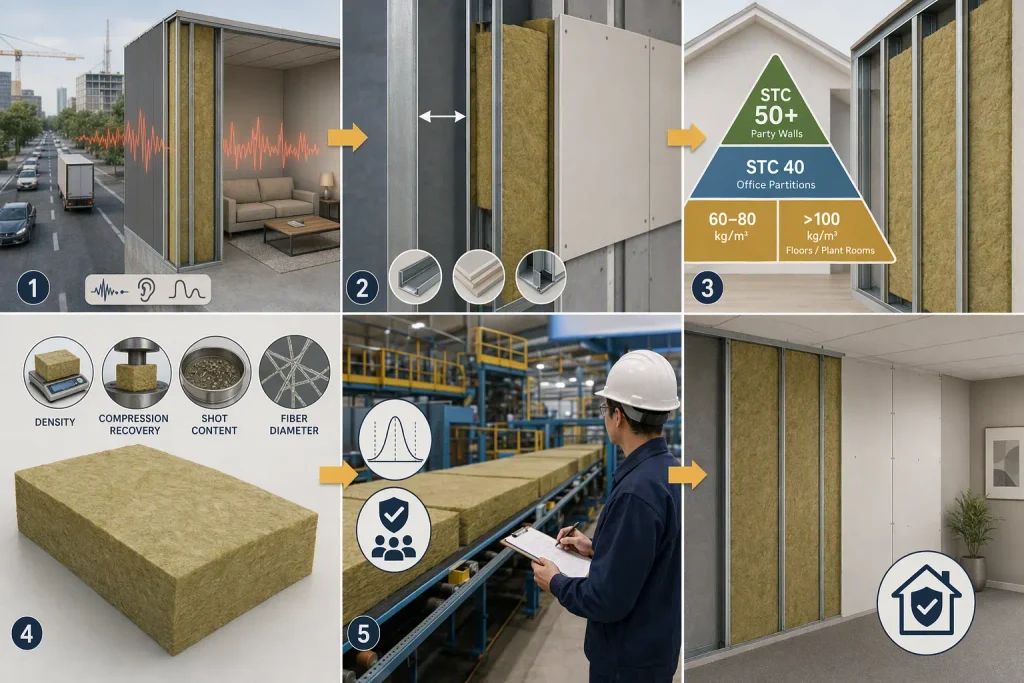
Work backwards from the noise source and the assembly: identify the dominant frequency band, fix the available cavity depth, then choose the lowest density that meets the absorption target without compressing the material. Raising density is the last lever to pull, not the first.
- Characterize the noise. Speech sits at 500 to 2000 Hz, while traffic and plant carry energy below 250 Hz and need depth and mass rather than absorption.
- Fix the construction. Cavity depth, stud type, board layers and resilient channels decide the achievable STC before insulation is specified.
- Set the target. Party walls commonly aim for STC 50 or higher, office partitions for 40, and density follows from that target: 60 to 80 kg/m³ with full cavity fill as the default, above 100 kg/m³ only for floors and plant rooms.
- Verify the supply. Check density tolerance, compression recovery, shot content and fiber diameter, since these decide whether the delivered product matches the tested one.
For buyers sourcing at volume, holding density within a narrow tolerance across a run is a better quality signal than one test report, so ask how uniformity is controlled on a full rock wool production line, not only at the sample stage.
FAQ
The three questions below cover what buyers ask most often after the density and thickness ranges above have been narrowed down.
Can rockwool be too dense for soundproofing?
Yes. Once a slab is rigid enough to transfer vibration between the two leaves of a partition, it acts as a sound bridge and the cavity loses its decoupling effect. In thin double-leaf walls, 40 to 60 kg/m³ material frequently measures better than 100 kg/m³ of the same thickness.
Does rockwool work for low frequency noise such as traffic or bass?
Only partly. Porous absorbers lose effectiveness as wavelength grows, so a 100 mm layer is limited below about 200 Hz. Low frequency problems need added mass, structural decoupling and greater cavity depth.
Does higher density rockwool improve fire and moisture performance?
Density matters less than fiber chemistry and binder type, which determine non-combustibility and water repellency. A 60 kg/m³ product can carry the same Euroclass A1 rating as a 120 kg/m³ one, and hydrophobic treatment matters far more than density.




