
Rock wool — sometimes called stone wool — has quietly become one of the most relied-upon insulation materials in modern construction and heavy industry. As global demand for energy-efficient, fire-safe buildings intensifies, manufacturers are scaling up capacity at a remarkable pace. The broader insulation market, valued at roughly $74 billion in 2025, is projected to surpass $127 billion by 2033, with stone wool accounting for a meaningful and growing slice of that expansion.
At the heart of this momentum sits the rock wool production line: an integrated system of furnaces, spinners, curing ovens, and cutting equipment that transforms raw volcanic rock into lightweight, high-performance insulation. But what actually happens inside these facilities? And what should manufacturers know before committing capital to one? This guide walks through the entire process — from raw material to finished board — with practical attention to the technical details that matter most.

Understanding the Rock Wool Production Line
What Exactly Is Rock Wool?
Rock wool is a fibrous insulation material made primarily from natural volcanic rock, most commonly basalt. The stone is melted at extreme temperatures and then spun into fine fibers, which are bound together with a thermosetting resin and cured into rigid boards, flexible blankets, or precision-cut pipe sections.
What sets it apart from other insulation types is an unusual combination of properties. It is non-combustible (Euroclass A1 rated), thermally efficient, naturally sound-absorbing, and resistant to moisture, fungi, and microbial growth. Rock wool is occasionally confused with slag wool — a related material derived from metallurgical slag rather than natural stone — but the two differ in raw material origin and, to some extent, in performance behavior under certain thermal and chemical conditions.
What Does the Production Line Do?
Put simply, a rock wool production line is a continuous manufacturing system that handles every stage between raw rock intake and finished, packaged insulation. It typically encompasses raw material handling and batching, a melting furnace, fiberizing equipment, a curing oven, cutting machinery, and automated packaging stations — all coordinated through a central PLC control system.
Modern lines are engineered for high throughput (often 10,000 to 50,000 tons per year) and tight quality control, making them suitable for both large-scale industrial operations and specialized, lower-volume product configurations.
Raw Materials That Feed the Process

The quality of rock wool begins with the rocks themselves. The primary ingredient is basalt, a dense volcanic rock rich in silica and alumina. This is blended with mineral additives — dolomite or limestone — to adjust melting behavior and viscosity, along with recycled slag and coke, which serves as fuel in cupola furnaces.
According to Eurima, the European Insulation Manufacturers Association, an increasing share of raw material input now comes from recycled sources, including internal production off-cuts and post-consumer demolition waste. This shift not only reduces energy consumption but also lessens dependence on virgin mining — a trend that aligns with broader circular economy goals across the building materials sector.
Table 1: Rock Wool Raw Material Composition and Functions
| Material | Typical Share | Primary Function |
|---|---|---|
| Basalt | 60–80% | Main silicate structure for fiber formation |
| Dolomite / Limestone | 10–20% | Adjusts melt viscosity and chemical balance |
| Recycled slag | 5–15% | Reduces virgin material use; lowers energy demand |
| Coke | 5–10% | Fuel source for cupola furnace combustion |
The chemical composition must fall within a fairly narrow window — SiO₂ at 38–45%, Al₂O₃ at 12–18%, CaO + MgO at 20–30%, and Fe₂O₃ at 5–10% — because even small deviations can throw off fiber viscosity and, consequently, the structural integrity of the final product.
Step-by-Step: How a Rock Wool Production Line Works
This is where things get technically interesting. The production sequence may look linear on paper, but in practice each stage feeds into the next with little room for correction once the material is in motion.
1. Raw Material Preparation and Batching
Before anything enters the furnace, raw materials are crushed and screened to a uniform particle size of roughly 10–50 mm. A PLC-controlled weighing and batching system then proportions each component with considerable precision. Storage silos for different materials feed automated belt weighers, ensuring the chemical composition of every batch stays within specification. Accurate batching matters more than it might seem — slight variations in the mix can ripple through the entire downstream process.
2. Melting in the Furnace
This is the most energy-intensive stage of the entire line. Two furnace types dominate the industry: the traditional cupola furnace and the electric melting furnace.
Table 2: Cupola Furnace vs. Electric Melting Furnace
| Parameter | Cupola Furnace | Electric Furnace |
|---|---|---|
| Operating temperature | 1,450–1,550°C | 1,500–1,600°C |
| Melting capacity | 6–30 t/h | 5–20 t/h |
| Energy source | Coke combustion | Electricity (600–900 kWh/t) |
| Emissions profile | Higher CO₂; requires flue gas cleaning | Lower direct emissions; cleaner melt chemistry |
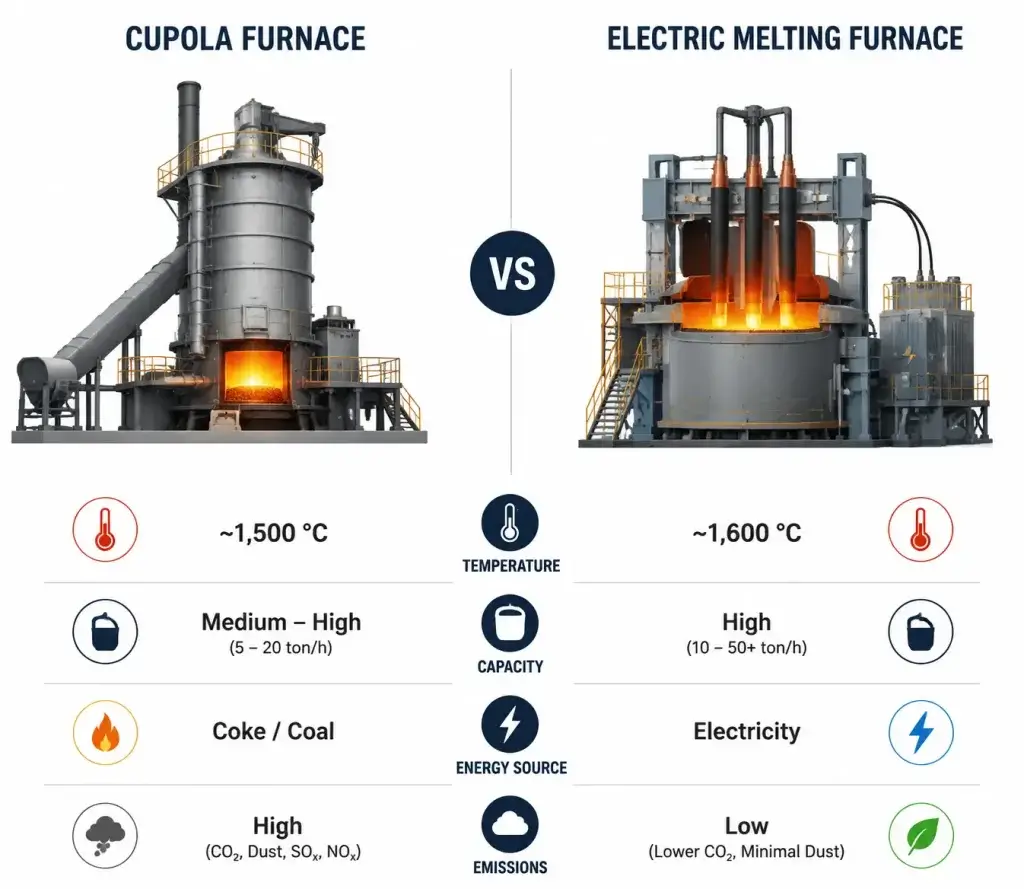
Cupola furnaces remain popular for their throughput and relatively simple construction, though electric melters are gaining ground where emissions regulations are stricter or where renewable electricity is affordable. In both cases, melt temperature stability is critical — fluctuations here lead directly to inconsistent fiber formation downstream, and that translates into product rejects.
3. Fiberization — Turning Rock into Wool
Once the rock is fully molten, it flows onto high-speed spinning wheels (typically rotating at 3,500–4,500 rpm). Centrifugal force flings the melt outward, stretching it into fibers just 4–7 micrometers in diameter. High-velocity air streams further attenuate the fibers and guide them toward a collection chamber.
During this stage, a binder solution — usually phenolic resin mixed with curing agents, mineral oil (for dust suppression), and water — is sprayed onto the forming fibers. Binder content typically lands between 2% and 4% of the final product weight, which is enough to hold the mat together structurally without compromising fire performance.

4. Curing, Cutting, and Packaging
The collected fiber mat passes through a pendulum distribution system that oscillates laterally, ensuring uniform density across the full width of the board. It then enters the curing oven — a long chamber, usually 20–35 meters in length, operating at 200–250°C — where hot air circulates through the mat, polymerizing the binder and locking in structural strength. Adjustable upper and lower belts maintain thickness to within about ±1 mm, which is tighter than many competing insulation manufacturing processes.
After curing, the continuous slab is cut to size using cross-cutting saws, longitudinal slitters, and edge trimmers. Standard product dimensions range from 30 to 200 mm in thickness and 600 to 1,200 mm in width. Finally, an automated stacking and compression packaging system shrinks the product volume — compression ratios can reach 1:3 — which substantially cuts transportation and warehousing costs.
Key Properties and Applications of Rock Wool Products
The end products of a stone wool manufacturing line are valued for a distinctive and somewhat hard-to-replicate set of performance characteristics.
Table 3: Key Performance Parameters of Rock Wool Insulation
| Property | Typical Range | Significance |
|---|---|---|
| Thermal conductivity | 0.033–0.040 W/m·K | Lower values mean better insulation per unit thickness |
| Fire resistance | Up to 1,000°C | Euroclass A1 — fully non-combustible |
| Density | 40–200 kg/m³ | Adjustable for structural, thermal, or acoustic needs |
| Thickness tolerance | ±1 mm | Ensures consistent fit during installation |
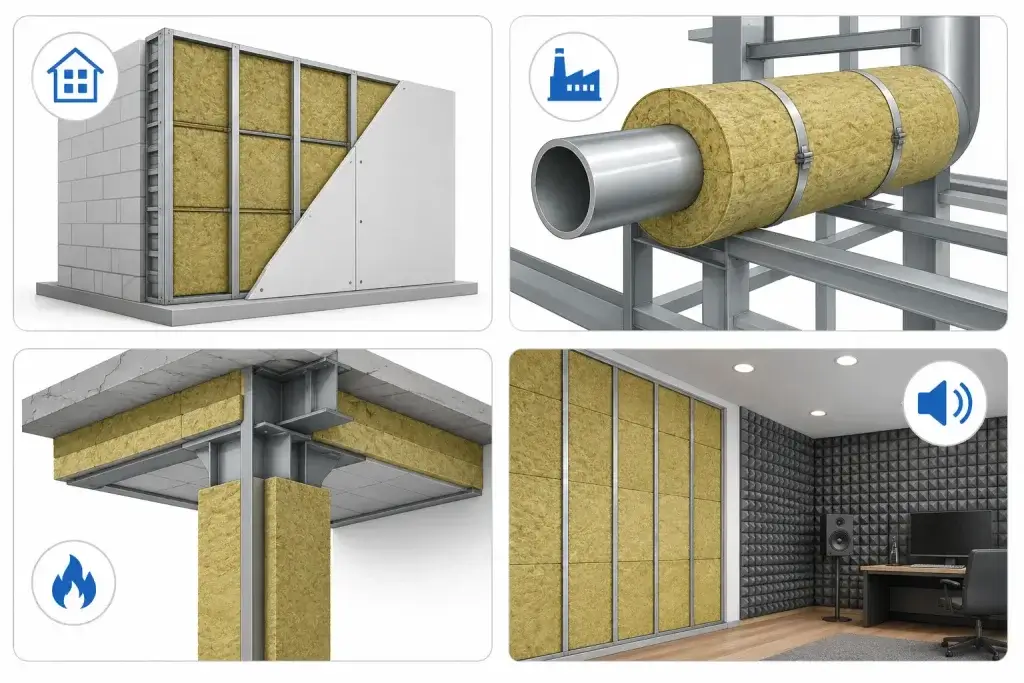
These properties translate into a broad and varied application spectrum:
- Building insulation — exterior walls, roofing systems, and internal partitions where both thermal and acoustic performance matter
- Industrial insulation — high-temperature equipment, boilers, storage tanks, and process piping
- Fire protection — fire-rated doors, compartment walls, and structural steel fireproofing systems
- Acoustic treatment — recording studios, auditoriums, and mechanical rooms where sound absorption is a priority
The ability to calibrate density and thickness during production means that a single well-configured line can serve multiple end-use markets with relatively minimal reconfiguration.
Sustainability and Industry Trends
Environmental pressures are reshaping how stone wool lines operate, and the pace of change has accelerated noticeably over the past few years. Recycling has become a central theme — not just of production waste but of post-consumer material recovered from renovation and demolition sites. Some manufacturers now incorporate recycled briquettes directly into the melt.
A particularly promising development is the double-density layered manufacturing technique, which can reportedly save up to 44% in raw materials and energy compared to conventional single-density products. Electric melting technology, though still more expensive upfront, is gradually displacing coke-fired cupolas in regions where decarbonization mandates are tightening and renewable power is accessible.
Beyond the factory floor, macro-level forces are working in the industry’s favor. Stricter building energy codes across Europe, North America, and parts of Asia are driving demand for high-performance insulation. And because rock wool’s embodied energy is recovered many times over through the energy it saves in use — a ratio often cited as exceeding 100:1 over a building’s lifetime — the material’s lifecycle economics remain compelling even as production costs fluctuate.
How to Choose a Rock Wool Production Line
Selection usually depends on more than budget, although budget always comes back into the discussion sooner or later.
A buyer should normally look at:
- planned annual capacity
- product type (boards, blankets, pipe sections, etc.)
- target density range
- furnace type
- automation level
- energy consumption
- dust and emission control
- available plant area
- after-sales support and spare parts
Line composition, equipment selection, delivery conditions, and cost are typically considered case by case, based on output goals, raw material availability, quality requirements, and other production factors.
In other words, there is no one “standard best” line for every factory. There is only a line that fits the intended production model well enough.
Plant Layout and Space Considerations
This part gets postponed in many early discussions, though it should not. Space planning has a way of turning from a background issue into a serious one once installation starts.
Auxiliary areas such as dust removal equipment, filter rooms, and cooling pools may require substantial space in addition to the main production area, raw material storage, and finished goods warehousing. The same source gives example planning figures of about 2000 m2 for auxiliary rooms, 3000 m2 for main production equipment, 4000 m2 for raw material storage, and around 5000 m2 for finished-product storage.
That does not mean every project should follow those exact numbers. It does suggest, though, that layout planning should start early and not be treated as a minor afterthought.
Benefits of Rock Wool Products
The reason this entire process exists, with all its heat and equipment and complexity, is that the finished product does useful things rather well.
Main advantages of rock wool include:
- Fire resistance – because it is made from stone-based raw materials, it performs well under high temperatures.
- Thermal insulation – the fibrous structure helps reduce heat transfer.
- Sound absorption – helpful in both buildings and industrial settings.
- Durability – the material is dimensionally stable and resistant to decay.
- Process adaptability – the same general line concept can support different product forms.
That combination is a big reason why rock wool insulation production equipment remains relevant even as the wider insulation market keeps evolving.
Conclusion
A rock wool production line is, at its core, a remarkable exercise in controlled transformation — taking one of the earth’s most abundant rocks and converting it into a material that protects buildings from fire, conserves energy across decades, and absorbs unwanted sound. As sustainability standards tighten and global construction demand continues to climb, understanding the technical architecture of these lines becomes increasingly valuable for manufacturers, investors, and specifiers alike. For those ready to explore automated production solutions in greater depth, the next step is closer than it might appear.
Frequently Asked Questions
How does a rock wool production line differ from a glass wool manufacturing setup?
Although both fall under the mineral wool umbrella, the two processes diverge at the raw material stage. Glass wool is made from sand, soda ash, and recycled cullet (which can constitute up to 85% of input), melted at roughly 1,200–1,400°C. Stone wool, by contrast, requires harder volcanic rock melted at significantly higher temperatures (1,450–1,600°C), which demands more robust furnace infrastructure and higher energy input. The fiberization methods also differ — glass wool typically uses rotary spinners operating at lower speed ranges, while stone wool relies on heavier-duty multi-roller centrifugal spinners designed to handle more viscous melt.
What is the typical lifespan of rock wool insulation produced on these lines?
Rock wool insulation is chemically inert and dimensionally stable, meaning it does not slump, rot, or degrade under normal service conditions. In building applications, its functional lifespan generally matches that of the building itself — often 50 years or more. The material’s resistance to moisture absorption, microbial growth, and repeated temperature cycling means that, unlike some organic insulants, it retains its declared thermal performance over decades without measurable drift.
Can existing rock wool production lines be upgraded to handle higher proportions of recycled materials?
In many cases, yes — though the extent of retrofitting depends heavily on the original equipment configuration. Upgrades typically involve modifying the batching and weighing system to accept recycled briquettes or secondary slag, adjusting furnace charging logic to maintain melt consistency, and sometimes installing additional flue gas filtration to handle altered emission profiles. Plants already operating cupola furnaces tend to adapt more readily, since the combustion process is inherently tolerant of varied charge compositions. Electric furnace retrofits, while technically feasible, usually require more extensive electrical and control system modifications.




