
Mineral wool insulation is specified for fire resistance, acoustic control, and stable thermal performance. On site it arrives baled under pressure, cut to fit cavities that are rarely exactly nominal, and pushed around pipes and conduits. Each step changes thickness, and thickness is the variable that thermal resistance depends on.
Yes, mineral wool insulation compresses, and compression reduces thermal performance, but the loss is predictable rather than catastrophic. A semi-rigid batt lightly squeezed into a stud bay keeps most of its rated R-value, while a product forced into a cavity far below its labeled thickness loses R-value roughly in proportion to the thickness it gives up. Settling is a smaller and separate effect in batts and boards, and a larger one in loose fill.
This guide separates the two effects, quantifies the loss, and shows where it is decided.
What Happens to Mineral Wool When It Is Compressed
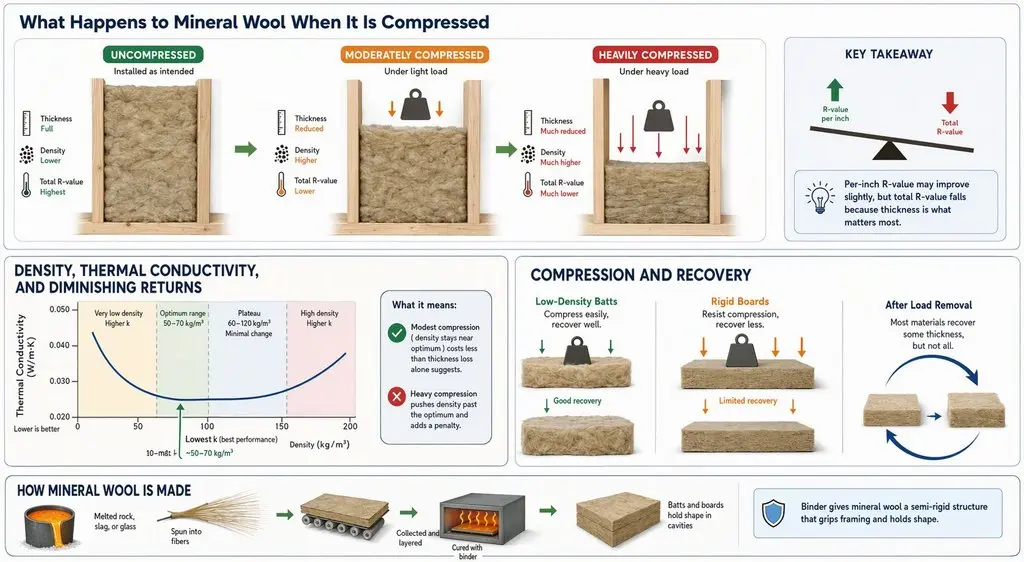
Compression packs the fibers closer, raises density, and reduces thickness. R-value per inch may improve slightly, but total R-value falls, because thermal resistance depends on installed thickness rather than on how tightly the fibers are packed.
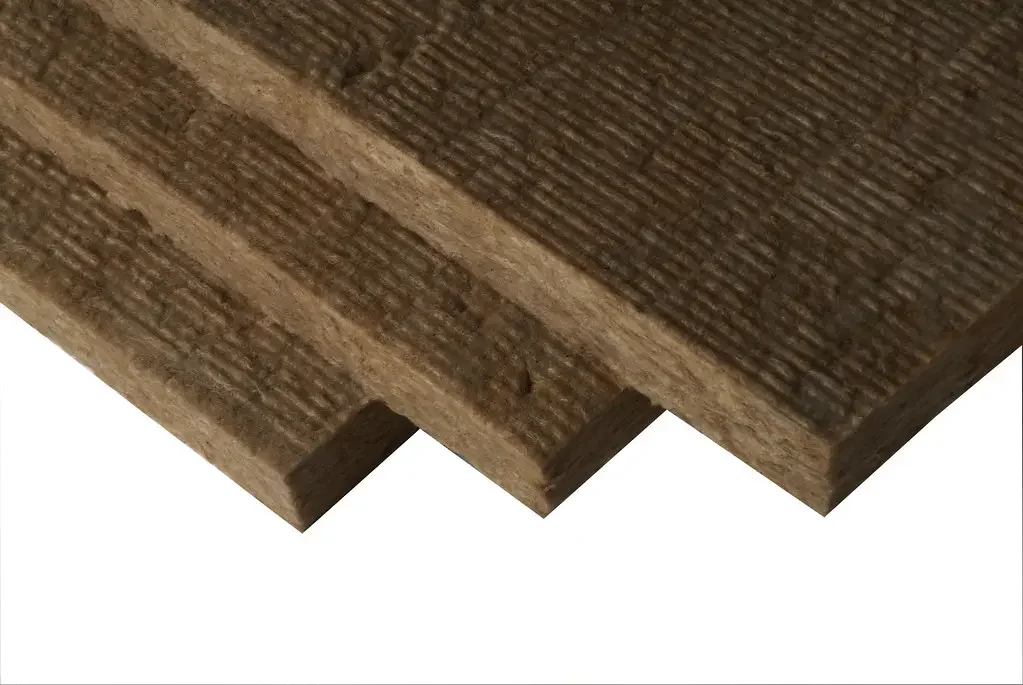
Mineral wool is spun from melted rock, slag, or glass, then collected, layered, and cured with a binder. That binder gives batts and boards a semi-rigid structure that grips framing and holds shape in a vertical cavity. Under load the fiber network resists compression to a point, then deforms, and recovers only part of its thickness when the load is removed. Low-density batts recover well, rigid boards resist compression but recover less, and the fiber chemistry behind that difference is covered in a separate guide answering what is mineral wool.
R-Value per Inch Versus Total R-Value
Per-inch and total values move in opposite directions, which is where most confusion starts: total resistance is thickness multiplied by resistance per unit thickness, so it almost always drops even when the material performs slightly better per inch.
| Nominal thickness | Typical density | Lambda (W/mK) | R-value (m2K/W) | R-value (imperial) |
| 50 mm | 40 to 60 kg/m3 | 0.035 | 1.43 | R-8 |
| 75 mm | 40 to 60 kg/m3 | 0.035 | 2.14 | R-12 |
| 100 mm | 50 to 80 kg/m3 | 0.035 | 2.86 | R-16 |
| 150 mm | 60 to 100 kg/m3 | 0.035 | 4.29 | R-24 |
Density, Thermal Conductivity, and Diminishing Returns
Conductivity falls as density rises from very low values, flattens between roughly 60 and 120 kg/m3, then climbs as solid conduction through the fibers dominates. Published measurements place the optimum near 50 to 70 kg/m3, so modest compression costs less than the thickness loss alone suggests, while heavy compression removes that offset and adds a penalty.
How Much R-Value Do You Lose When Compressing Insulation
R-value loss typically runs between 60 and 90 percent of the thickness lost. Ten percent compression costs about 6 to 9 percent of R-value, 20 percent compression costs 12 to 18 percent, and 50 percent compression can remove a third or more of the rated performance.
| Compression | Thickness of a 100 mm product | Typical R-value loss | Resulting R-value (from R-2.86) |
| 5 percent | 95 mm | 3 to 5 percent | R-2.72 |
| 10 percent | 90 mm | 6 to 9 percent | R-2.60 |
| 20 percent | 80 mm | 12 to 18 percent | R-2.35 |
| 30 percent | 70 mm | 20 to 27 percent | R-2.10 |
| 50 percent | 50 mm | 35 to 45 percent | R-1.60 |
For example, 100 mm rated R-2.86, roughly R-16, forced into a 75 mm cavity lands near R-2.2, or R-12.5, a loss of about 22 percent on a wall that still looks correctly insulated from the room side.
North American batt guidance estimates that R-value falls by about half the compression percentage. That shortcut was developed for glass fiber and works as a screening tool only, so manufacturer compressed-R tables take precedence. Where none exists, measure installed thickness and apply the range above.
Is It Okay to Compress Mineral Wool Insulation?
Light, incidental compression is acceptable and often unavoidable. Deliberate compression beyond roughly 10 to 15 percent of the labeled thickness is not, because a closed cavity prevents the material from recovering to its rated thickness.
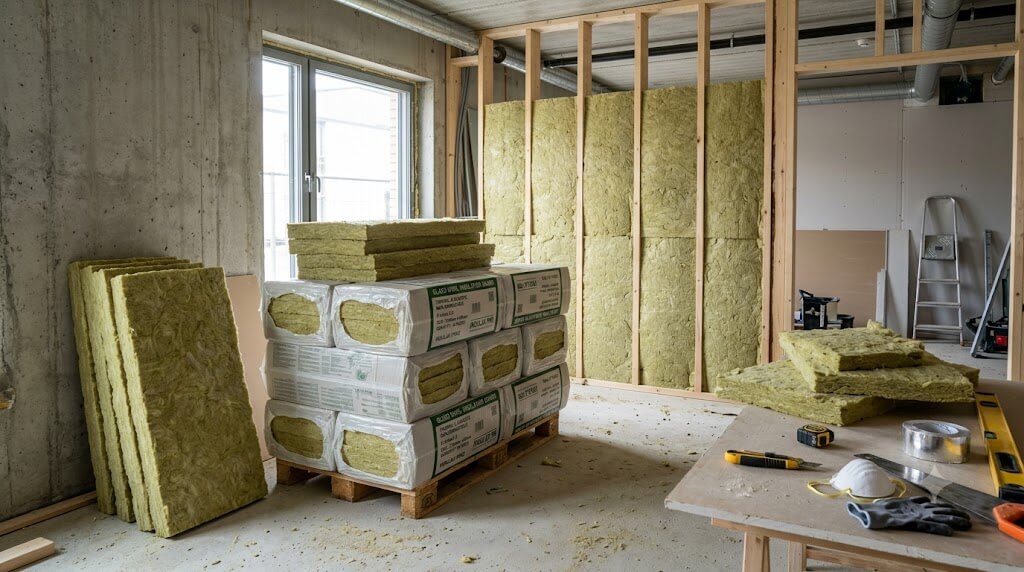
Semi-rigid batts are designed for friction fit: one cut 10 to 20 mm wider than the bay compresses on insertion, grips the studs, and holds without sagging. That is the intended method, not a defect.
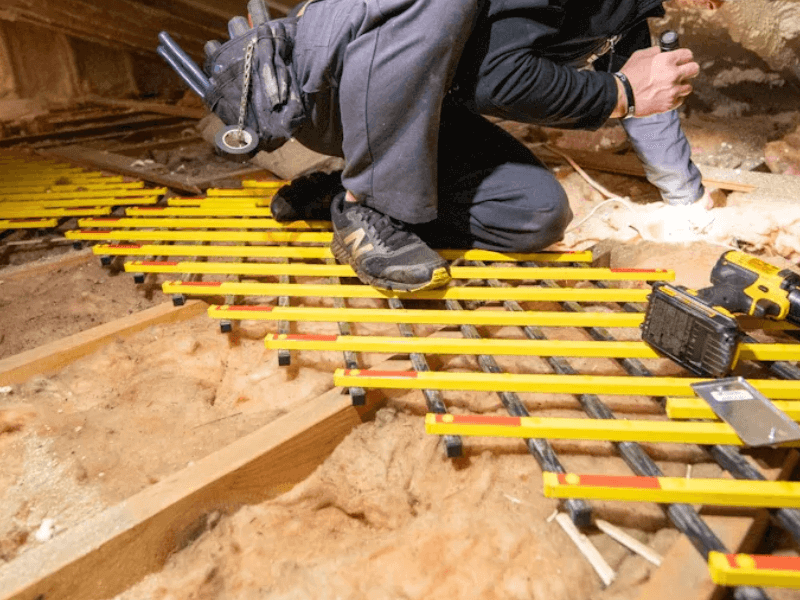
Acceptable compression covers friction fit, folding around corners, filling voids behind junction boxes and pipes, and bale compression before opening. Unacceptable cases include a 100 mm product forced into a 60 mm cavity, stacked loads on installed batts, and kneeling on attic insulation, which crushes thickness permanently in patches.
Gaps usually cost more than compression. A fully filled cavity with slightly compressed wool outperforms full-thickness batts that leave 20 mm voids at edges and services, because air bypasses the insulation through those voids. Recovery also takes time, so allow a few hours before closing an assembly.
Does Mineral Wool Settle Over Time?
Batts and boards settle very little, typically under 2 percent of thickness over the life of a building, because the cured binder holds the fiber structure in place. Loose-fill mineral wool settles more, commonly 5 to 15 percent depending on density, blowing technique, and vibration.
Settling is not compression. Compression is a one-time reduction during installation, while settling is a gradual loss afterwards driven by gravity, vibration, thermal cycling, and moisture. The two add up, which is why a compressed batt on vibrating equipment performs worse than either mechanism alone suggests.
| Product form | Typical settling | Design allowance |
| Batts in walls | Under 2 percent | None if correctly installed |
| Boards and lamella | Negligible | None |
| Loose fill in open attics | 5 to 15 percent | Specify 10 to 15 percent extra depth |
| Blown cavities | 3 to 8 percent | Verify installed density at handover |
| Blankets on vibrating plant | 2 to 5 percent | Higher density plus mechanical support |
Mineral wool resists slump better than glass wool in vertical cavities because its fibers are stiffer, though the advantage disappears at low density or when the product is saturated.
What Are the Disadvantages of Mineral Wool Insulation?
The main disadvantages are weight, cost, dust and skin irritation during handling, and the fact that mineral wool is not an air barrier. Compression sensitivity matters mainly in shallow cavities, and most other drawbacks are manageable through correct specification.
- Higher density means heavier bales, which matters on ceilings and in retrofit work, and unit cost is generally higher than glass wool.
- Cutting generates dust, and fibers can irritate skin and eyes, so gloves and eye protection are needed.
- The material is water repellent but not waterproof, so saturated sections must be dried or replaced.
- It does not stop air movement, so joints, penetrations, and perimeter framing need separate sealing.
- Thin cavities leave little margin, since a 20 mm oversize batt in a 60 mm bay is already a third of the way to significant loss.
Most of these are procurement and workmanship issues rather than thermal failures. A specification that states density, thickness tolerance, and compression recovery removes much of the risk.

Where Compression Starts: Density Control in Production and Packaging
Most compression-related loss is decided before installation. Fiberizing, web formation, curing, cutting tolerance, and baling pressure determine how much thickness a product can hold and how completely it recovers after opening.
Uniformity comes first. Wool that leaves the layering stage with uneven mass distribution compresses unevenly in service, and thin patches set the real performance of the assembly, so the link between equipment settings and rock wool density and uniformity is direct. Curing is next, since under-cured binder leaves the web springy and prone to creep, while over-cured product turns brittle. Cutting accuracy follows, because EN 13162 classes such as T4 and T5 allow a small negative deviation, and a product that starts below nominal cannot recover what it never had.
Baling is intentional compression, not a defect. Product is compressed to cut freight volume and should recover to within a few percent of nominal thickness after opening. Recovery above 95 percent is achievable, but it depends on compression ratio, storage time, temperature, and stacking, all of which are set by the equipment on a mineral wool production line. That is why two products with the same nominal thickness can behave differently on site.
Store bales flat and dry, and do not judge thickness while the strapping is still on.
How to Install Mineral Wool Without Losing R-Value
Match product thickness to cavity depth, cut for friction fit rather than force, fill every gap, and allow recovery before the assembly is closed.
- Measure the real cavity depth, since sheathing, furring, and services reduce usable depth.
- Select a product whose labeled thickness matches that depth, allowing light friction fit but never heavy compression.
- Cut 10 to 20 mm oversize in width, and cut accurately around obstructions instead of stuffing material behind them.
- Split the layer where services cross the cavity, so thickness is maintained in front of and behind the pipe.
- Fill edges, corners, and the top plate, then seal air paths separately.
- Open bales early enough to allow recovery, and keep the material dry.
Walls, Roofs and Industrial Equipment
In walls, the risk is a cavity that turns out shallower than assumed once services are installed. In roofs, it is compression at eaves and ridge, where access is difficult. On industrial pipework, it is over-tensioned bands and wide support spacing, which thin the layer along its full length rather than at one point.
FAQ
Can compressed mineral wool recover its original thickness?
Yes, within limits. Bale compression is elastic, and most products recover to within a few percent of nominal thickness within hours of opening. Inside a closed cavity the result differs, because framing prevents expansion.
Does compressing mineral wool improve acoustic or fire performance?
Higher density can improve absorption at low and mid frequencies, but thickness dominates low-frequency performance, so heavy compression usually hurts acoustics overall. Fire classification does not improve with compression, and crushed material in a firestop detail can reduce the integrity of the assembly.
How can I tell whether installed mineral wool is under-thickness?
Measure at several points with a probe before the assembly is closed and compare the result with the label. Check edges and corners for voids, since gaps often matter more than density. Thermal imaging after commissioning shows thin areas as warmer or cooler bands, but it should confirm a suspicion rather than replace measurement.




