
Capacity is usually fixed in the first two meetings of a rock wool project and then defended for twenty years. Buyers new to the material start from the equipment quotation, because that is the document suppliers send first, and the tonnage on page one quietly becomes the plan. Furnace size, building span, power contract and working capital all follow from that number.
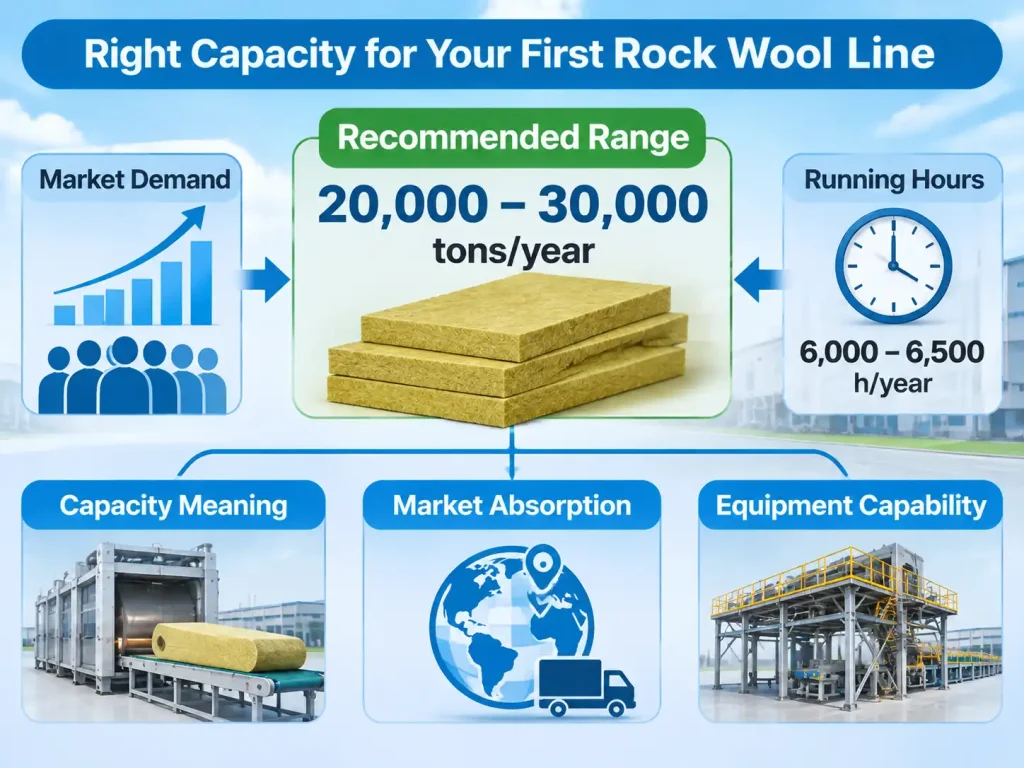
For a first line, the defensible range is 20,000 to 30,000 tons of saleable product per year. Work backwards from the tonnage your delivery radius can absorb at a price the market already pays, then test it against 6,000 to 6,500 real running hours. Under 15,000 tons fixed costs dominate the unit cost, and over 40,000 tons a new entrant finances inventory it cannot sell.
The decision rests on three measurements: what capacity means, what your market absorbs, and what the equipment can hold.
What Capacity Actually Means in a Rock Wool Line
Capacity means saleable tons per year at your site’s real running hours, not the tonnage printed on a quotation. Two lines both sold as 30,000 tons can differ by a third in delivered output once hourly rate, uptime and product mix are counted.
Suppliers quote annual tonnage because it is what buyers compare, yet the figure multiplies two variables rarely stated: tons per hour and hours available. When either is optimistic, the quotation stays the same and the plant underperforms for a decade.
Nameplate tons versus delivered tons
Rock wool lines do not run 8,000 hours a year. A realistic figure is 6,000 to 6,500, lower in northern markets where sites close for winter and a stopped furnace needs a full restart, higher in the south. Output counts only when the board meets its declared thickness, density and thermal values, such as those set in EN 13162 for factory made mineral wool, and edge trim and rejects take another 3 to 6 percent.
Hourly output is the number that matters
Ask instead for tons of finished board per hour at a stated density and thickness, a figure that can be measured on a trial run and written into the contract.
| Quoted annual capacity | Realistic hourly output and delivered tonnage |
| 20,000 t | 3.0 to 3.5 t per hour, so 18,000 to 21,000 t over 6,000 hours |
| 25,000 t | 3.5 to 4.0 t per hour, so 21,000 to 24,000 t over 6,000 hours |
| 30,000 t | 4.0 to 5.0 t per hour, so 24,000 to 30,000 t over 6,000 hours |
| 40,000 t | 5.0 to 6.0 t per hour, so 30,000 to 36,000 t over 6,000 hours |
The bands overlap because output depends on product. A line holding 5 tons per hour at 100 kg/m3 and 50 mm will not hold it at 180 kg/m3 and 150 mm.
Start From Demand, Not From the Machine
Size the line from the tonnage you can sell inside your own delivery radius, then pick the nearest standard band. Investors who start from a machine quotation usually buy more capacity than their market absorbs in three years, and the surplus is paid for every month through fixed cost.
Rock wool is heavy and low value per cubic meter, so freight is a real share of landed cost. The relevant market is a radius of 300 to 500 km, not a national consumption figure.
Mapping the tonnage your market can absorb
Keep four assumptions visible, because anyone lending to the project will test them.
- Consumption inside the reachable radius, from construction volume and import records.
- Volume already supplied by plants you cannot undercut on cost.
- Share a new brand can win in three years, usually 30 to 45 percent.
- That share converted into tons and matched to the nearest band.
| Demand element | Worked example |
| Regional consumption | 150,000 t per year |
| Reachable within 400 km | 40 percent, so 60,000 t |
| Share won in three years | 35 to 45 percent, so 21,000 to 27,000 t |
| Capacity to build | 25,000 t per year |
One calibration step makes the estimate credible. Visit installed Rock Wool Production Lines in comparable markets and ask what the plant ships each month, not what the line is rated at.
Utilization you can realistically sell
New lines do not start at design output. Product qualification, operator learning and distribution build hold first year utilization at 40 to 60 percent, while most projects need 55 to 65 percent to cover fixed cost.
The Standard Capacity Bands and Who They Suit
Equipment is built in a few standard bands, roughly 15,000, 20,000, 25,000, 30,000 and 40,000 tons per year. A first line normally lands at 20,000 to 30,000 tons, the band that balances unit cost against the volume a new brand can place.
The bands exist because furnace shells, oven sections, collectors and saws are tooled around them. A 27,000 ton request ships as a 25,000 or 30,000 ton configuration, so a bespoke figure adds engineering risk without market advantage.
| Band | Hourly output and typical fit |
| 15,000 to 20,000 t | 2.5 to 3.5 t per hour; one product family, regional sales, lowest entry cost |
| 25,000 t | 3.5 to 4.0 t per hour; boards plus strips, a common first compromise |
| 30,000 t | 4.0 to 5.0 t per hour; most common first line, needs a distribution plan |
| 40,000 t | 5.0 to 6.0 t per hour; justified by contracted volume or an existing channel |
The 15,000 to 25,000 ton band
This band suits one dominant product, usually 100 mm facade board, and customers within a day’s trucking. Smaller equipment cuts building span, crane capacity and transformer size. The limit is economic: compliance, laboratory work, maintenance and management cost nearly the same at 15,000 tons as at 30,000, so fixed cost per ton roughly doubles.
The 30,000 to 40,000 ton band
Economics improve quickly here, but so do the preconditions. A 40,000 ton line absorbs around 3,000 tons a month that must be placed on a repeatable schedule. Without contracted volume that output becomes inventory and local price pressure, and the equipment discussion shifts from price to oven length and campaign length.
Why one size up often costs less than rebuilding
One size up at the start usually means a furnace with more melting headroom, a longer oven and a wider collector. Doing it later means a new power connection, extended civil work and months of lost production.
Match Capacity to Your Product Mix
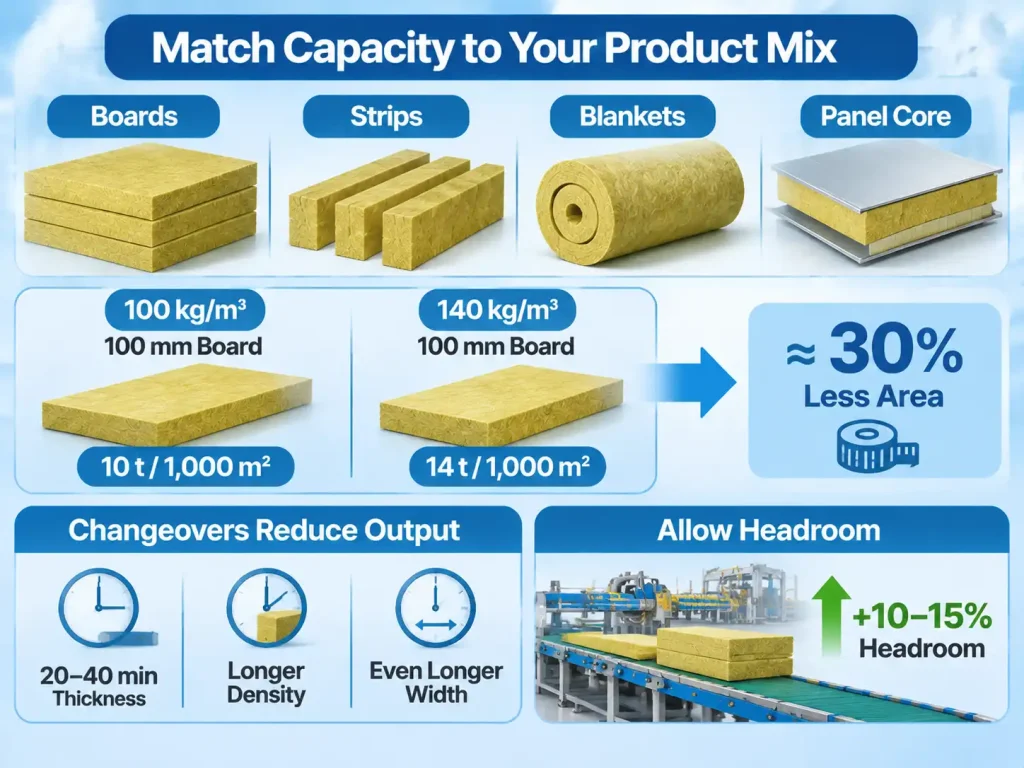
Tonnage alone is a poor target, because rock wool is sold by thickness and area as often as by weight. Density and thickness decide how many tons leave the line for the same square meters, so a line sized on boards behaves differently when it runs strips or panel core.
Mineral wool covers stone wool and slag wool across a wide density range, as the basic description of mineral wool sets out. Basalt with an acidity coefficient above 1.6 gives rock wool for facade and fire applications, while a slag melt below that figure gives mineral wool for industrial insulation and lower grade panels. A rock wool line can make the lower grade, not the reverse.
Boards, strips, blankets and sandwich panel cores
The conversion explains most capacity surprises. One thousand square meters of 100 mm board at 100 kg/m3 weighs 10 tons; at 140 kg/m3 it weighs 14, so identical hourly tonnage yields 30 percent less finished area.
| Product | Tons per 1,000 m2 |
| 50 mm board at 100 kg/m3 | 5 t |
| 100 mm board at 100 kg/m3 | 10 t |
| 100 mm board at 140 kg/m3 | 14 t |
| 150 mm board at 120 kg/m3 | 18 t |
| 100 mm panel core strip at 120 kg/m3 | 12 t |
Fix your density and thickness mix before comparing suppliers, then ask each for hourly output at that mix rather than at their best case.
Changeover and effective capacity
A thickness change takes 20 to 40 minutes, a density change with binder adjustment longer, a width change longer still. A plant running six changes a shift loses 10 to 15 percent of effective capacity, which is why a first line selling into a fragmented market needs one band of headroom.
Equipment That Sets the Ceiling on Capacity
A rock wool line runs at the speed of its slowest section. Melting rate, fiberizing capacity, collection width, oven length and cutting throughput each impose a limit, and upgrading the wrong one leaves the real bottleneck untouched.
Suppliers describe lines section by section, which makes components easy to compare and imbalance easy to miss. Ask what each section passes per hour and where the constraint appears first.
| Section | What caps throughput |
| Melting furnace | Tapping rate and campaign length before relining |
| Centrifuge and blowing | Fiber output per wheel and consistency of the melt |
| Collection and pendulum | Collector width and pendulum speed, up to 165 m per minute |
| Curing oven | Oven length and conveyor speed at the thickness being run |
| Cutting and stacking | Saw speed, tooling changes, size changes per shift |
Melting furnace output and campaign length
The Melting Furnace sets the bound twice: tapping rate at working temperature, and campaign length before a stop for cleaning or repair. A stable campaign runs around 14 days, and plants that cannot hold it lose output to restarts and to thermal shock that shortens refractory life. Coke fired cupolas cost less and melt fast but depend on coke quality and on permits for their emissions, while electric furnaces respond faster to load changes and hold a more consistent melt.
Fiberizing, collection and pendulum speed
Fiberizing capacity is set by the centrifuge and blowing system, the section most sensitive to melt quality: unstable temperature produces more shot, which appears downstream as density variation and higher binder use. Collector width and pendulum speed then set how fast fiber becomes mat, up to 165 m per minute on high speed lines.
Curing oven and cutting throughput
The oven is often the practical limit. Length and conveyor speed define the dwell time a thickness needs to cure, so a line reaching rated output on 50 mm board may sit at 70 percent of it on 150 mm. Saw lines serving six sizes per shift need more automation than those serving one.
Line Width, Layout and Utilities
A 2.4 meter working width has become the default for new first lines because it fits common board sizes and still supports 30,000 to 40,000 tons. Width drives building span, oven size, crane capacity and the power connection, so it is a civil decision as much as a mechanical one.
Width is also the parameter hardest to change later, since collector, pendulum traverse, oven, saw and roof span are all built around it.
| Working width | What it implies |
| 1.2 to 1.3 m | Small lines, narrow board range, low civil cost, limited expansion |
| 1.8 to 1.9 m | Mid size lines, standard board widths, moderate span |
| 2.4 m | First line default, supports 30,000 to 40,000 tons |
Installed power and the energy contract
Total installed power typically falls between 800 and 1,800 kW, drawn at 70 to 75 percent in normal operation, and a 30,000 ton line with electric melting sits near 1,300 kW. The supply agreement is sized on installed capacity while the bill follows consumption, and energy scales with melting rather than with finished tons.
Building height, oven length and material flow
An oven of 30 to 36 m, a forming section, a saw line and packing produce 85 to 95 m of line, often in an L shape. Clearance above the pendulum, crane access and a straight route from batching to melting decide how much of the rated capacity the plant can use. Plan 18 to 30 months from order to full capacity.
Investment and Operating Cost at Each Capacity Level
Capital cost rises more slowly than capacity, so cost per annual ton falls as the line grows. The penalty for oversizing is not the equipment price but the fixed operating cost of a plant running at half load for three years.
The number worth optimising is total cost per ton of saleable product, built from capital, energy, labour, consumables, maintenance and the cost of capital tied up in idle capacity.
What the capital figure must include
A line quotation is rarely the project cost. Add these blocks before comparing suppliers, because the last four are where first time budgets break.
- Main process equipment, batching to packaging.
- Environmental system and gas treatment.
- Civil works, foundations and building.
- Utility connections and transformer.
- Installation and commissioning.
- Spares, tooling and laboratory.
- Training and start-up team.
- Working capital for raw material and inventory.
Unit investment falls as capacity rises
A larger furnace, oven and collector cost more, but the building, control room, laboratory, environmental system and site infrastructure do not double, so unit cost falls. The index below is relative, not a price.
| Capacity band | Indicative capital per annual ton |
| 15,000 to 20,000 t | 100, reference index |
| 25,000 to 30,000 t | 78 to 85 |
| 40,000 t | 68 to 75 |
Read it as a trade: the second band buys roughly 50 percent more capacity for about 25 percent more capital, and each investor has to judge that against market risk.
Payback sensitivity to utilization and energy price
Payback is normally calculated at full output, which flatters every project. At 60 percent utilization the plant carries the same staff, maintenance and most of its energy demand for 60 percent of the revenue. Labour runs 15 to 20 people per line across three shifts; energy decides survival in a price war. A Rock Wool Production Line Cost breakdown is most useful read as what each scope item buys in output and reliability.
How to Stress-Test a Quoted Capacity
Ask every supplier for a written guarantee of hourly output on saleable product under named raw material conditions, and tie acceptance to a measured run. A capacity claim without a measurement method is a marketing number.
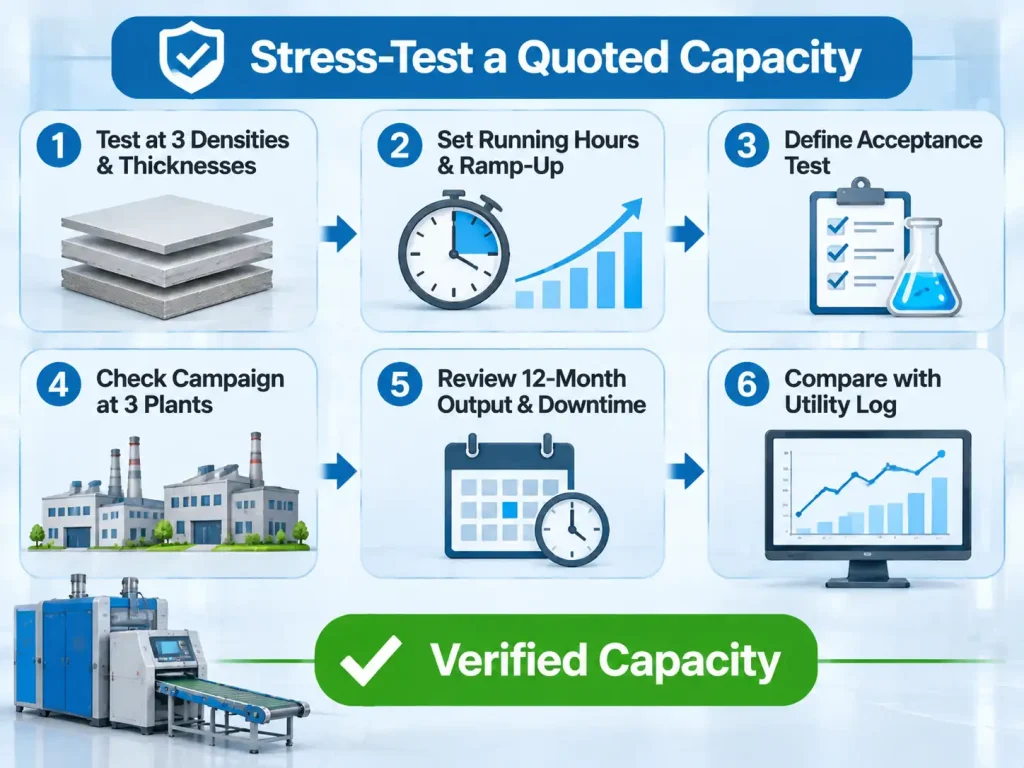
Capacity is testable, and the test must be agreed before the contract, or commissioning becomes an argument about definitions.
- Require tons per hour at three stated densities and thicknesses.
- Require assumed running hours and the ramp-up curve.
- Specify the acceptance test: duration, mix, who measures.
- Ask for campaign length at three reference plants.
- Request twelve months of output and downtime records.
- Compare that plant’s utility log against its output.
| Supplier statement | How to verify it |
| 30,000 tons per year | Ask for tons per hour and assumed hours separately |
| Uptime above 95 percent | Ask for a twelve month log including campaign length |
| Runs all densities | Ask for the full rate range, not the reduced rate range |
| Low energy consumption | Ask for kWh per ton at a stated density and thickness |
| Simple to operate | Ask for headcount per shift on a running line |
Common Capacity Mistakes First-Time Investors Make
The expensive errors repeat across projects: sizing to optimistic demand, ignoring density when converting tons to square meters, and treating line width as a detail. Each is cheap to correct on paper and very expensive to correct in concrete.
A final check before signing is worth more than another round of price negotiation.
- Sizing for year five demand, then paying fixed cost for idle capacity in years one to three.
- Comparing annual capacities without hourly output at the intended density and thickness.
- Choosing a furnace on capital cost while ignoring the energy contract and emission limits.
- Leaving no melting headroom, so every expansion becomes a furnace replacement.
- Fixing the smallest working width, then finding the board range cannot be widened.
- Buying unmatched sections from several sources instead of a Turnkey Rock Wool Production Line, then absorbing interface problems during commissioning.
Frequently Asked Questions
These three questions appear in almost every first project review, and each has a short answer that holds up under scrutiny.
What is the smallest rock wool line worth building?
Around 15,000 tons per year, or 2 to 2.5 tons per hour. Below that, the fixed cost of environmental compliance, laboratory control and a minimum technical team spreads over too few tons, so unit cost rises faster than equipment price falls. Smaller lines survive in narrow applications such as agricultural products or pipe section.
How long does it take from order to full capacity?
Between 18 and 30 months, and the upper half of that range is more common than buyers expect. Design and permitting take four to six months, equipment manufacturing five to eight, installation three to four, and commissioning another two to three. Reaching nameplate output then takes six to twelve months of learning and market building.
Can a first line be expanded later?
Usually yes, if the site and furnace were planned for it. Expansion adds a second collector, lengthens the oven or adds a centrifuge, and costs 30 to 50 percent less per ton than a new line. The precondition is melting headroom plus reserved transformer capacity, building span and a foundation for a second oven.




