
Non-combustible insulation keeps pulling new capacity into regions that are building their first stone wool plants. The hard part is rarely the decision to build, but the specification stage, where dozens of machines designed by different departments must run as one process. Suppliers who deliver Rock Wool Production Lines as packages bring layout logic, but the buyer still approves every size and interface.
Machinery for a rock wool production line is organized into six functional groups: raw material handling and batching, melting, fiberizing and collection, forming and curing, cutting and packaging, and the support systems for emissions, waste recovery, and control. A complete line holds 40 to 60 machines, all sized around one hourly output. Read a quotation by checking four numbers first: tons per hour, line width, line speed, and curing oven length.
The sections below follow the material through each group, then show how capacity, furnace choice, and automation cascade downstream.
What Machinery Makes Up a Rock Wool Production Line
The line is a chain of six machine groups along the material flow, each with one duty: prepare the batch, melt it, spin it into fibre, collect and distribute it, cure and cut the mat, then compress and pack it. Emissions, waste recovery, and control run alongside all six.
| Stage | Core machinery | Specification that matters most |
| Raw material handling | Crusher, screen, silos, weigh hoppers, batch controller | Batching accuracy and cycle time |
| Melting | Cupola or electric furnace, charging, heat exchanger | Melt rate in tons per hour at stable temperature |
| Fiberizing | Four wheel centrifuge, air blower, binder pumps | Wheel speed and fibre diameter control |
| Collection and forming | Collection chamber, drum collector, pendulum distributor | Fleece uniformity across the width |
| Curing | Curing oven, hot air furnace, circulating fans, belts | Zone temperature and thickness control |
| Cutting and packaging | Slitters, cross cut saw, compression unit, stacker | Length tolerance and compression repeatability |
Upstream Machinery: Raw Material Handling and Batching
Crushers and screens reduce basalt and dolomite to a consistent 10 to 50 mm, then weigh hoppers and a batch controller deliver a logged recipe. A drift of two percent in the dolomite share shifts melt viscosity and reappears downstream as variation in fibre diameter and board density. Chemistry also decides whether the fibre qualifies for EUCEB certification under Note Q of the European classification regulation.
Core Machinery: Melting, Fiberizing, and Collection
This group absorbs most of the capital and fixes the ceiling: a furnace rated at a given melt rate defines what the line can produce, and no downstream upgrade recovers a shortfall in melting. The centrifuge spins melt into fibre at 3,500 to 4,500 rpm, with wheel condition and air pressure deciding diameter, typically 4 to 7 micrometres. Binder pumps add resin at 1 to 4 percent of product weight, and the collection chamber draws the fibre onto a drum.
Downstream Machinery: Forming, Curing, Cutting, and Packaging
A pendulum sweeps the fleece laterally to build uniform layers, a pre-compressor sets thickness, and trimmers fix working width. The curing oven circulates air at 200 to 250 degrees Celsius to polymerize the binder while belts hold thickness to about plus or minus one millimetre. Slitters and a saw divide the slab, and final machines compress it to one third of cured thickness.
The Rockwool Manufacturing Process: How the Machines Work Togethe
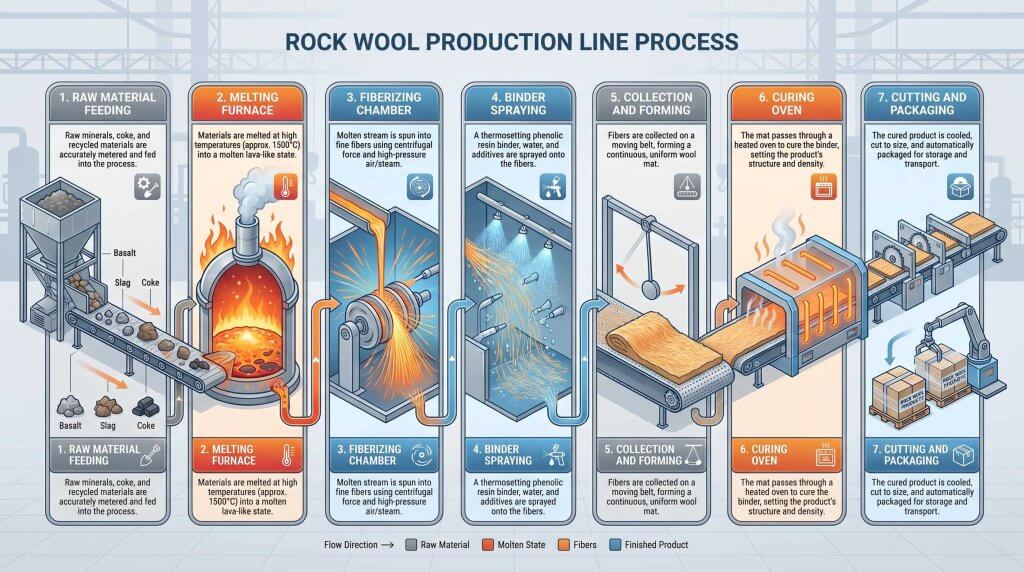
The process runs in eight steps that map onto machine groups: batch, melt, fiberize, apply binder, collect and distribute, cure, cut, and pack. Material moves continuously, so the slowest machine sets the output of the whole line, not the fastest.
- Batching. Weigh hoppers deliver a logged recipe to the charging system.
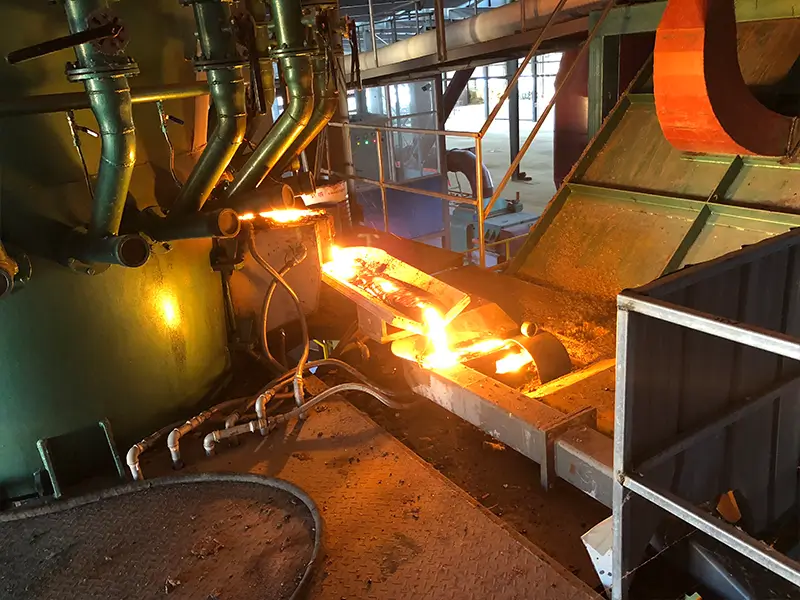
- Melting. The furnace holds melt near 1,500 degrees Celsius and taps it in a stream.
- Fiberizing. Four wheels throw the melt into fibre while air attenuates it.
- Binder application. Metering pumps spray resin, water repellent, and water.
- Collection. Negative pressure draws fibre onto a drum to form the primary fleece.
- Distribution. A pendulum lays the fleece in folds to equalize density.
- Curing. Hot air drives off water and cross links the binder.
- Cutting and packing. Slitters, a saw, a press, and a stacker produce pallets.
Two figures show how well the chain runs: furnace campaign length and the ratio between design and average output. A campaign holding ten to fourteen days indicates stable charging, and a ratio below 0.85 traces back to one of three interfaces.
Where Lines Lose Money: The Three Mismatch Points
- Melting against collection. A furnace that outruns the negative pressure system produces shot that never reaches the belt, so melt is paid for twice and sold once.
- Oven length against line speed. Running faster than the oven can cure leaves an uncured core that fails to recover thickness after packing.
- Cutting and packing against line speed. When the saw or stacker cannot keep pace, the accumulator fills and the line stops, which is why a nominal 30,000 ton line often delivers 24,000 tons.
A Pendulum System that cannot reach maximum line speed caps throughput even when the oven and cutter keep up.
Sizing the Machinery to Your Target Capacity
Capacity is not a single number in a quotation. It is a rated output in tons per hour multiplied by realistic operating hours, and every machine should be specified against that hourly figure rather than the annual headline.
| Annual capacity | Required output | Typical line width | Curing oven length |
| 10,000 t/y | 1.6 t/h | 1.2 m | 18 to 22 m |
| 20,000 t/y | 3.2 t/h | 1.2 to 2.4 m | 22 to 26 m |
| 30,000 t/y | 4.8 t/h | 2.4 m | 26 to 30 m |
| 50,000 t/y | 8.1 t/h | 2.4 m | 30 to 35 m |
| 80,000 t/y | 12.9 t/h | 3.0 m | 35 m and above |
The 6,000 Hour Rule
Plants do not run 8,760 hours. Counting relining, maintenance, holidays, and seasonal demand, a well maintained line reaches 6,000 to 6,500 productive hours, so 5 tons per hour is a 31,000 ton line rather than 43,000.
Why Line Width and Speed Set the Rest of the Line
A 1.2 m line is easier to keep uniform and suits boards and pipe sections at moderate volume. A 2.4 m line dominates new capacity because it balances output per operator against a mat weight the distributor can handle. Near 100 m per minute the oven is the constraint; at 165 m per minute cutting and packing become the constraint.
Melting Machinery: Cupola Furnace vs Electric Furnace
The furnace decision reshapes the whole line. A cupola burns coke and needs a full gas cleaning train, while an electric furnace trades fuel logistics for grid capacity and yields a cleaner melt with lower sulphur.
| Criterion | Cupola furnace | Electric furnace |
| Primary energy | Coke, with gas support | Electricity |
| Melt quality | Stable, higher sulphur | Cleaner, low sulphur |
| Campaign | Long campaign, planned relining | Fast response to load changes |
| Emissions | Extensive cleaning for dust and sulphur dioxide | Smaller off gas volume, larger grid demand |
| Capital cost | Lower per ton at large capacity | Higher at equivalent capacity |
What Each Choice Does to the Rest of the Line
A cupola requires coke storage, a charging skip, a hot blast exchanger, and a gas train sized for dust, sulphur dioxide, and carbon monoxide. An electric furnace replaces that with a transformer, an electrode system, and far less off gas, but it shifts the constraint to the substation: a 30,000 ton line can draw tens of megawatts during melting, and grid timing often decides the schedule. Buyers planning a phased expansion should confirm whether the Electric Furnace they order can be uprated, or whether phase two means a second furnace.
Automation and Emission Control
Automation here is less about robots than about closing loops between machines, and emission equipment belongs inside the line rather than beside it, because both decide how many hours the plant can run.
What to Automate First
Sequence matters more than total spend. Laser tracking of the melt stream, belt weigh scales for density feedback, thermocouples in every oven zone, and encoders tying cut length to line speed all earn their cost. The fastest payback runs from automatic batching, to closed loop binder dosing, to automatic length and thickness control, to automatic stacking, and finally to supervisory control with alarms. Measurement bought without a controller ends up as data and no benefit.
Dust, Gas, and Offcut Recovery
Bag filters handle dry dust efficiently and suit collection and cutting, while wet electrostatic precipitators cope better with sticky or condensing streams from curing and solid fuel furnaces. Cooling the gas ahead of the filter matters as much as the filter, since a hot stream damages media and a cold one condenses tar. On the waste side, a crushing circuit returns cured offcuts to the batch at a controlled ratio. The limit is chemistry: recycled product already carries binder, so too high a ratio brings foaming and inconsistent fibre.
Machinery for Horticultural Rock Wool
Rockwool for plants is the same mineral fibre used for insulation, but made as a hydrophilic growing medium: finer fibre, a wetting agent instead of a water repellent, and a moulded shape such as a plug, block, or slab. Mineral wool, the family that includes rock wool, has served construction and horticulture for decades.
Growing media differs from insulation in density, pore structure, and surface chemistry rather than raw material. It typically sits near 70 kg per cubic metre with porosity above 95 percent, holding a predictable balance of water and air. Fresh product is alkaline, so it is conditioned before packing to bring surface pH into a range that nutrient solutions can work with.
How the Line Changes for Grow Blocks and Slabs
- The centrifuge runs at the top of its range, because fine fibre gives the capillary behaviour blocks depend on.
- Binder is reduced or removed, and a wetting agent is dosed so the product wets out instead of repelling water.
- The continuous mat gives way to a moulding station that forms plugs, cubes, and slabs to fixed dimensions.
- A conditioning tunnel adjusts pH, followed by controlled drying instead of heavy compression.
- Cutting runs to tight tolerances on semi dry product, and packing avoids crushing the pore structure.
These stations sit outside a standard insulation package, so serving both markets means fixing the divergence point early. The Eurima mineral wool overview confirms growing media is an established use of the same fibre family.
Specifying, Buying, and Commissioning the Machinery
A specification should fix performance rather than list equipment. It needs guaranteed hourly output at a stated density, thickness tolerance, energy consumption per ton, emission limits, and a battery limit for every supplier on site.
Site, Utilities, and Location Logic
Electric melting needs a dedicated substation, while cupola melting needs coke storage, gas supply, and a taller stack. Both need cooling water, compressed air, and covered storage. Location follows the same logic: plants cluster near basalt quarries and slag sources, near cheap power, and near customers.
Where the Money Goes
| Machine group | Share of mechanical equipment budget |
| Melting, charging, heat recovery | 25 to 35 percent |
| Fiberizing and collection | 12 to 18 percent |
| Forming and curing | 20 to 28 percent |
| Cutting, finishing, packaging | 12 to 18 percent |
| Emissions, recovery, control, electrical | 13 to 25 percent |
Cutting the melting group costs more later, because a furnace cannot be enlarged without rebuilding the line around it. Trimming finishing stations is easier to reverse.
What a Complete Quotation Should Contain
- An itemized list by machine group, with model, motor rating, material, and country of manufacture.
- Performance guarantees expressed as output per hour at a stated density and thickness.
- A battery limit showing where each supplier’s scope begins and ends, including ducting and cabling.
- A spare parts list covering two years of wear items, with prices.
- Installation, commissioning, and training scope, with technician numbers and time on site.
- Warranty terms, acceptance criteria, and the test method that proves them.
Buyers comparing a Turnkey Rock Wool Production Line against separate equipment should price the interfaces too, since ducting and control integration are where budgets slip.
FAQ
These three questions surface in almost every technical review, and none of them is settled by an equipment list alone.
Can one line make both boards and blankets?
Yes, within a defined window. A board line can usually run blankets at lower density, but the compression unit, folding station, and packaging line differ, and changeover takes hours rather than minutes.
How long does it take from order to first saleable product?
Design and manufacturing take three to five months, with civil works in parallel. Shipping adds four to eight weeks, installation two to three months, and commissioning another four to eight. The line is not proven until a full furnace campaign is completed.
What energy consumption per ton is realistic?
Melting dominates. Electric melting generally falls between 380 and 550 kWh per ton of melt, while a cupola consumes roughly 100 to 140 kg of coke per ton plus electrical energy for fans and drives. A single figure that does not separate melting from downstream is worth challenging.




