
Walk through a glass wool plant, and the curing oven is hard to miss. It’s huge—often longer than a football field. Hot air roars through it. The smell of curing resin hangs in the air. And at the exit, fluffy, fragile wool has become a rigid, resilient board or blanket.
The curing oven is where glass wool becomes a finished product. Before the oven, the fibers are just loose strands held together by sticky, uncured binder. After the oven, the binder has cross-linked into a solid thermoset resin, locking the fibers into a permanent shape. That transformation matters. A lot.
Having spent time around these ovens, they’re not simple boxes with hot air. They’re precisely engineered systems with temperature zones, airflow control, and compression sections. This is a look at what a glass wool curing oven actually does.

Why a Glass Wool Curing Oven Is Essential
Before explaining how it works, it helps to understand why the curing step exists at all.
The Role of Binder
Glass fibers themselves don’t stick together. They’re smooth, round, and slippery. To make a stable insulation product, the fibers need a binder—typically a phenolic resin (formaldehyde-based) or a bio-based alternative. The binder is sprayed onto the fibers as they form, coating each strand.
Freshly formed wool is wet and sticky. The binder hasn’t cured yet. It’s like uncooked glue. If the material left the line at this stage, it would collapse under its own weight. The fibers would slide apart. The product would have no strength.
The glass wool curing oven fixes that. Heat causes the binder to polymerize—the molecules link together into a rigid, three-dimensional network. Once cured, the binder won’t soften again. The fibers are locked in place permanently.
What Curing Achieves
Proper curing gives the final product:
• Compressive strength (resists crushing during handling and installation)
• Tensile strength (holds together when lifted or unrolled)
• Dimensional stability (doesn’t sag or shrink over time)
• Water resistance (cured binder is hydrophobic)
• Color development (binder turns from light tan to amber-brown)
Under-cured wool is weak, floppy, and may have a residual resin smell. Over-cured wool is brittle, dark, and loses mechanical properties.
How a Glass Wool Curing Oven Works
A glass wool curing oven is essentially a long, heated tunnel. The wool mat passes through on a conveyor while hot air circulates through it.
Basic Configuration
The oven has three main sections:
| Section | What Happens | Typical Temperature |
|---|---|---|
| Pre-heat zone | Wool warms up gradually; binder viscosity drops | 150–180°C |
| Curing zone | Binder polymerizes; cross-linking occurs | 200–250°C |
| Cooling zone | Wool cools; binder solidifies completely | Ambient air (no added heat) |
The conveyor is a steel mesh belt that allows hot air to pass through the wool from above and below. The wool mat is compressed to a specific thickness by the upper and lower conveyor belts. Compression is critical—it sets the final density.
Air Circulation System
Hot air is the working fluid. A large centrifugal fan pulls air from the oven, pushes it through a gas burner or heat exchanger (to raise the temperature), and returns it to the oven through nozzles above and below the wool. The air velocity is tuned to penetrate the wool evenly.
A typical oven might have:
• Multiple fans (for independent zone control)
• Recirculation ducts (most air is reused; a small portion is exhausted)
• Fresh air intake (to control humidity and VOC concentration)
• Exhaust stack (to remove binder vapors)
Compression System
The wool mat enters the oven at one thickness and exits at another. The upper conveyor is adjustable in height. As the wool moves through the oven, the gap between the upper and lower conveyors narrows gradually—or stays constant, depending on the product.
For low-density products (attic insulation), the wool is compressed slightly during curing, then expands after the oven. For high-density boards, the wool is compressed to final thickness before curing and held there.
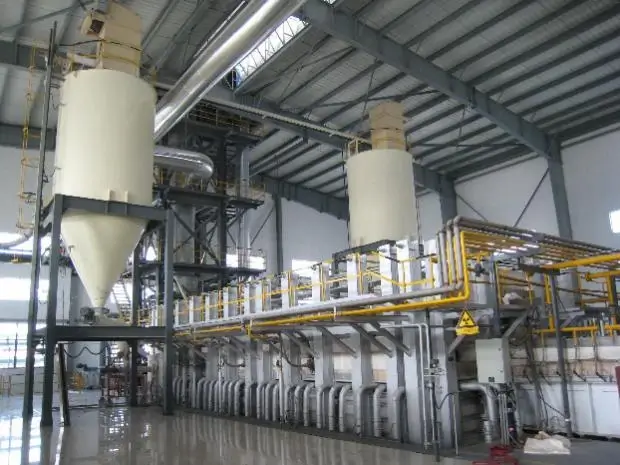
Temperature Control and Zoning
Getting the temperature right is tricky. Too hot, and the binder cures too fast—the surface hardens before the interior, trapping volatile gases. Too cold, and the binder never fully polymerizes.
Zone Control
Most glass wool curing ovens are divided into multiple zones (3 to 7 zones, depending on length). Each zone has independent temperature control and airflow. The zones allow a temperature profile: cooler at the entrance (to avoid shocking the wet wool), hottest in the middle (where curing happens), then cooler at the exit.
A typical temperature profile along the oven:
• Zone 1 (entry): 160°C
• Zone 2: 190°C
• Zone 3: 220°C
• Zone 4: 230°C
• Zone 5 (exit): 210°C
The exact numbers depend on line speed, wool thickness, and binder type.
Temperature Measurement
Thermocouples measure air temperature at multiple points. Some ovens also have infrared sensors that measure the wool surface temperature. The goal is to know the wool temperature, not just the air temperature. Because the wool has low thermal conductivity, the center of a thick mat can be much cooler than the surface.
Airflow and Pressure Balance
Hot air needs to flow through the wool, not around it. That requires a pressure difference across the mat.
Through-Air vs. Over-Air Designs
The best ovens use through-air circulation: higher pressure above the mat, lower pressure below (or vice versa). The pressure difference pushes air through the wool. Nozzles are designed to create uniform airflow across the entire width.
If the pressure is too high, the wool blows apart. Too low, the air goes around the edges. Finding the balance is part of the art.
Edge Seals
The edges of the wool mat are vulnerable. Air likes to go around the sides rather than through the thick center. Edge seals—metal plates or flexible curtains—block those paths. Without good edge seals, the edges cure faster than the center, leading to uneven properties across the width.
Exhaust and Emission Control
The curing oven emits volatile organic compounds (VOCs) from the binder. Those need to be treated.
What's in the Exhaust
The exhaust gas contains:
• Water vapor (from binder drying)
• Unreacted phenol and formaldehyde (if using traditional resin)
• Ammonia (from some binder formulations)
• Abatement oil mist (from dust suppression)
• Fine fiber dust
Control Technologies
Most plants route oven exhaust to one or more treatment systems:
1. Thermal oxidizer: Burns VOCs at 750–850°C. Very effective but uses fuel.
2. Catalytic oxidizer: Lower temperature (350–400°C) using a catalyst. Less fuel but catalyst degrades over time.
3. Wet electrostatic precipitator: Removes particulate and some VOCs.
In a complete glass wool production line, the curing oven is often the largest source of emissions after the furnace. Proper abatement is non-negotiable for regulatory compliance.
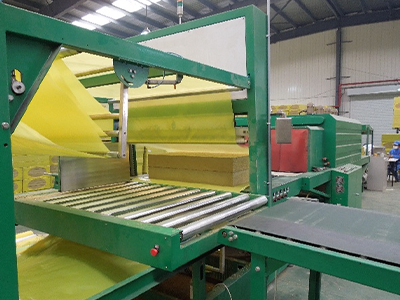
Oven Maintenance and Common Issues
Curing ovens run continuously, often for years with only brief stops. They need attention.
Common Problems
• Nozzle plugging: Dust and binder residue clog the air nozzles, reducing airflow uniformity. Regular cleaning is required.
• Conveyor belt tracking: The steel mesh belt can wander off-center, causing damage. Alignment sensors and adjustable guides help.
• Binder buildup: Uncured binder accumulates on the • conveyor and oven walls. Over time, it burns and flakes off, causing quality defects.
• Fan imbalance: The circulating fans run at high temperature. Blades collect deposits, causing vibration. Balance checks are part of annual maintenance.
Cleaning Methods
Cleaning a curing oven is unpleasant. The buildup is a sticky, semi-cured resin mixed with glass fibers. Methods include:
1. Mechanical scraping (slow, labor-intensive)
2. High-pressure water jets (messy, requires drying time)
3. Dry ice blasting (clean but expensive)
4. Burn-off cycles (heating the empty oven to 400°C to incinerate deposits — effective but uses energy)
Most plants schedule a major oven cleaning during annual furnace shutdowns.
Product Quality and the Curing Oven
The curing oven directly affects final product properties.
Cure Degree Measurement
Quality control labs measure the cure degree using:
• Loss on ignition (LOI): The binder content by weight.
• Resin extraction: Dissolving uncured binder to measure residual reactivity.
• Flexural strength: Bending a sample to see if it breaks cleanly or delaminates.
Under-cured wool feels greasy, smells strongly of resin, and has low strength. Over-cured wool is dark brown or black, brittle, and may have a burnt smell.
Thickness and Density Control
The oven compression settings determine final thickness. For a given line speed and wool weight, tighter compression gives higher density. Lower compression gives lower density. The oven can’t change density alone—it works with the forming section upstream—but it sets the final thickness.
FAQ
How hot does a glass wool curing oven get?
Typical curing temperatures are 200–250°C (390–480°F). The pre-heat zone is cooler, around 150–180°C. After the oven, the wool is cooled to near ambient temperature before packaging.
How long does the wool stay in the curing oven?
Residence time varies by product and line speed. For typical insulation batts, 30–90 seconds. Thick, high-density boards may need 2–3 minutes. Faster lines need longer ovens to achieve the same cure time.
Can a glass wool production line run without a curing oven?
No. The binder needs heat to polymerize. Without curing, the product has no strength and will fall apart. The oven is an essential part of any glass wool production line.




