
Glass wool is everywhere. In walls, attics, ducts, and even car dashboards. But the process of making it—turning sand and cullet into soft, fluffy insulation—is surprisingly complex. Walk through a glass wool plant, and it feels like a series of interconnected machines, each doing one specific job. If one system hiccups, the whole line feels it.
Having seen a few of these facilities, the best way to understand the process is to look at each system for glass wool production individually. They all have to work together, but knowing what each does makes the whole thing clearer.
This is a look at the main systems involved.
The Batch House and Raw Material System
Every system for glass wool production starts with raw materials. Glass wool is made from sand, limestone, soda ash, and a large percentage of recycled glass (cullet). The batch house is where these ingredients are stored, weighed, and mixed.
What the Batch System Does
Stores raw materials in silos or hoppers
• Weighs each ingredient precisely (recipes change by product type)
• Mixes the batch and conveys it to the furnace
• Adds colorants or special additives if needed
The batch system doesn’t get much attention, but when it fails, the whole line stops. A bad batch—wrong recipe or poor mixing—can ruin hours of production. Most modern plants have automated batching with closed-loop control. Weigh scales check themselves. Conveyors have metal detectors.
Cullet Handling
Cullet (crushed recycled glass) is a major raw material. It melts at a lower temperature than virgin materials, saving energy. But cullet needs its own handling system: magnets to remove metal, screens to control particle size, and sometimes color sorting. Too much fine cullet dust causes problems in the furnace.
The Melting Furnace System
The heart of any glass wool production line is the furnace. This is where raw materials become molten glass. Temperatures reach 1,500–1,600°C.
Furnace Types
| Furnace Type | How It Works | Typical Capacity |
|---|---|---|
| Cross-fired regenerative | Gas burners fire across the bath; regenerators preheat combustion air | 100–400 tons/day |
| Oxy-fuel | Pure oxygen instead of air; smaller footprint, lower NOx | 50–300 tons/day |
| Electric boost | Electrodes in the glass add energy to gas-fired furnace | Retrofit to increase output |
Oxy-fuel furnaces have become more common. They’re more efficient and produce fewer emissions. But they need an on-site oxygen supply—either a cryogenic plant or a vacuum pressure swing adsorption (VPSA) system.
Glass Conditioning
At the furnace exit, the molten glass passes through a conditioning channel. This system cools the glass to the right temperature for fiberizing (typically 1,100–1,200°C). It also homogenizes the glass and removes bubbles. The conditioning system includes:
• Refractory channels with precise temperature control
• Stirring devices (to mix the glass)
• Bubbler systems (to help remove tiny bubbles)

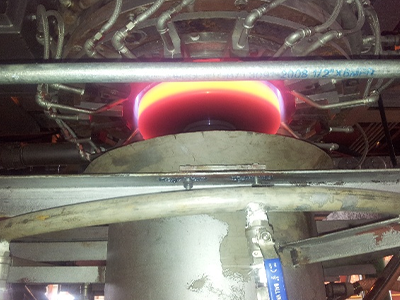
This is where glass becomes wool. The fiberizing system is the most distinctive part of any system for glass wool production. Molten glass flows into a spinning machine—called a spinner—that rotates at thousands of revolutions per minute.
How Fiberizing Works
The spinner has thousands of small holes in its outer wall. Centrifugal force throws molten glass through these holes, forming fine streams. A high-velocity gas ring (burner) blasts these streams, attenuating them into thin fibers. A binder (usually phenol-formaldehyde or a bio-based alternative) is sprayed onto the fibers as they form.
The fiberizing system includes:
• The spinner itself (a consumable part that wears out every few weeks)
• The gas burner ring (precise control of gas and air)
• Binder spray nozzles (atomize the resin)
• An annular suction slot that pulls fibers downward onto a conveyor
Spinner Maintenance
Spinners run at extreme conditions—high temperature, high speed, and chemical exposure. They last anywhere from 200 to 800 hours depending on the product. Changing a spinner is a precise, time-sensitive operation. The old spinner comes out; a pre-heated new one goes in. The line can’t stop for long.
The Forming and Curing System
Once fibers are formed, they fall onto a moving conveyor. This is where the wool becomes a continuous mat. The forming and curing system turns loose fibers into a rigid board or flexible blanket.
Fiber Collection and Mat Formation
A vacuum draws the fibers onto the conveyor, creating a uniform mat. The conveyor passes through a series of compression rollers and ovens. The mat’s thickness and density are controlled by the conveyor speed and compression.
The key parts:
• Collection chamber: Fibers drop; vacuum pulls them down
• Pre-compression rolls: Squeeze the mat to remove air and initiate bonding
• Curing oven: Heated air (200–250°C) cures the binder, locking the fibers together
The Curing Oven
The curing oven is massive—often 30–50 meters long. The mat passes through while hot air circulates through it. The binder cross-links (polymerizes), turning from a sticky liquid into a solid, water-resistant bond. The oven exhaust contains binder vapors, which are typically sent to a thermal oxidizer or wet electrostatic precipitator for treatment.
Exhaust gas from the curing oven is often used to preheat combustion air for the furnace. That’s one example of how different systems for glass wool production integrate.
The Cooling and Sizing System
After the oven, the wool is still warm—maybe 150–200°C. It needs to cool before handling. The cooling system pulls room air through the mat, dropping the temperature to near ambient.
Cooling and Trimming
Cooling section: Fans pull air through the mat from the bottom
• Edge trimming: Rotary knives cut off the uneven edges
• Length cutting: A flying shear cuts the continuous board into panels
• Stacking: The cut pieces are stacked automatically
Edge trim and off-cuts are typically ground up and returned to the furnace as cullet. Good plants recycle nearly all internal scrap.
The Packaging System
Final products need to be wrapped, labeled, and palletized. The packaging system varies by product type:
| Product Type | Packaging Method |
|---|---|
| Batts (faced or unfaced) | Compressed, bagged in plastic, stacked on pallets |
| Boards (rigid) | Stacked, shrink-wrapped, labeled |
| Pipe insulation | Cartoned or bagged |
| Loose fill | Bagged in large plastic bags |
Compression is important for batts. They come out of the line fluffy. The packaging system compresses them to a fraction of their original volume, then bags them. They spring back when opened at the job site.
Ancillary and Support Systems
Beyond the main production systems, a glass wool production line depends on several support systems.
Binder Preparation
Binder doesn’t come ready-to-use. It’s mixed on-site from concentrate, water, and additives (silane coupling agents, dust-suppressing oils, sometimes colorants). The binder system includes:
• Storage tanks for concentrate
• Mixing and dilution skids
• pH and viscosity control
• Circulation pumps to keep the binder from settling
Exhaust Gas Treatment
The furnace and curing oven produce exhaust that must be treated. Systems include:
• Bag filters or wet electrostatic precipitators for particulate
• Thermal oxidizers for organic compounds
• Scrubbers for acid gases (SO₂, HCl)
Cooling Water and Compressed Air
Every factory needs utilities. For glass wool, cooling water is used for furnace electrodes, spinner bearings, and air compressors. Compressed air runs pneumatic valves, cleaning systems, and controls.
FAQ
What is the most critical system in glass wool production?
The fiberizing system (spinner and gas ring) is the most unique and sensitive. If it fails, production stops immediately. But the furnace is equally critical—it takes days to restart.
How long does a glass wool production line run between shutdowns?
Continuous operation of 6–12 months is typical. Furnace refractory needs replacement every 5–8 years, requiring a longer shutdown. Some lines run for years with only brief stops for spinner changes.
Can the same production line make different glass wool products?
Yes, but not instantly. Changing from low-density attic insulation to high-density board requires adjustments to the binder system, oven temperature, and compression settings. Changeovers take hours. Many lines specialize in one product family for efficiency.




