
Mineral wool remains the leader among thermal insulation materials in the Russian and near-international markets. Choosing the right production capacity for your mineral wool line becomes the foundation of a successful business. This decision directly affects cost control, the operational efficiency of your basalt fiber equipment, and the competitiveness of your enterprise in the local market.
Product characteristics — inability to store for long periods, wide product range, and high logistics demands — make capacity selection a multi-faceted decision. In this practical guide from RWOOL, we will break down the key principles, the features of different line scales, and how to adapt a mineral wool production line to the Russian market conditions using our company’s modern equipment.
Key Specifics of Mineral Wool – Why Capacity Selection Requires Attention
Mineral wool production has unique characteristics that define all the rules for capacity selection – ignoring them means risking high costs and inefficient operation of your RWOOL mineral wool production line equipment.
Production Features That Limit Capacity Selection
1. No inventory – production only on demand: Mineral wool loses quality over time (softens, changes color), so long-term storage is not possible. A wide product range (over 100 types by density, thickness, and size) requires precise alignment of production with market demand.
2. Large volume – high logistics demands: The low density of the material limits stacking height (2–4 meters). This requires close coordination between production, warehouse management, and logistics – any mismatch leads to resource loss.
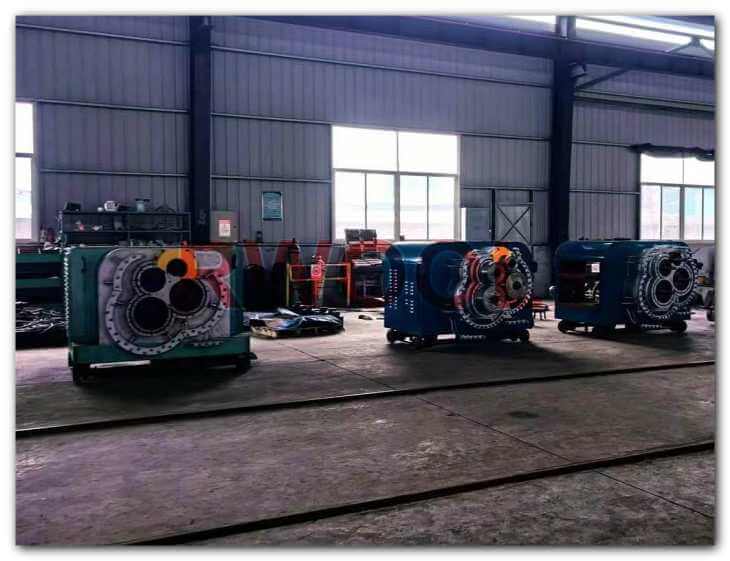
3. Product changeover – loss of time and raw materials: When changing product specifications, the line stops for at least 10 minutes, generating waste. The higher the capacity of the mineral wool production line, the greater the losses during frequent product changeovers – an important factor to consider when selecting the RWOOL XTLI22-LXJ-360D8 centrifugal machine and other key components.
These features mean: high-power lines are profitable only for large orders of the same type, and for the Russian market with scattered demand, flexible low- and medium-power options are better suited.
Mineral wool production lines of different capacities – who is each option suitable for?
The annual capacity of mineral wool lines is divided into five main classes, but three groups are the most relevant for the Russian market – each with eigenen advantages and adapted to our conditions. At the same time, RWOOL offers equipment for any scale, including the most popular line for the production of mineral wool 50000 tons per year.
Comparison of Mineral Wool Production Lines by Capacity
| Capacity Range | Best For | Key Advantages | Typical Investment Level |
|---|---|---|---|
| 10,000–25,000 tons/year | Startups and new businesses | Low initial investment, high flexibility, quick changeover, low maintenance requirements | Low |
| 30,000–40,000 tons/year | Companies with stable customer base | Balance between capacity and flexibility, lower unit costs, handles both bulk and diversified orders | Medium |
| 50,000+ tons/year | Large-scale industrial enterprises | Maximum output per hour, lowest unit cost, high efficiency for long production runs | High |
Low-capacity lines (10-25 thousand tons/year) are the best choice for startups
The low-capacity mineral wool line is the gold standard for new businesses in the Russian market: it combines low initial investment with high flexibility, which is critical when adapting to local demand.
- Advantages: Short adaptation period: production-warehouse-sales; Low requirements for maintenance and personnel, quick change of assortment without significant losses. With a limited budget, choose 10-20 thousand tons / year, with a sufficient one – 20-25 thousand tons / year.
- RWOOL equipment: Compact equipment is ideal for such lines – an oil-free centrifuge for mineral wool XTLI22-LXJ-360D8, energy-efficient cutting machines and small-scale furnaces that ensure high product quality at minimal cost.
- Expansion: Later, it is possible to supplement the line with high-pressure centrifuge fans or add a second line – flexibly adjusting the power to customer demand.
The only drawback is the relatively high average costs, but at the initial stage this is compensated by low risks.
Medium-capacity lines (30-40 thousand tons/year) – balancing capacity and flexibility
A medium-capacity mineral wool line is a versatile option for companies with a stable customer base (construction companies, industrial enterprises) and a desire to increase production without losing flexibility.
- Advantages: Optimal ratio of production capacity to operating costs, the ability to efficiently process both large orders of the same type and diversified demand, as well as low unit costs per unit of production in comparison with less powerful production lines.
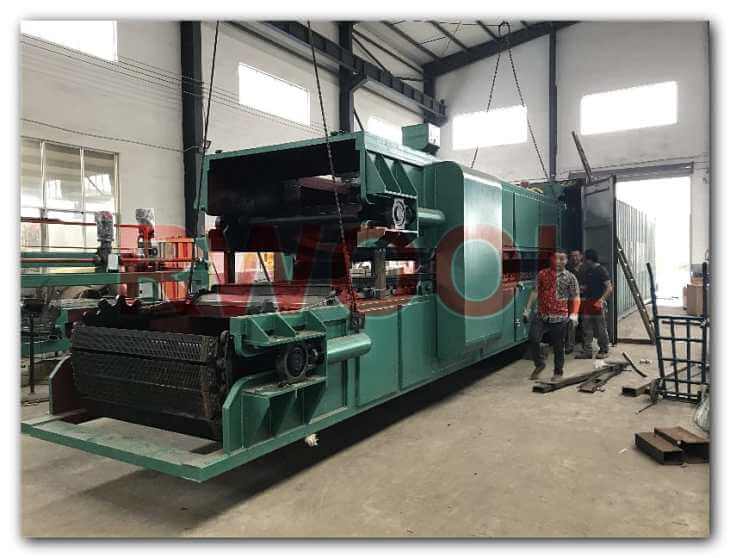
- Equipment from RWOOL: Comprehensive equipment, including modernized furnaces and automated cutting machines, ensuring stable operation and high quality basalt fiber.
In the Russian market, medium-power lines are the most popular – they meet the demand of most customers and do not require huge investments in maintenance.
High-capacity lines (40-55 thousand tons/year) – for large players with a stable market
A high-capacity mineral wool line (including a 50,000 tonnes annual mineral wool production line from RWOOL) is not suitable for start-ups – it requires serious conditions, but it becomes a profitable choice for large enterprises with a wide customer base.
1. Requirements: Stable high demand (government contracts, long-term agreements with construction holdings), large orders of the same type and a high level of maintenance.
2. Advantages: Minimum cost of mineral wool production under stable operating conditions, the ability to meet mass market demand and compliance with modern industrial standards. RWOOL offers two furnace options for these production lines: an electric furnace and a coke oven for the production of mineral wool. We are ready to find the best solution for your technical requirements and operating conditions.
3. Investment: Upfront costs are higher but pay off due to the low cost of production. High-quality equipment (XTLI22-LXJ-360D8 centrifuges, high-pressure fans) reduces the risk of downtime and increases service life.
Large enterprises often use a combined approach: one high-capacity line is combined with a small flexible one – differentiating sales and maintaining the stable operation of the main equipment.
The main factors in choosing power are adaptation to the Russian market
When choosing the capacity of a mineral wool production line for the Russian market, it is necessary to comprehensively analyze three key factors – all of them are taken into account in the development of equipment for RWOOL mineral wool.
The cost of mineral wool production is not only an initial investment
In the Russian market, the price of mineral wool is $600-950 per tonne – extreme cost control (as in the Chinese market) is not required. Therefore, you should not overpay for high-power lines if there is no stable mass demand – it is better to choose a medium-power line with high-quality equipment that provides low cost without unnecessary investment.
When choosing, consider not only the cost of the equipment, but also the cost of operation: the energy efficiency of stoves, the reliability of centrifuges and cutting machines, the cost of spare parts. RWOOL mineral wool equipment has optimal performance parameters – reducing fixed costs and increasing profitability.
Technical features of the equipment - adaptation to Russian conditions
How to choose a mineral wool production line taking into account technical requirements? Highlights for the Russian market:
1. Maintenance: The higher the capacity, the higher the requirements for personnel – RWOOL offers equipment with easy maintenance and full support (spare parts delivery, staff training).
2. Quality of components: Key parts (XTLI22-LXJ-360D8 centrifuge, high-pressure fans) are reliable – reducing downtime risks and extending service life.
3. Furnace selection: Electric furnaces and coke ovens are relevant for the Russian market – we provide a detailed comparison of their technical and economic parameters, helping to choose the best option.
Market demand is the main criterion for choosing capacity
The capacity of the mineral wool production line must exactly match the demand in the Russian market:
- If you work with small/medium customers (local construction companies, repair firms) – choose a low- or medium-capacity flexible line.
- If there are long-term contracts with large holdings/government organizations, consider a high-capacity 50000 tons of mineral wool production line from RWOOL.
- Take into account regional specifics: the demand for mineral wool varies by region of Russia – adapt the capacity to local requirements.
Modern equipment for mineral wool from RWOOL - for any scale of production
No matter how you choose the capacity of your mineral wool production line, quality equipment is a key factor in successful operation. RWOOL offers a complete solution – from compact lines for start-ups to high-capacity mineral wool production lines of 50000 tons per year for large enterprises.
Key components of the mineral wool production line from RWOOL
Rock Wool Centrifuge XTLI22-LXJ-360D8: The oil-free model is the main component of any line, ensuring the high quality of basalt fiber.
- High-pressure fans for centrifuges: Innovative solutions to ensure the right air pressure and quality of the end product.
- Cutting machines: Automated pneumatic and servo-driven mechanisms adapted to different production volumes.
- Furnaces: For high-power lines – electric furnaces and coke ovens with a detailed comparison of parameters for Russian conditions.
- Full support: Delivery, installation, staff training, delivery of spare parts and ongoing maintenance.
Visit us at MosBuild exhibitions – see the equipment in action
RWOOL invites you to exhibitions dedicated to construction equipment and other construction exhibitions, for example, MosBuild. We try to take part in all sites where you can present mineral wool equipment.
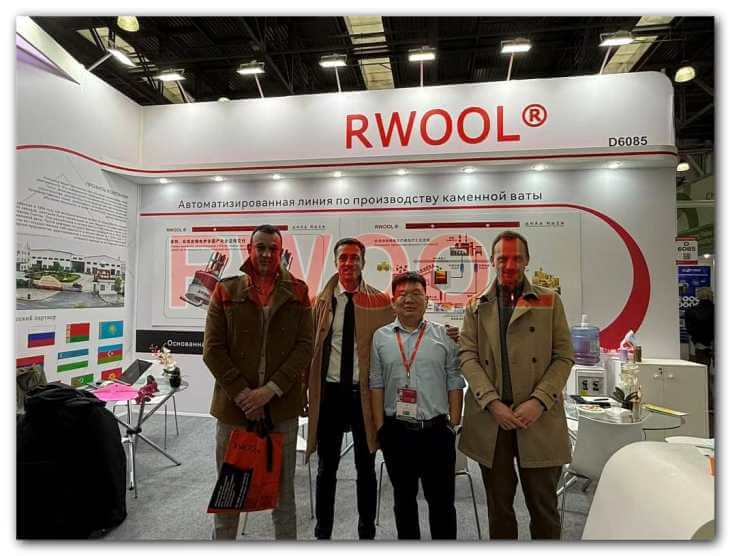
For example, at the last MosBuild 2026 exhibition, the specialists of our company provided all interested parties with more than 200 information materials, provided consulting services to 56 visitors, and received more than two dozen applications for various types of equipment.
There you can:
- Get acquainted with the advanced concept of basalt fiber production equipment;
- See the operation of key components (XTLI22-LXJ-360D8 centrifuge, furnaces, cutting machines) in action;
- Consult with our specialists on the selection of the capacity of the mineral wool production line and the selection of equipment;
- Get an answer to the question, an electric furnace or a coke oven for a mineral wool line, for your business tasks.
The result is a simple rule for choosing capacity for the Russian market
How to choose the capacity of a mineral wool line for successful operation in the Russian market? It all comes down to one basic principle: matching local demand and our own capabilities, complemented by the choice of quality RWOOL mineral wool equipment.
- For startups: Low-capacity mineral wool line of 10-25 thousand tons/year minimizes risks and allows you to quickly adapt to the market.
- For enterprises with stable demand: Medium-capacity mineral wool line of 30-40 thousand tons / year – a balance of capacity, flexibility and low cost.
- For large players: A high-capacity mineral wool line of 40-55 thousand tons/year (including 50,000 tons/year) is a profitable choice for long-term contracts and mass demand.
It is not worth investing in high-power lines just for status – their effectiveness is realized only when they are stable. It is better to choose a capacity that corresponds to your customer base, and equip the line with equipment from RWOOL – this guarantees stability, high quality of products and competitiveness in the Russian market.
FAQ
Why can't mineral wool be stored for long periods, and how does this affect capacity selection?
Mineral wool degrades over time (softens, changes color) and is sensitive to moisture, making long-term storage impractical. This means production must be closely aligned with market demand. If capacity is too high relative to actual orders, it leads to equipment idling and resource waste. If capacity is too low, the company cannot meet customer demand on time. Therefore, capacity selection must be matched with real sales volume and order rhythm.
Why does product changeover cause losses, and are high-capacity lines less flexible?
When switching between different product specifications (e.g., density, thickness), a mineral wool line typically stops for at least 10 minutes, generating waste material. On a high-capacity line, every minute of downtime results in significantly greater losses. Therefore, if a company produces a wide range of products in small batches, a medium or modular capacity configuration is often more economical and flexible than a single high-capacity line.
How do logistics conditions influence capacity selection for a mineral wool line?
Mineral wool has low density and limited stacking height (typically 2–4 meters), which places high demands on warehouse space and transportation capacity. If production capacity exceeds the plant’s shipping or warehouse turnover capabilities, it leads to product backlog, increased storage costs, and delayed deliveries. As a result, capacity decisions must always be made in conjunction with an assessment of logistics and warehousing capacity to maintain a balanced flow from production to storage to shipment.




