
Introduction: Why Industrial Centrifuges Matter in Rock Wool Production
Rock wool is widely used across industrial facilities, mechanical equipment, and construction projects due to its fire resistance, thermal performance, and dimensional stability. In large-scale manufacturing environments, the efficiency and consistency of rock wool production directly affects product quality, operating costs, and delivery cycles.
One of the most critical pieces of equipment in a modern rock wool production line is the Industrial Centrifuge. This machine handles molten rock fibers during spinning and forming, ensuring uniform fiber shaping and stable material density. In B2B procurement, understanding how industrial centrifuges function allows factories, EPC contractors, and decision-makers to evaluate supplier capability, process reliability, and long-term operational efficiency.
Understanding the Role of Industrial Centrifuges
Industrial centrifuges are separation and forming machines used in different industries such as mining, pharmaceuticals, wastewater treatment, and fiber production. In rock wool manufacturing, the centrifuge spins molten rock into fine fibers through high-speed rotation and controlled airflow.
This process determines the fiber length, fineness, and distribution — all factors that influence insulation performance. To better understand how this equipment operates in various industries and why its design matters, an additional resource may be helpful. For more information, see our article What is an Industrial Centrifuge Machine and How Does it Work?
How Industrial Centrifuges Function in a Rock Wool Production Line
Rock wool production is a continuous and highly standardized industrial process. While every production line differs in layout, each follows four main stages where industrial centrifuges play a vital role.
Stage 1 – Fiber Formation From Molten Rock
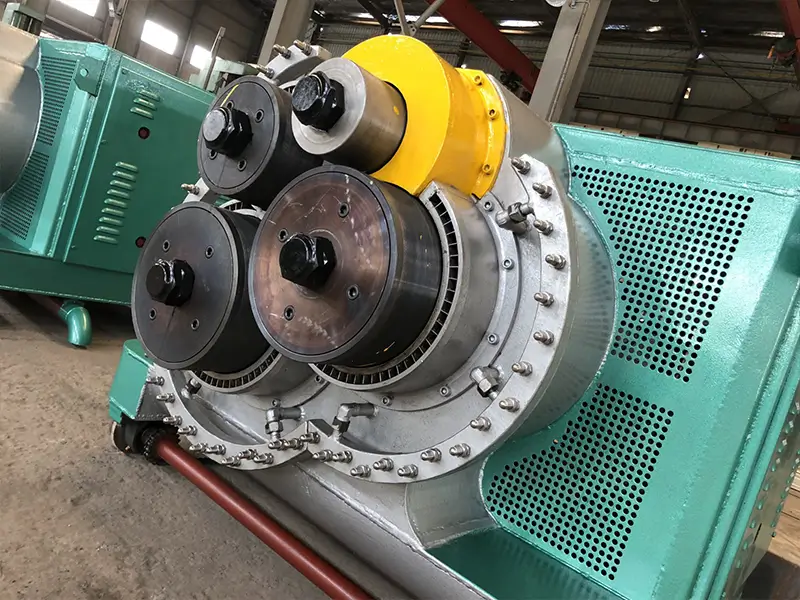
Raw materials are melted into liquid form in a furnace. The molten mixture flows into Industrial Centrifuges, where rapid rotation converts the liquid into fine fibers. These fibers are the foundation of rock wool. High-performance centrifuge systems produce fibers that are:
- Consistent in thickness
- Well distributed
- Stable for further processing
Uniform fiber formation reduces wasted material and ensures better insulation performance.
Stage 2 – Fiber Droplet Separation and Slag Removal
During fiber spinning, small particles and impurities may appear. Industrial centrifuges separate these particles before they enter downstream processing. In a B2B purchasing environment, this stage matters because:
- Efficient separation reduces defects and scrap
- Cleaner fibers improve bonding with binder resins
- Waste management costs decrease over time
Industrial centrifuges improve operational efficiency while reducing manual inspection and waste handling.
Stage 3 – Fiber Distribution and Mat Forming
After separation, the fibers move to forming equipment. Centrifuges help regulate the fiber distribution rate, contributing to uniform mat formation. This stage influences:
- Product density stability
- Dimensional uniformity
- Surface flatness of the final insulation board or blanket
Rock wool producers aim for repeatability and uniformity, especially when supplying for large industrial projects or building material distributors.
Stage 4 – Delivery to Downstream Processing
After fiber mat formation, the material continues to curing, trimming, cutting, and packaging. Stable and consistent fiber output reduces machine stops and quality adjustments.
For B2B end buyers — including insulation manufacturers, distributors, and EPC project operators — reliable centrifuge performance decreases downtime and operating cost.
Benefits of Industrial Centrifuges in Rock Wool Manufacturing
Industrial centrifuges bring measurable business value in B2B operations. Instead of focusing solely on raw capacity, buyers often evaluate process reliability and total lifecycle value. Key benefits include:
Consistent Fiber Quality: Stable centrifuge motion ensures uniform fibers, improving product appearance and application performance.
Increased Operational Efficiency: Automation reduces manual labor and speeds up forming and separation.
Lower Material Waste: Efficient slag separation decreases reprocessing and disposal cost.
Predictable Production Output: High repeatability supports long-cycle orders and reduces customer complaints. In procurement decisions, these benefits directly impact cost control and project ROI.
Why Choose a Supplier With Complete Production Line Capabilities
Selecting the right centrifuge supplier is critical. In rock wool projects, buyers typically prefer equipment suppliers that provide:
- Full design and production line planning
- Training and technical guidance
- Continuous after-sales service and process improvement
- Support for technological transformation and system upgrades
A supplier with integrated capabilities reduces project risk and speeds up implementation.
About RWOOL — Supporting Rock Wool Projects from Concept to Production
RWOOL is an integrated rock wool production line manufacturer. The company provides services including:
- Design of civil construction
- Research and development of automated production lines
- Organization of production processes
- Staff training
- Technological upgrades and diversification
With decades of experience in heavy industry processing, the enterprise maintains leading precision engineering capability. The team consistently focuses on innovation and iterative improvement, implementing internal design standards that cover the entire production life cycle — from concept planning to production operation. RWOOL emphasizes automation, process reliability, and scalable production solutions to support rock wool manufacturers in the global market.
Conclusion: Industrial Centrifuges Enable High-Efficiency Rock Wool Production
Industrial centrifuges are essential to modern rock wool manufacturing. They enable cleaner fiber formation, stable separation, reduced waste, and improved product consistency. For B2B buyers, selecting the right supplier is not just an equipment decision — it is a strategic choice that influences production capability, operational cost, and market competitiveness. Industrial centrifuges are not merely machines — they are the foundation of efficient rock wool manufacturing. By partnering with a production line provider that understands the complete process, manufacturers can achieve:
- Higher productivity
- Better fiber consistency
- Lower operational risk




