
1. Product Overview
The high-speed pendulum system is a key piece of equipment in the fiber-forming section of a 2.4 m-wide rock wool production line. It reciprocally lays the fiber wool layer discharged by the wool collector to form a uniform wool mat. Its operating speed, positioning accuracy, and operational stability directly determine the production-capacity ceiling of the entire line and the uniformity of the finished product’s areal density.
Mainstream pendulum systems currently face a common speed bottleneck: their practical speed is generally only 80-90 m/min, while their maximum no-load speed is approximately 110 m/min. They also suffer from excessive areal density and restricted output, making it difficult to meet the core requirements of large-scale, high-quality production.
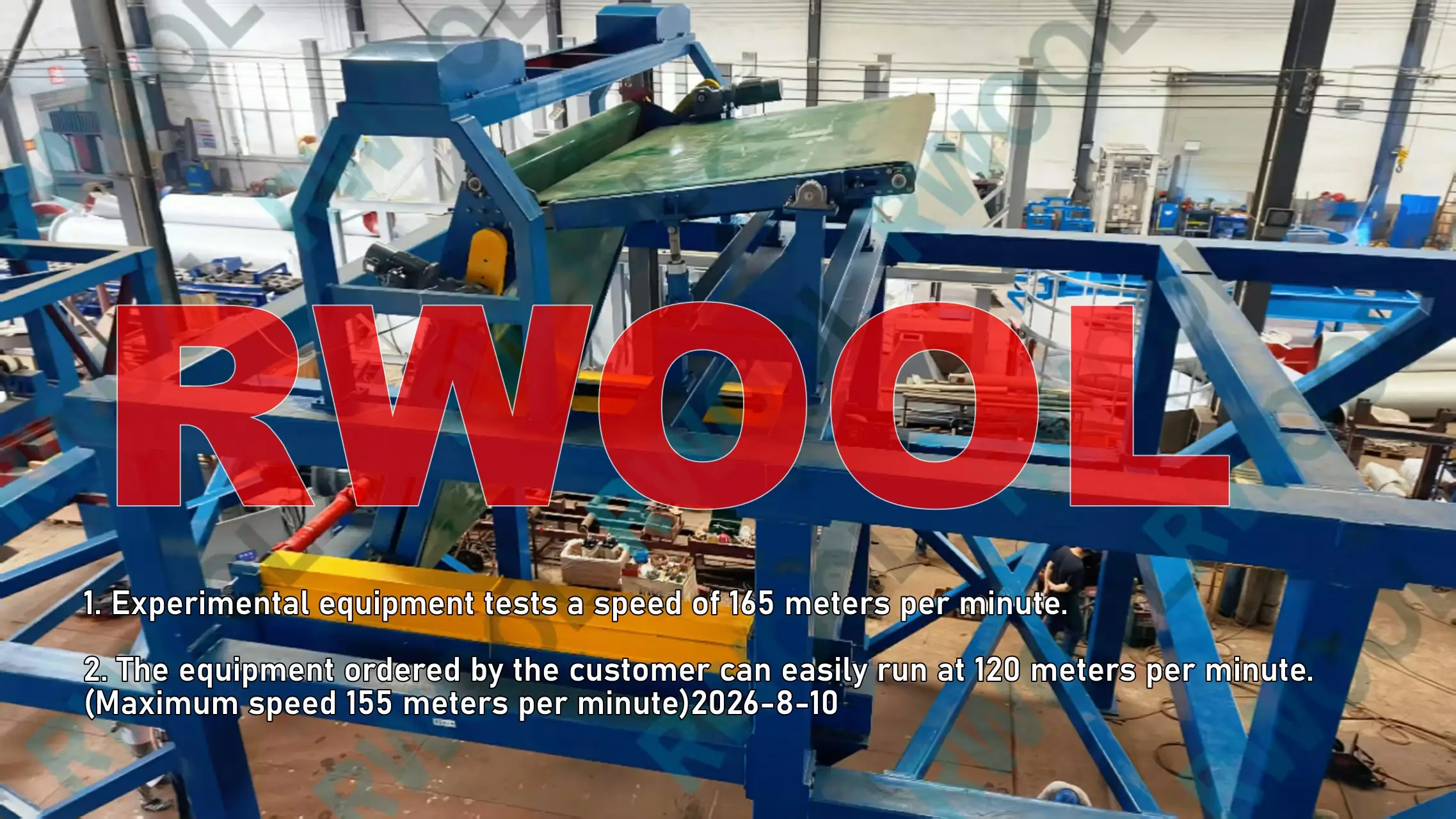
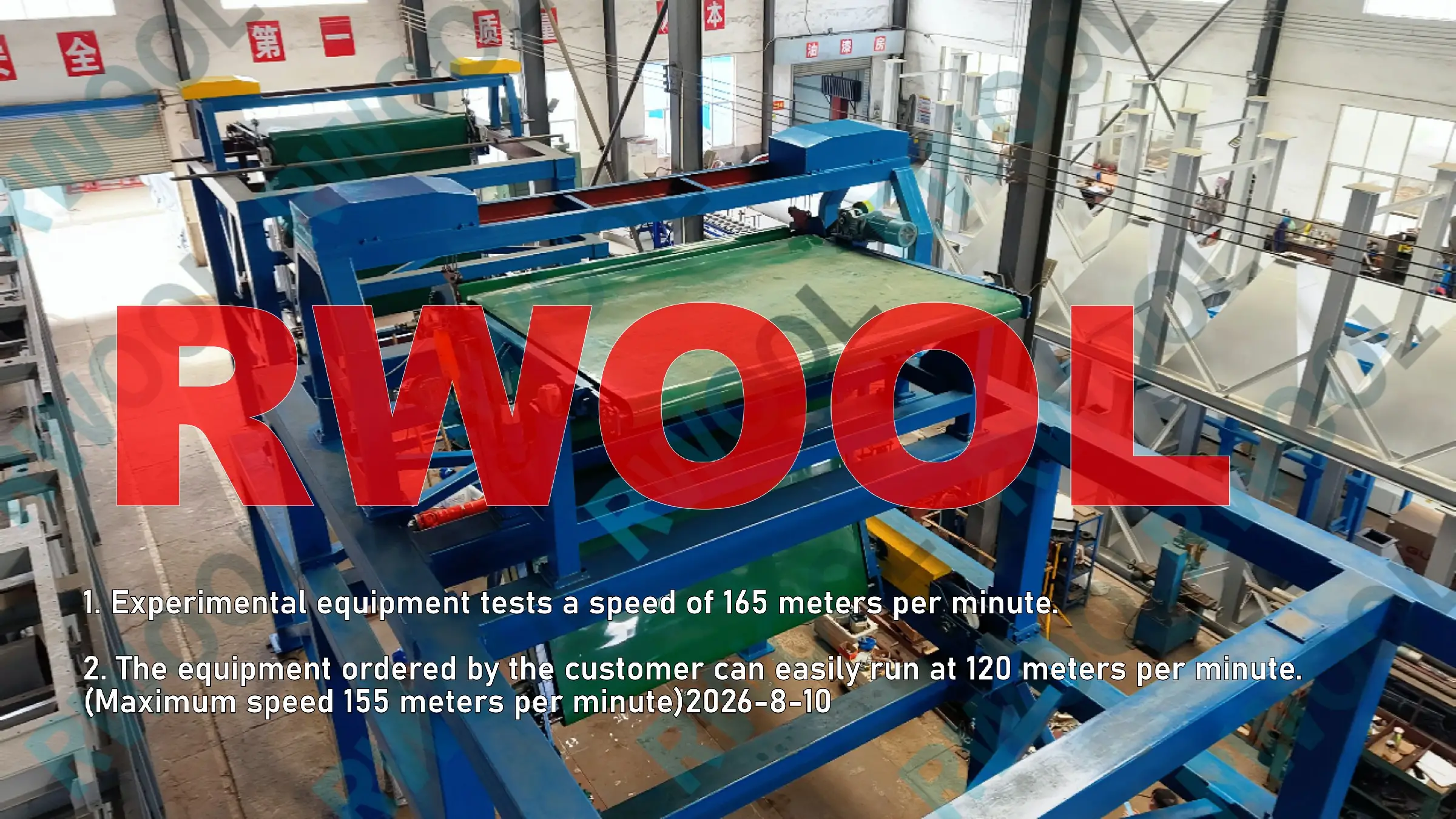
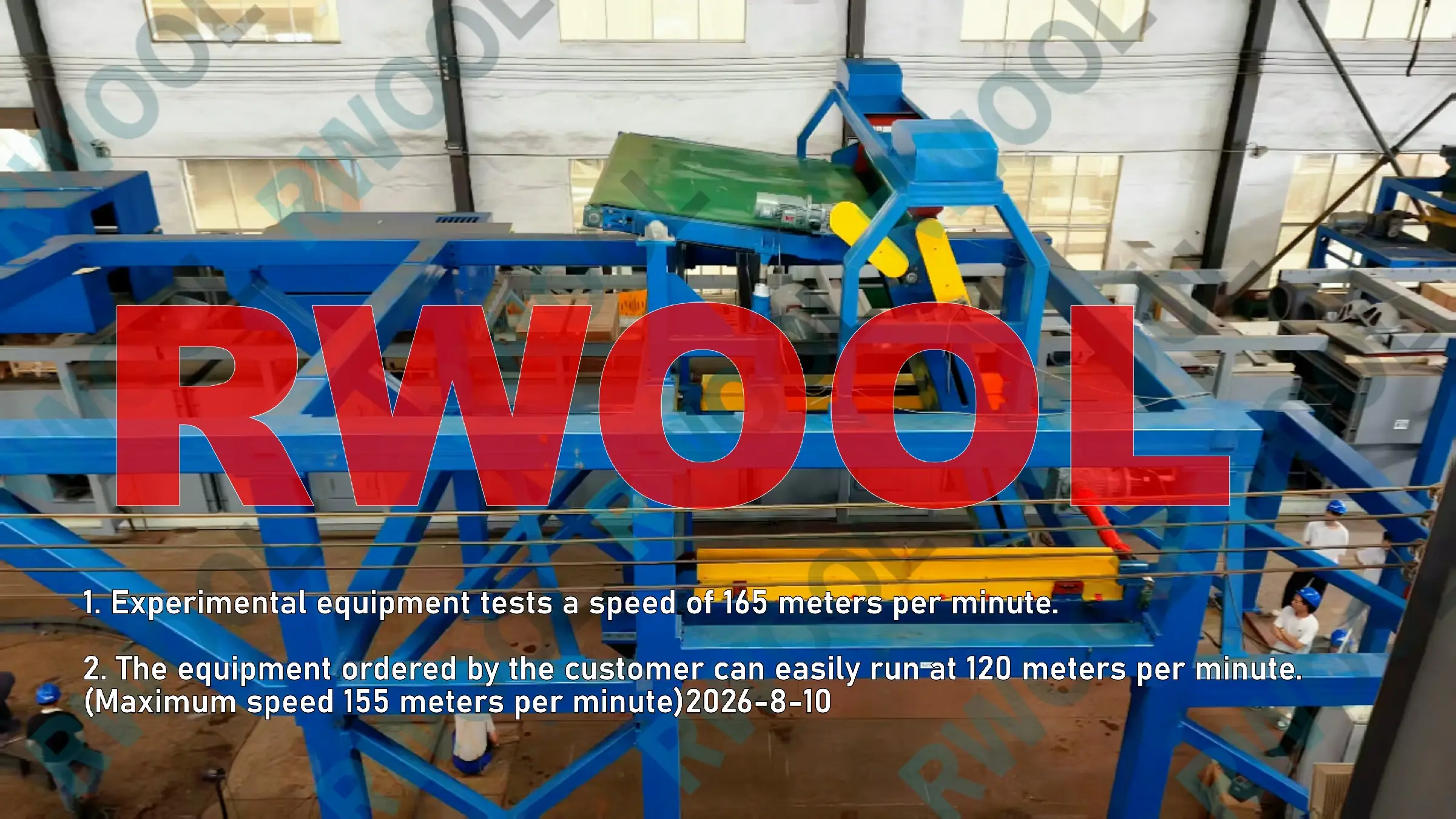
Our newly developed high-speed pendulum system for 2.4 m production lines breaks through these industry limitations with a maximum design speed of 165 m/min, surpassing the industry’s previous 110 m/min ceiling. Beginning with an experimental model last year, the system has undergone a complete process of development, testing, and optimization and is now available as a finished product for customer delivery. Complete technical documentation and process parameters are available. It is currently the only high-speed pendulum system in the Chinese market available for serial production and supply at this speed level. It also offers international customers the combined competitive advantages of an advanced structure and attractive pricing.
2. Speed-Areal Density-Output Comparison
2.1 Process Parameter Comparison
The following table shows hourly output at different pendulum operating speeds and areal densities. The effective laying width is 2.7 m.
| Areal density (g/m²) | 80 m/min / 216 m² | 90 m/min / 243 m² | 100 m/min / 270 m² | 110 m/min / 297 m² | 120 m/min / 324 m² | 130 m/min / 351 m² | 140 m/min / 378 m² | 150 m/min / 405 m² | 165 m/min / 445.5 m² |
| 240 | 3,110 | 3,499 | 3,888 | 4,277 | 4,666 | 5,054 | 5,443 | 5,832 | 6,415 |
| 275 | 3,564 | 4,010 | 4,455 | 4,901 | 5,346 | 5,792 | 6,237 | 6,683 | 7,351 |
| 280 | 3,629 | 4,082 | 4,536 | 4,990 | 5,443 | 5,897 | 6,350 | 6,804 | 7,484 |
| 300 | 3,888 | 4,374 | 4,860 | 5,346 | 5,832 | 6,318 | 6,804 | 7,290 | 8,019 |
| 320 | 4,147 | 4,666 | 5,184 | 5,702 | 6,221 | 6,739 | 7,258 | 7,776 | 8,554 |
| 330 | 4,277 | 4,811 | 5,346 | 5,881 | 6,415 | 6,950 | 7,484 | 8,019 | 8,821 |
| 350 | 4,536 | 5,103 | 5,670 | 6,237 | 6,804 | 7,371 | 7,938 | 8,505 | 9,356 |
| 370 | 4,795 | 5,395 | 5,994 | 6,593 | 7,193 | 7,792 | 8,392 | 8,991 | 9,890 |
| 400 | 5,184 | 5,832 | 6,480 | 7,128 | 7,776 | 8,424 | 9,072 | 9,720 | 10,692 |
| 450 | 5,832 | 6,561 | 7,290 | 8,019 | 8,748 | 9,477 | 10,206 | 10,935 | 12,029 |
| 470 | 6,091 | 6,853 | 7,614 | 8,375 | 9,137 | 9,898 | 10,660 | 11,421 | 12,563 |
| 500 | 6,480 | 7,290 | 8,100 | 8,910 | 9,720 | 10,530 | 11,340 | 12,150 | 13,365 |
Unit note: Values in the table represent hourly output (kg/h). Effective pendulum laying width: 2.7 m. Area = speed × width × 60 minutes.
2.2 Operating-Zone Classification
| Zone | Color | Areal-density range | Speed range | Description |
| Basic operating zone | Green | 450-500 g/m² | 80-100 m/min | The basic range associated with prevailing national-standard requirements and the conventional operating range of mainstream equipment. |
| Extended operating zone | Dark red | 320-400 g/m² | 100-140 m/min | The stable operating range of our equipment, with areal density reduced below 350 g/m² and speed increased to 120-140 m/min. |
| Theoretical limit zone | Light red/pink | 240-300 g/m² | 120-165 m/min | The theoretically achievable design range, providing technical reserve for future product and capacity upgrades. |
2.3 Interpretation of Operating Zones and Technical Reserve
Current industry status (green zone):
- The national standard requires rock wool areal density below 450 g/m², while mainstream equipment generally operates at 450-500 g/m².
- Operating speed is only 80-100 m/min, limiting output to 5,800-8,100 kg/h.
- This is the industry’s current basic qualification threshold and the capability ceiling of most equipment.
Our capability (dark-red zone):
- Areal density can be controlled steadily at 350 g/m² or lower.
- Operating speed can reach 120-150 m/min.
- At the same areal density, output increases by more than 50%.
- At the same output, areal density is greatly reduced and product quality is significantly improved.
- This is the equipment’s regular stable operating range and has been validated through delivery of finished machines.
Technical reserve (pink zone):
- Maximum design speed is 165 m/min, and theoretical areal density can be as low as 240 g/m².
- This capacity is reserved for future product requirements.
- When industry standards or customer requirements increase, existing capability can be released without redeveloping the system.
- The equipment is designed to retain technological leadership over the next 5-10 years.
2.4 Interpretation of Key Data
Based on the 450 g/m² national-standard threshold:
| Speed | Output | Increase vs. 80 m/min | Significance |
| 80 m/min | 5,832 kg/h | Baseline | Conventional industry level |
| 100 m/min | 7,290 kg/h | +25% | Upper end of the conventional industry range |
| 120 m/min | 8,748 kg/h | +50% | Starting point of our regular operating range |
| 150 m/min | 10,935 kg/h | +87.5% | Our stable operating range |
| 165 m/min | 12,029 kg/h | +106% | Design limit and technical reserve |
Based on a premium product areal density of 350 g/m²:
| Speed | Output | Product level |
| 100 m/min | 5,670 kg/h | Premium product, low-speed production |
| 120 m/min | 6,804 kg/h | Premium product, medium-speed production |
| 150 m/min | 8,505 kg/h | Premium product, high-speed mass production |
| 165 m/min | 9,356 kg/h | Premium product, maximum capacity |
Key conclusion: Within the customer’s required operating range of 120-150 m/min, the equipment can steadily produce premium rock wool with an areal density of 350 g/m² while retaining ample speed reserve (up to 165 m/min) and areal-density reserve (down to 240 g/m²), leaving sufficient room for future capacity expansion and product upgrades.
3. Core Technological Breakthroughs
3.1 Speed Innovation – Breaking the Industry Speed Ceiling
| Indicator | Mainstream equipment | This high-speed pendulum system | Improvement |
| Practical operating speed | 90-100 m/min | 120-150 m/min | More than 50% |
| Maximum design speed | 120 m/min (no load) | 165 m/min | 37.5% |
| Rated operating-speed range | – | 120-150 m/min | Far above the industry average |
Key note: The system has a maximum design speed of 165 m/min. When operating within the customer’s normal required range of 120-150 m/min, it remains comfortably below its rated limit, providing ample load margin and strong assurance of operating stability, component life, and maintenance intervals.
3.2 Quality Improvement – Areal-Density Control Beyond the National Standard
The national standard explicitly requires rock wool areal density below 450 g/m², while mainstream equipment commonly produces values above 500 g/m². Through stable high-speed operation, this system improves both quality and efficiency.
| Operating speed | Areal-density control | Corresponding output | Quality level |
| 90 m/min | Precisely controlled at 450 g/m² | 6.56 t/h | National-standard threshold |
| 140 m/min | Can be reduced to 320 g/m² | 7.26 t/h | Premium product level |
| 150 m/min | Steadily controlled below 350 g/m² | 8.5 t/h | Premium mass-production level |
- Surface uniformity and compactness are significantly improved.
- Premium rock wool production standards are readily met.
- Laying uniformity is greatly improved, ensuring excellent product consistency.
3.3 Capacity Breakthrough – Enabling Output Above 8 t/h from a Single Spinning Machine
The output of a single spinning machine is commonly limited to less than 8 t/h, creating a key bottleneck for large-scale production. Increasing the speed of this system breaks that bottleneck:
- At 150 m/min, areal density remains steadily controlled below 350 g/m².
- Output from a single spinning machine readily exceeds 8 t/h.
- Total line capacity increases directly by more than 30%.
- Capacity can be expanded without adding more spinning machines.
4. Drive-System Configuration
The pendulum system uses a complete servo-drive solution. The primary laying motion and belt conveying are independently driven to provide precise speed control and position synchronization.
4.1 Main Drive – 45 kW Servo Motor for Reciprocating Wool Laying
| Item | Parameter |
| Drive method | Servo motor drive |
| Motor power | 45 kW |
| Function | Drives the pendulum body in reciprocating linear motion for back-and-forth wool laying |
| Control accuracy | High-precision closed-loop position control |
| Response | Rapid acceleration/deceleration and smooth, impact-free reversal |
4.2 Belt Drive – 2 × 3 kW Servo Motors
| Item | Parameter |
| Drive method | Servo motor drive |
| Number of motors | 2 |
| Power per motor | 3 kW |
| Function | Drives the conveyor belts in precise synchronization with pendulum movement |
| Synchronized control | Real-time linkage with the main drive ensures laying accuracy |
4.3 Drive-System Advantages
- Full servo solution: Dual closed-loop speed and position control provides far greater accuracy than variable-frequency drive systems.
- Independent drives: The main motion and belt conveying operate independently without mutual interference, ensuring high synchronization accuracy.
- Fast response: Excellent acceleration and deceleration performance minimizes reversal impact.
- Energy efficiency: High-efficiency servo motors consume less energy than conventional drive systems.
5. Structural Design and Core Materials
Stable high-speed operation is enabled by an extremely lightweight design and the precise selection of high-quality materials. Scientific structural design and high-precision machining reduce the overall weight of the main pendulum frame by more than 65%, with a maximum weight reduction of 70%, fundamentally addressing excessive inertia and insufficient stability at high speed.
5.1 Carbon-Fiber Shaft
| Item | Parameter |
| Material | T300-grade carbon fiber |
| Tensile strength | Up to 2,800 MPa |
| Tensile modulus | 230 GPa |
| Core advantages | Ultra-lightweight, high strength, fatigue resistance, and corrosion resistance |
| Compared with a conventional metal shaft | Significantly reduced weight with substantially improved rigidity and stability |
| Result | Reduces vibration-related wear during high-speed operation and extends equipment service life |
5.2 Aluminum-Alloy Frame
| Material/profile | Key parameters | Application/features |
| European-standard 4040 aluminum profile | Static load: 320 kg; dynamic load: 150 kg; deformation over a 2 m span: ≤0.3 mm/m | Main frame structural members |
| European-standard 5050 aluminum profile | Tensile strength: 130-250 MPa; anodized-film thickness: ≥15 μm | Lightweight, high strength, corrosion resistant, and wear resistant |
5.3 Aluminum Support Rollers and Frame
| Item | Parameter |
| Material | Premium 6061-T6 aluminum alloy |
| Tensile strength | ≥260 MPa |
| Hardness | 95 HB |
| Surface treatment | Anodized; anodized-layer hardness ≥300 HV; wear resistance increased threefold |
| Dynamic balancing grade | ISO G6.3 |
| Concentricity | ≤0.02 mm |
| Result | Low running resistance and high stability ensure precise positioning and smooth conveying at high speed |
5.4 High-Precision Linear Guideways
| Item | Parameter |
| Model | TRHG55CA |
| Preload class | Z1 preload |
| Core characteristics | Zero clearance, high rigidity, and high positioning accuracy |
| Function | Effectively withstands inertial impact during high-speed operation |
| Result | Ensures an accurate pendulum trajectory, prevents deviation or jamming, and improves areal-density uniformity |
5.5 Precision Machining Assurance
- CNC machining is performed on a large 5 m-wide gantry machining center.
- Machining accuracy is controllable, with extremely small tolerances.
- Dimensional and assembly accuracy is ensured for every component.
- All components operate in coordination and interface seamlessly.
- Stability and reliability at high speed are assured from the manufacturing stage.
- Equipment failure rates and maintenance costs are greatly reduced.
6. Main Technical Parameters
| Category | Item | Parameter |
| Basic parameters | Applicable production-line width | 2.4 m |
| Effective pendulum laying width | 2.7 m | |
| Maximum design speed | 165 m/min | |
| Recommended operating-speed range | 120-150 m/min | |
| Speed improvement | 50% above mainstream industry equipment | |
| Drive system | Main drive (laying motion) | 45 kW servo motor × 1 |
| Belt drive | 3 kW servo motor × 2 | |
| Drive method | Full-servo closed-loop control | |
| Quality indicators | Areal density at 90 m/min | 450 g/m² (national-standard threshold) |
| Areal density at 140 m/min | 320 g/m² | |
| Areal density at 150 m/min | ≤350 g/m² | |
| Minimum achievable areal density | 240 g/m² (theoretical) | |
| Capacity indicators | Matched output of one spinning machine | More than 8 t/h |
| Output at 450 g/m² and 150 m/min | 10.9 t/h | |
| Output at 350 g/m² and 150 m/min | 8.5 t/h | |
| Structural materials | Main-frame weight reduction | 65%-70% |
| Carbon-fiber shaft | T300 grade, 2,800 MPa | |
| Aluminum-alloy frame | European-standard 4040/5050 profiles | |
| Aluminum support rollers | 6061-T6; ISO G6.3 dynamic balancing | |
| Linear guideway | TRHG55CA; Z1 preload | |
| Machining accuracy | Machining equipment | 5 m gantry CNC machining center |
| Support-roller concentricity | ≤0.02 mm | |
| Frame deformation | ≤0.3 mm/m over a 2 m span |
7. Development History and Technical Maturity
7.1 Complete Development and Validation Process
| Stage | Time | Status |
| Solution design and simulation validation | Early stage | Completed |
| Experimental model development | Started last year | Completed |
| Prototype testing and parameter optimization | Conducted continuously | Completed |
| Process finalization and drawing release | – | Completed |
| Delivery of finished machines to customers | Current | Achieved |
| Complete technical documentation and parameters | – | Available |
7.2 Technical Maturity
- This is not a conceptual product or a drawing-stage design; it is a mature product that has completed its full development cycle and has already been delivered as finished equipment.
- The complete process from experimental model to finished-machine delivery has been validated, and all technical parameters have been finalized.
- A full set of technical documents, process parameters, and test data is available.
- The system can be integrated directly into customer production lines for rapid implementation and commissioning.
8. Market Position and Competitive Advantages
8.1 Chinese Market – The Only High-Speed Pendulum System Available for Supply
At present, ours is the only high-speed pendulum system in the Chinese market available for mass production and supply with a design speed of 165 m/min and a practical operating-speed range of 120-150 m/min.
- Domestic competitors remain at the 100-120 m/min speed level.
- We have already achieved finished-product delivery of the high-speed pendulum system.
- The technological gap is clear, placing the system at least one performance level ahead of the industry.
8.2 International Market – Advanced Structure and Price Advantage
- Advanced structure: Many comparable overseas high-speed pendulum systems remain at the drawing stage and have not yet achieved finished-product production.
- Price advantage: China’s comprehensive industrial supply chain enables efficient coordination across core-material procurement, component machining, and complete-machine assembly, effectively controlling production costs.
- Leading value for money: Equal or superior performance is offered at a price substantially below comparable international products.
- Delivery capability: Batch delivery capacity and dependable lead times are available.
8.3 Supply-Chain Strength
- Fully leverages China’s comprehensive industrial supply-chain system.
- Efficiently coordinates material procurement, component machining, and complete-machine assembly.
- Ensures stable core-material quality and timely supply.
- Controls production costs effectively to create a benchmark high-value product.
- A comprehensive supply-chain system ensures a timely after-sales response.
9. Applications and Customer Value
9.1 Applications
- All types of 2.4 m-wide rock wool production lines.
- Production lines requiring efficient, high-precision pendulum wool laying.
- Large-scale manufacturers pursuing high capacity and premium product quality.
- Speed upgrades and modernization of existing production lines.
- New premium rock wool production lines.
9.2 Core Value for Customers
| Value dimension | Specific benefit |
| Capacity increase | Output from a single spinning machine exceeds 8 t/h, increasing total line capacity by more than 30%. |
| Quality upgrade | Areal density is reduced below 350 g/m², enabling premium-grade products. |
| Cost optimization | Energy consumption per unit of output is reduced, and less binder is required per unit area. |
| Easier operation and maintenance | Lightweight design reduces wear, while premium materials lower the failure rate. |
| Technical reserve | A 165 m/min design speed and minimum areal density of 240 g/m² provide ample room for future development. |
| Competitive head start | Customers gain early access to the industry’s highest-speed pendulum system and a stronger market position. |
Conclusion
With a design speed of 165 m/min, a stable operating range of 120-150 m/min, a full-servo drive solution, an ultra-lightweight structure, and a complete set of mature technical documentation, the high-speed pendulum system for 2.4 m production lines redefines the performance limits of high-speed pendulum equipment.
The speed-areal density-output comparison clearly presents the system’s full capability spectrum, from the basic green zone through the extended dark-red zone to the theoretical pink zone. The system meets current requirements while retaining ample technical reserve for future capacity expansion and product upgrades. Its unique availability in the Chinese market, internationally competitive technology, and cost advantages derived from Chinese manufacturing provide rock wool producers with an excellent solution for breaking capacity bottlenecks and upgrading product quality.




