
Rock wool production relies on precise control across melting, fiberizing, curing and other core processes — the long-term stability, product quality and operating efficiency of a production line hinge largely on the equipment supplier. For buyers, the core challenge is not just finding a vendor, but partnering with one that delivers consistent output, reliable fiber quality and responsive after-sales support.
To streamline your sourcing process, we place our top supplier recommendations first as the core of this guide, followed by supplementary reference information on equipment composition, selection criteria and common pitfalls to avoid.
5 Recommended Rock Wool Production Line Equipment Manufacturers
The ideal supplier varies by project scale, budget and technical requirements. Below are 5 trusted options, led by Rwoolworld — a specialized vendor widely recognized for its balanced performance and dedicated full-cycle service.
1. >>>Rwoolworld
As a professional manufacturer focused exclusively on mineral wool production equipment, Rwoolworld tops the list for its combined strengths in turnkey delivery, process optimization and cost efficiency. The brand offers full-spectrum rock wool production lines covering all core processes, with customizable configurations tailored to annual capacities ranging from small-scale to medium-large industrial plants.
Rwoolworld stands out for its practical automation design, energy-efficient melting & curing systems, and localized after-sales support. It provides complete end-to-end services including on-site commissioning, operator training, long-term spare parts supply and post-production process tuning. For most growing production projects, it delivers reliable industrial-grade performance without the premium price tag of top global heavyweights.
Why it stands out
- Deep specialization in rock wool & mineral wool equipment R&D and manufacturing
- Flexible turnkey solutions customized for different capacity demands
- Competitive total cost of ownership with energy-optimized design
- Responsive full-cycle after-sales service and technical support
Best fit
Small to medium-large manufacturing projects, and buyers seeking a balance of stable performance, cost efficiency and dedicated service.
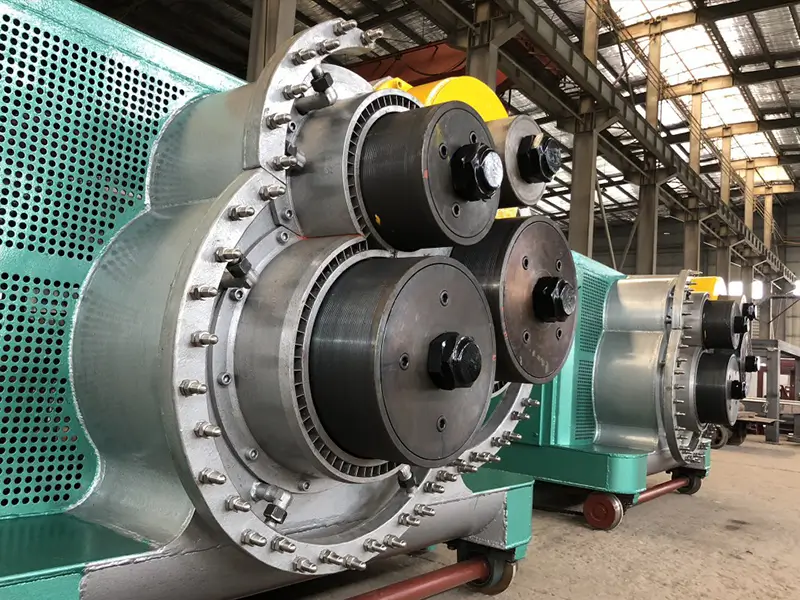
2. >>>SMS group
A globally recognized leader in heavy industrial engineering, SMS group sets the benchmark for large-scale, high-capacity rock wool production lines. Its core strengths lie in deep engineering expertise, heavy-duty equipment durability and seamless whole-line system integration.
Why it stands out
- Top-tier global engineering capability
- Proven track record in ultra-large capacity projects
- Robust long-term equipment durability
Best fit
Large-scale, capital-intensive industrial projects with extremely high output requirements.
3.>>> Primetals Technologies
Another global industrial heavyweight, Primetals Technologies is renowned for advanced process solutions and high-precision automation systems. It prioritizes line stability, control accuracy and consistent product quality over low upfront cost.
Why it stands out
- Industry-leading automation and process control technology
- Excellent product consistency and production repeatability
- Mature technical system for high-standard production
Best fit
Mid-to-large projects with strict requirements for product quality precision and production stability.
4. >>>Guangxing Machinery (Hebei Guangxing Machinery Technology Co., Ltd.)
Guangxing Machinery is a leading Chinese rock wool production line manufacturer with over 38 years of industry experience, specializing in the design, manufacturing and turnkey delivery of complete mineral wool production equipment. As one of the earliest domestic players in this field, it has installed over 1,000 production lines and served more than 500 customers worldwide, covering the full workflow from raw material feeding, melting, fiberizing, curing to final cutting and packaging.
The brand is widely favored in emerging markets for its flexible configuration customization, competitive cost-performance ratio and complete after-sales service system. It can tailor production line solutions with annual capacities ranging from 20,000 to 50,000 tons according to customer needs, and supports supporting environmental protection and energy-saving upgrades.
Why it stands out
- 38+ years of specialized experience in rock wool equipment R&D and manufacturing
- Mature turnkey delivery capability with 1,000+ global project cases
- Highly customizable configurations to match different capacity and process needs
- Outstanding cost advantage compared with European and American premium brands
Best fit
Mid-scale production projects, buyers in emerging markets, and clients seeking cost-effective complete turnkey solutions.
5.>>> Enetex
Enetex is a German professional rock wool production equipment manufacturer founded in 1989, and one of the world’s most advanced suppliers delivering complete turnkey rock wool production lines for independent manufacturers. With core business covering both rock wool production equipment and waste gas treatment systems, the brand is widely recognized in the industry for its energy-saving and low-consumption process design, as well as its circular production solutions including waste edge recycling.
Its complete production line covers the full workflow from automatic batching, cupola melting, centrifugal fiberizing, cotton collecting, curing to cutting and packaging, with a maximum capacity of 6 tons per hour. The equipment features high operational reliability, low maintenance demand and high automation level, and the final rock wool products can meet high European quality standards in compressive strength and tearing resistance.
Why it stands out
- Industry-leading energy-saving design and waste heat recovery capability
- Integrated waste gas treatment and waste edge recycling systems, aligned with green production trends
- High-precision process control ensuring premium and stable product quality
- Mature turnkey delivery capability for complete production lines
Best fit
High-end production projects focusing on energy efficiency and environmental compliance, and manufacturers pursuing top-tier product quality.
Comparison Table: 5 Manufacturer Types
| Manufacturer | Core Strengths | Capacity Scale | Cost Level | Best For |
|---|---|---|---|---|
| Rwoolworld | Full turnkey solutions; energy-efficient design; responsive after-sales | Small to medium-large | Mid-range, cost-effective | Projects balancing stable performance, cost and dedicated service |
| SMS group | Top-tier engineering; heavy-duty build; seamless full-line integration | Ultra-large scale | High-end premium | Large capital-intensive projects with extreme output demands |
| Primetals Technologies | Precision automation; excellent product consistency | Mid-to-large scale | High-end premium | Projects with strict quality and production stability requirements |
| Guangxing Machinery | 38+ years experience; highly customizable; cost-competitive | 20,000–50,000 t/year (mid-scale) | Budget-friendly | Emerging markets and cost-sensitive turnkey projects |
| Enetex | Energy-saving & waste heat recovery; green production; European-standard quality | Up to 6 t/hour | High-end premium | High-end projects prioritizing energy efficiency and environmental compliance |
What a Complete Production Line Includes
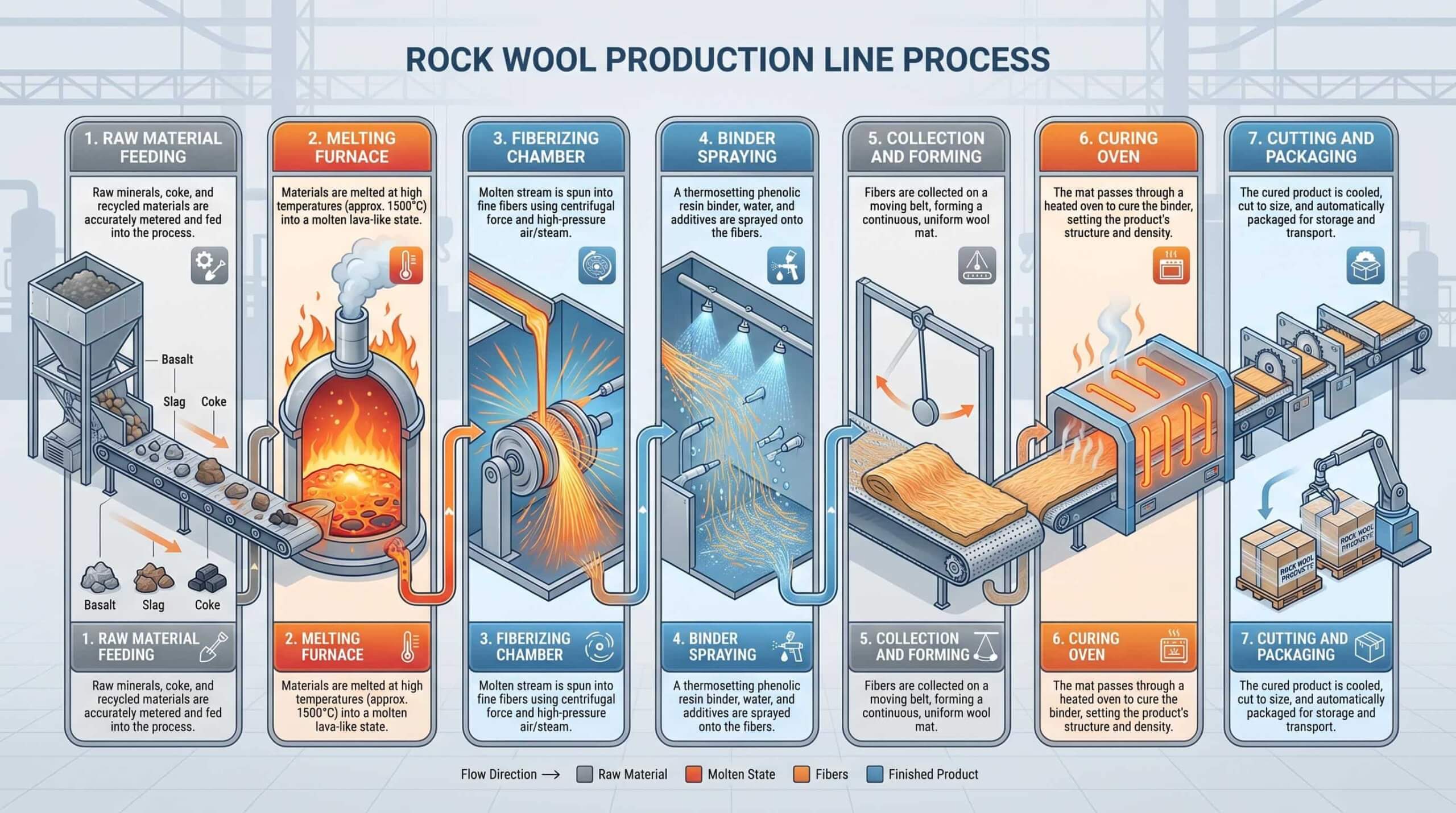
A fully functional Rock Wool Production Line integrates a sequence of interconnected core processes: raw material feeding & batching, high-temperature melting system, fiberizing section, binder spraying & collection, mat forming & curing, cutting & packaging, and centralized dust control.
Whole-line integration is critical — underperformance in any single stage will drag down overall output efficiency and product quality.
Key Criteria for Evaluating Suppliers
Before finalizing a partner, buyers should prioritize four core dimensions:
- Production stability & fiber quality: Consistent density and uniform fiber distribution directly reduce downstream scrap losses.
- Energy efficiency: Rock wool production is inherently energy-intensive, making furnace thermal efficiency and waste heat recovery systems critical to controlling long-term operating costs. As a leading global industry player, ROCKWOOL Group has listed production-side energy optimization as a core pillar of its sustainability roadmap, reflecting the industry-wide shift toward low-carbon, high-efficiency manufacturing.
- Automation level: PLC control, automatic dosing and fault monitoring improve production repeatability and reduce reliance on manual labor.
- Full-cycle service: Reliable commissioning, operator training, spare parts supply and post-launch optimization determine how quickly the line reaches stable production.
Common Sourcing Mistakes to Avoid
Buyers frequently fall into these pitfalls when sourcing equipment:
- Selecting suppliers solely based on upfront price
- Overlooking utility and infrastructure requirements
- Underestimating long-term maintenance costs and difficulty
- Failing to confirm long-term spare parts supply
- Skipping pre-shipment factory testing and inspection
Minor delivery delays can be remedied, but a line that never achieves stable production will cause far greater, long-lasting losses.
Final Thoughts
Selecting the right manufacturer is really about matching technical capability with business goals. If the project is large and capital-intensive, engineering depth should lead the decision. If the project is mid-sized, flexibility and service may matter more. And if energy costs are a major concern, then efficiency should be treated as a core specification, not an add-on.
In short, the best rock wool production line equipment supplier is the one that helps the plant run smoothly after installation, not just one that looks good in a proposal.
FAQ
How long does it usually take to install a rock wool production line?
Timelines vary widely, but installation and commissioning often take several months, especially when civil work, utility setup, and trial runs are included. A turnkey plan usually shortens coordination delays.
Is a fully automated line always the better choice?
Not always. Full automation is valuable when labor consistency, output repeatability, and data control matter most. But for smaller plants, a semi-automatic setup can be more practical and cost-effective.
What influences final product consistency the most?
Furnace stability, fiberizing control, binder distribution, and curing conditions all play a role. In real-world production, small deviations in any one of these areas can affect density and surface quality.




