
Introduction to the Automation Control System
The automation control system is purpose-built to coordinate and regulate the full range of operations in a glass wool production line—from high-temperature melting to fiber formation, product shaping, packaging, and environmental management.
At its core is an integrated control platform based on industrial PLCs, intelligent touch panels, and variable frequency drives (VFDs). The system enables synchronized management across subsystems, ensuring stable performance and high throughput. Real-time data collection and feedback loops provide operators with actionable insights and fast response capability.
Key Features of the Automation Control System
1. Distributed Cabinet Control with Centralized Command
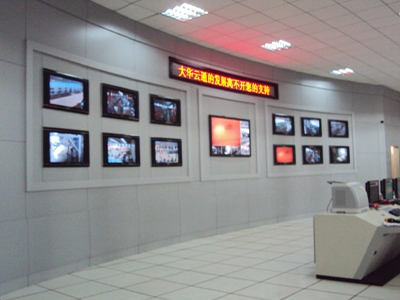
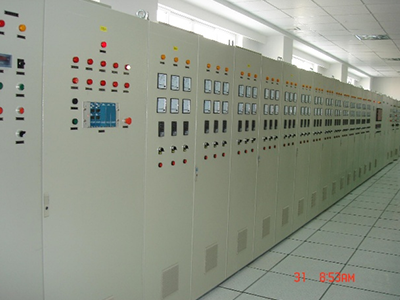
Each functional zone—such as the furnace, curing oven, or cutting station—is equipped with a dedicated electrical cabinet. These units communicate with a centralized control station that aggregates sensor inputs, process alarms, and video monitoring into one coordinated interface.
2. HMI-Based Interaction and Logic-Driven Sequences
Operators interact with the system via touchscreen HMIs that provide direct access to key parameters. The underlying PLC programs manage sequencing, safety interlocks, and adaptive logic control, enabling hands-off operation during normal production.
3. Sensor Integration for Closed-Loop Precision
The automation control system collects real-time values such as airflow rate, temperature, fiber density, and fluid levels. This data feeds into control loops that dynamically adjust system behavior, improving consistency in product quality and resource usage.
4. Variable-Speed Drive Optimization
Motors across the line—fans, conveyors, mixers—are driven by VFDs that adjust speed and torque as needed. This not only cuts energy consumption but also reduces mechanical stress, prolonging equipment lifespan and stabilizing the process.
Applications of the Automation Control System
1. Melting and Air Quality Management
In the melting section, temperature control modules work alongside water-level sensors to stabilize furnace operation. Meanwhile, desulfurization and dust control systems are regulated to meet emissions standards.
2. Fiber Formation and Web Laying
During fiberizing, the pendulum-forming mechanism adjusts its amplitude and frequency in response to line speed and fiber thickness—maintaining uniformity across the insulation layer.
3. Pressing, Oven Curing, and Board Trimming
For rigid board production, the system governs oven temperature zones, press lift mechanics, and synchronized edge-cutting. Operators can switch between production formats on-the-fly without pausing the line.
FAQ
Can this automation control system be installed on an existing production line?
Yes. The architecture supports both new builds and retrofit applications. Thanks to its modular design and support for standard protocols like Modbus or Profibus, it can integrate with a wide range of legacy systems.
Does the automation control system support remote diagnostics and monitoring?
It does. With proper network configuration, operators and maintenance staff can monitor system health and process parameters remotely, enabling proactive troubleshooting and reduced downtime.
Is the automation control system compatible with multiple process variants?
Yes. The control software supports mode-switching logic, allowing users to toggle between different production scenarios—such as switching from standard rolls to foil-laminated boards—without hardware modification.

